

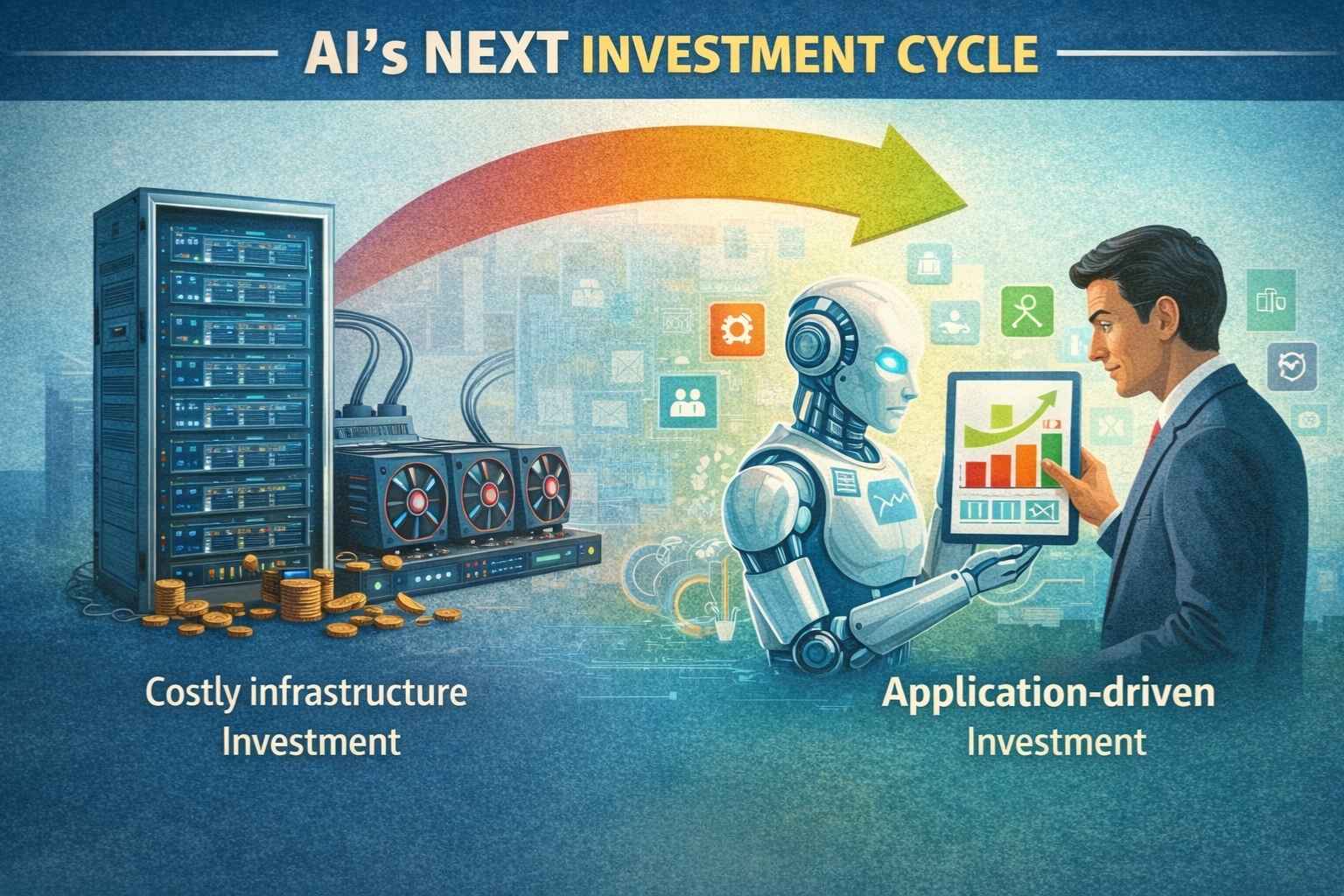
The global AI sector is moving from costly infrastructure investments toward application-driven growth, where real demand and profitability are emerging—an evolution closely tracked by aspirants preparing through UPSC coaching in Hyderabad.
Background
- For years, AI investment was concentrated on infrastructure—GPUs, data centres, and large models.
- In 2025, nearly $320 billion was spent on infrastructure, but foundation model firms still face low margins and high inference costs.
- Example: OpenAI earned $13 billion in revenue but reported $5 billion losses in 2024, underscoring unsustainable economics.
- The focus is now shifting to applications that deliver direct business value.
Rise of AI Applications
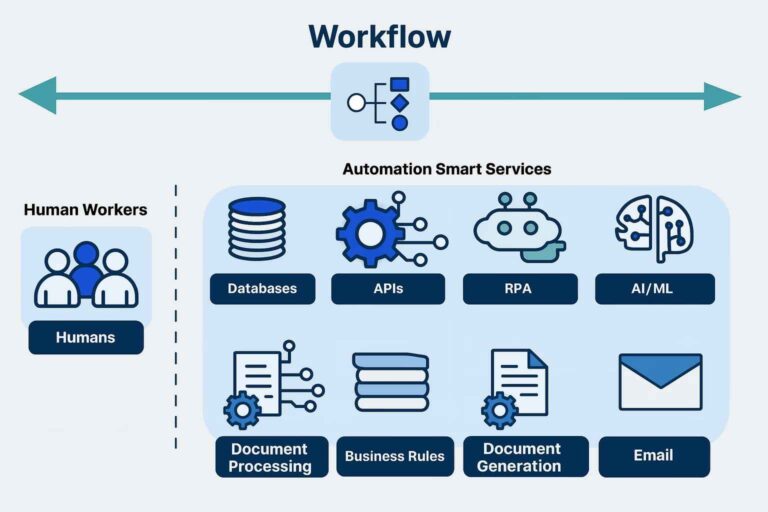
- In 2025, spending on AI applications reached $19 billion, over 6% of the global software market.
- At least 10 AI products now generate more than $1 billion annually, while 50 products earn above $100 million.
- Meta’s $2 billion acquisition of Manus (a Singapore startup) in 2025 highlights investor interest in practical AI solutions.
- Private equity deals in AI applications rose 65% year-on-year, with M&A values up 242%.
Where Value Lies
- Departmental AI: Coding tools dominate, contributing $4 billion of the $7.3 billion departmental AI market.
- Over 50% of developers use AI coding tools daily; in top firms, usage rises to 65%.
- Firms like Anthropic gained share by focusing on coding applications—reaching 40% of enterprise LLM spending—while OpenAI’s share fell to 27%.
- Profits are increasingly captured by companies offering end-to-end solutions, not just raw compute.
Strategic Importance
- Competitiveness: Applications embedded in workflows (healthcare, law, finance, manufacturing) create durable value.
- Profitability: Generative AI achieved a 34% contribution margin in 2025, projected to reach 67% by 2028 as costs fall.
- Market Dynamics: Applications now drive infrastructure adoption, reversing the earlier trend—an insight often discussed in Hyderabad IAS coaching.
Policy Concerns
- Competition: Foundation model providers entering applications may disadvantage smaller firms.
- Copyright & Privacy: Training data sources and access to personal information raise legal challenges.
- Regulation: Policymakers should allow experimentation while ensuring fair competition and curbing anti-competitive acquisitions and acqui-hires—topics relevant to governance analysis in UPSC online coaching.
What is AI and how it works
Artificial Intelligence (AI) means machines or computer systems that can perform tasks which normally require human intelligence, like learning, reasoning, problem-solving, or understanding language.
How AI Works
- Data Input: AI learns from large amounts of information (text, images, numbers, etc.).
- Patterns: It finds patterns and relationships in that data.
- Learning: Using algorithms, AI improves its performance over time (this is called machine learning).
- Decision Making: Based on what it has learned, AI makes predictions or decisions (e.g., suggesting movies, detecting fraud).
- Automation: AI can perform repetitive tasks faster and more accurately than humans.
- Adaptability: Advanced AI systems adjust to new information and improve without being reprogrammed.
Conclusion
The next AI growth cycle will be defined by applications, not infrastructure. India and other economies must prioritise sector-specific AI solutions that integrate deeply into workflows, ensuring profitability and global competitiveness in the digital economy.
This topic is available in detail on our main website.