
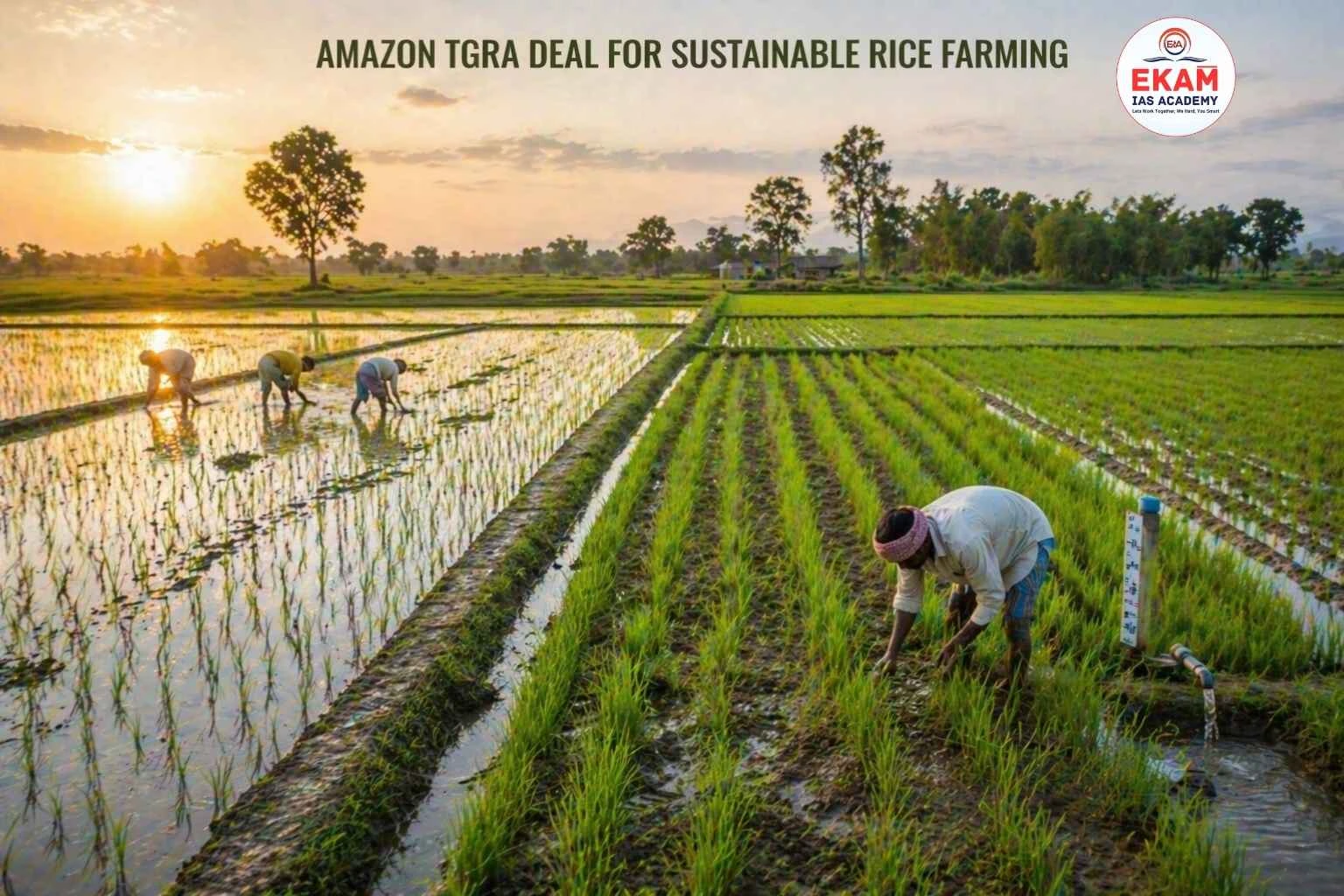
Amazon signed a long term carbon credit offtake agreement with The Good Rice Alliance (TGRA) to promote sustainable rice farming and methane reduction in India. This topic is highly relevant for aspirants preparing through IAS coaching in Hyderabad, UPSC coaching in Hyderabad, and UPSC online coaching.
TGRA Project
• Initiative: Private sector led, backed by Bayer, GenZero, and Shell.
• Scale: Covers 13,000 small farmers across 35,000 hectares.
• Goal: Reduce methane emissions from rice cultivation and generate carbon credits.
• Buyer: Amazon committed to purchase 685,000 metric tons of CO₂ equivalent credits in the first phase.
Such environment and climate-related initiatives are important in GS3 and widely covered in Hyderabad IAS coaching.
Approach & Practices
• Alternate Wetting and Drying (AWD): Periodic drying of fields instead of continuous flooding → reduces methane.
• Direct Seeded Rice (DSR): Seeds sown directly without transplanting → lowers water use and methane emissions.
• Monitoring: Emission reductions measured with field methods + digital tools, verified under Verified Carbon Standard (VCS).
• Partnership: Collaboration with International Rice Research Institute for scientific validation.
Benefits
• Climate Action: Rice farming contributes 8–10% of global methane emissions; India is a major emitter.
• Farmer Livelihoods: Training, financial incentives, higher yields, reduced input costs, improved resilience.
• Scalability: Large scale carbon credit deal enables expansion of climate friendly farming practices.
These topics are crucial for environment preparation under IAS coaching and civils coaching in Hyderabad.
Significance
• One of India’s first and largest agricultural carbon credit deals.
• Aligns with India’s climate mitigation goals and global carbon market expansion.
• Demonstrates how private sector partnerships can combine sustainability with farmer welfare.
Conclusion
The Amazon–TGRA deal is a landmark in climate smart agriculture, showing how carbon markets can support both methane reduction and farmer incomes. With rice being a major source of methane, such initiatives are crucial for India’s climate commitments and rural resilience. For aspirants using UPSC online coaching and IAS coaching in Hyderabad, this topic is highly relevant for GS3 Environment.
This topic is available in detail on our main website.