
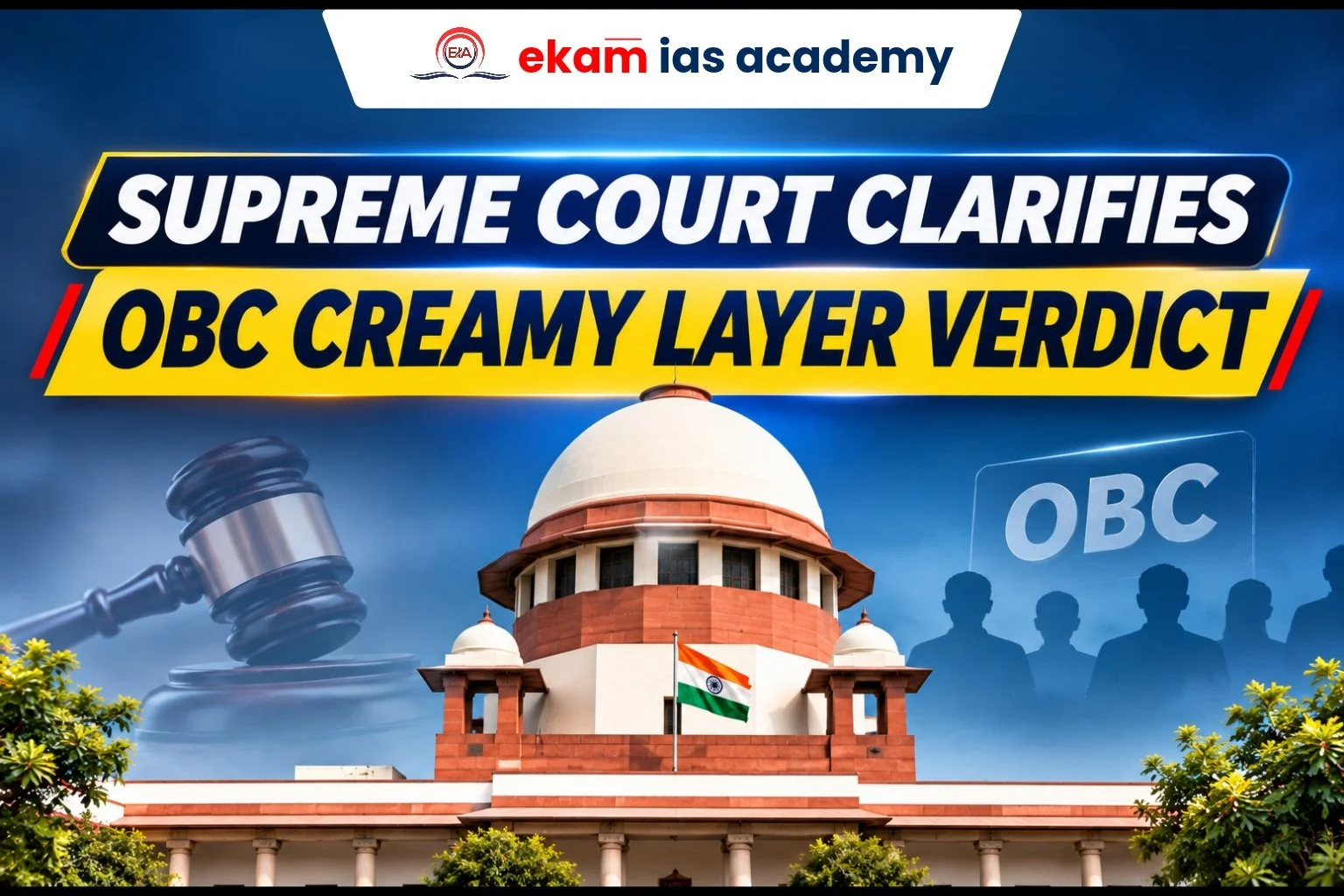
The Supreme Court has clarified that its March 11, 2026 judgment on determining the OBC Creamy Layer in India will not affect previously completed recruitment and service allocations. The clarification is important for understanding the Supreme Court OBC Creamy Layer Verdict, OBC Reservation in India and Reservation Policy in India.
Creamy layer principle
- The creamy layer principle excludes socially advanced sections of Other Backward Classes (OBCs) from reservation benefits.
- It aims to ensure that affirmative action reaches genuinely disadvantaged communities.
- The Supreme Court’s clarification addresses concerns regarding the retrospective application of reservation-related judgments.
- The Creamy Layer Concept UPSC is an important aspect of OBC Reservation and Social Justice.
Background of the Issue
- A 1993 Office Memorandum excluded certain categories from OBC reservation benefits.
- The controversy involved whether parental salary and agricultural income could be considered for determining creamy layer status, raising questions about the Income Criteria for OBC Creamy Layer.
- In its March 2026 judgment, the Supreme Court addressed the criteria used to identify the creamy layer, making OBC Creamy Layer Criteria central to the debate.
- The judgment raised concerns about its possible impact on earlier recruitment examinations and service allocations.
- The issue is also relevant to OBC Non-Creamy Layer Certificate requirements and OBC Reservation Eligibility.
Key Clarifications by the Supreme Court
- No Retrospective Application: The judgment does not require reopening completed selections.
- Protection of Appointments: Previously appointed candidates will not lose their positions merely because of the judgment.
- Seniority and Promotions: Existing service allocations, seniority and promotional prospects remain unaffected.
- CSE 2025: The Court clarified that its ruling did not direct a fresh allocation of services through the Civil Services Examination 2025.
- Government’s Role: The Centre may formulate a new creamy layer policy consistent with the Constitution.
- These clarifications form an important part of the Supreme Court OBC Reservation Judgment and the broader debate on OBC Reservation in India.
Constitutional Framework
- Article 14: Guarantees equality before the law.
- Article 15(4): Enables special provisions for socially and educationally backward classes.
- Article 16(4): Permits reservation in public employment for inadequately represented backward classes and is central to Article 16(4) Indian Constitution and OBC reservation.
- Article 340: Provides for commissions to investigate the conditions of backward classes.
- These provisions constitute the Constitutional Provisions for OBC Reservation and are important for Indian Polity and Governance UPSC.
Important Judicial Developments
- Indra Sawhney v. Union of India (1992): Upheld OBC reservation and established the creamy layer exclusion principle. The Indra Sawhney Case 1992 remains a landmark in India’s reservation jurisprudence.
- Ashoka Kumar Thakur v. Union of India (2008): Reinforced creamy layer exclusion in OBC reservations in educational institutions.
- These judgments are important for understanding the evolution of the Supreme Court OBC Reservation Judgment and OBC Reservation and Social Justice.
Way Forward
- Establish transparent and constitutionally valid creamy layer criteria.
- Ensure uniform implementation across government departments.
- Protect legitimate expectations arising from completed selections.
- Periodically review reservation policies using reliable socioeconomic data.
- Ensure clarity regarding OBC Creamy Layer Criteria, OBC Reservation Eligibility and the Income Criteria for OBC Creamy Layer.
Conclusion
The Supreme Court’s clarification balances social justice with administrative certainty by protecting completed appointments while permitting constitutional reform of OBC creamy layer criteria. The issue remains important for understanding Supreme Court OBC Creamy Layer Verdict, OBC Reservation in India, Reservation Policy in India and Indian Polity and Governance UPSC.