
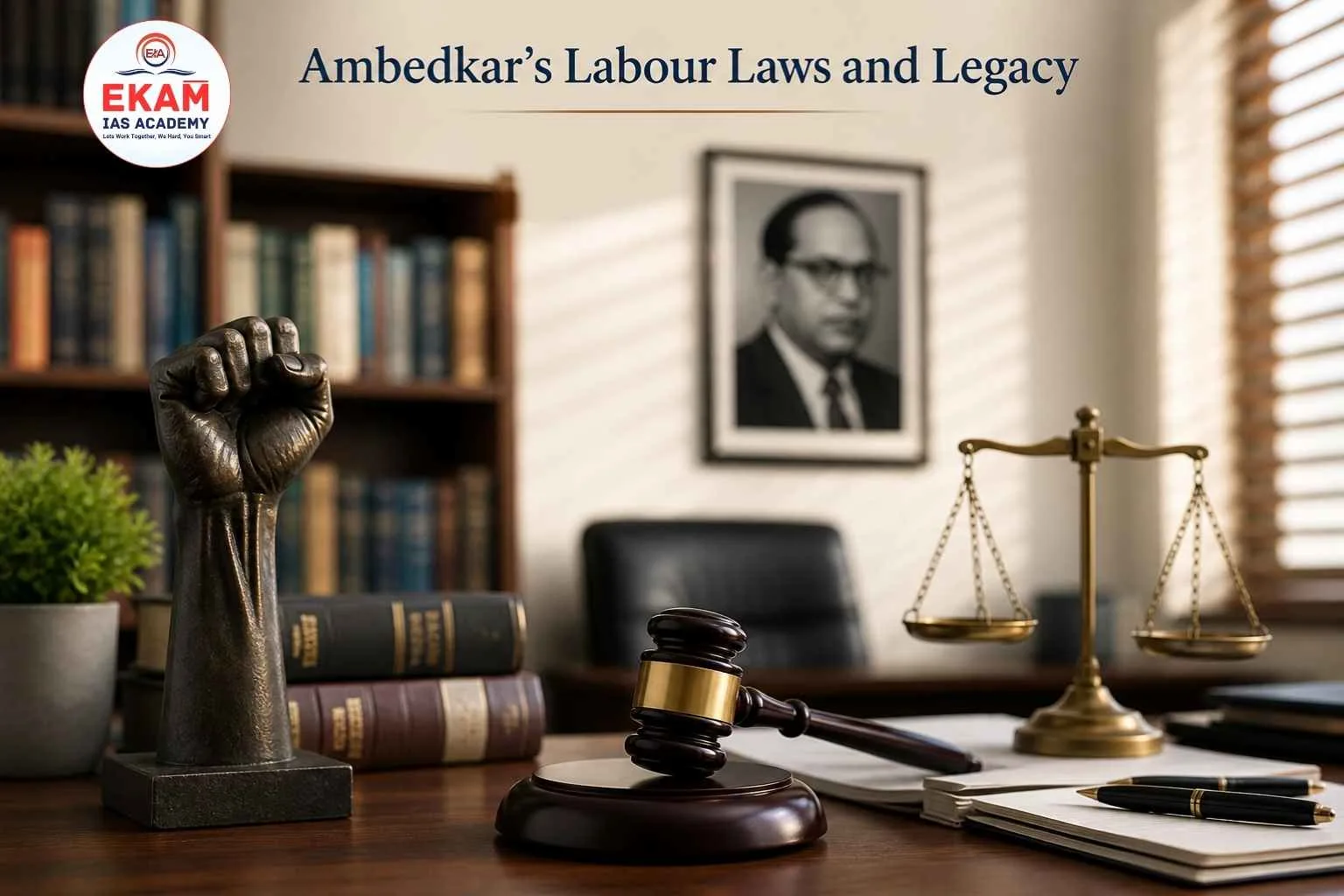
On April 14, Ambedkar Jayanti, discussions highlighted Dr. B.R. Ambedkar’s pioneering role in shaping labour rights in colonial India, a dimension often overshadowed by his constitutional work. This important topic is highly relevant for aspirants preparing through IAS coaching in Hyderabad, UPSC coaching in Hyderabad, and UPSC online coaching.
Ambedkar’s Vision for Labour
• Saw labour not just as survival but as self-development of human, cultural, and spiritual personality.
• Founded the Independent Labour Party (1936) to champion workers’ rights.
• Believed labour must have political representation to sustain reforms.
Ambedkar as Labour Member (1942–46)
• Appointed Labour Member in Viceroy’s Executive Council (1942) during wartime industrialisation.
• Period marked by rapid industrial growth but neglect of worker protections.
• Ambedkar’s tenure became a watershed moment for labour legislation.
Key Labour Reforms
• Working Hours: Reduced from 12 to 8 hours/day, aligning with global standards.
• Maternity Benefits: Secured rights for women workers.
• Provident Fund & Paid Leave: Introduced financial security measures.
• Dearness Allowance (DA): Protected wages against inflation.
• Trade Union Recognition: Made compulsory for industrial relations.
• Housing & Medical Facilities: Improved worker welfare.
• Employment Exchanges: Created for job matching.
• Employee State Insurance (ESI): Foundation of India’s social security system.
Tripartite Labour Conference (1942)
• First ever meeting of government, employers, and employees as equals.
• Debated placing labour laws in the Concurrent List for national uniformity.
• Conferences continued till 1946, shaping India’s future labour policy.
Labour Investigation Committee (1944)
• First fact-finding body to study wages, housing, and working conditions.
• Extended beyond coal and cotton to neglected sectors.
Sector Specific Welfare Measures
• Mica Mines Labour Welfare Fund (1946): First of its kind, later extended to coal, iron ore, manganese, limestone, dolomite, and beedi workers.
• Workplace Dignity: Mandated separate bathing facilities for miners (1946), linking labour rights with human dignity.
Labour Legacy in the Constitution
• Article 39: Adequate livelihood, equal pay for men and women.
• Article 43: Living wage, decent conditions, leisure, and cultural opportunities.
• Article 39(b) & (c): Prevent wealth concentration, ensure resources serve common good.
Conclusion
Ambedkar’s labour reforms laid the foundation of modern labour rights in India, combining welfare, dignity, and social security. His vision went beyond workplace reforms, insisting that labour must enter politics to secure lasting justice—a philosophy still relevant today.
For aspirants preparing through IAS coaching and civils coaching in Hyderabad, this topic is highly relevant for GS1 (Modern India) and GS4 (Ethics – dignity of labour).
This topic is available in detail on our main website.