

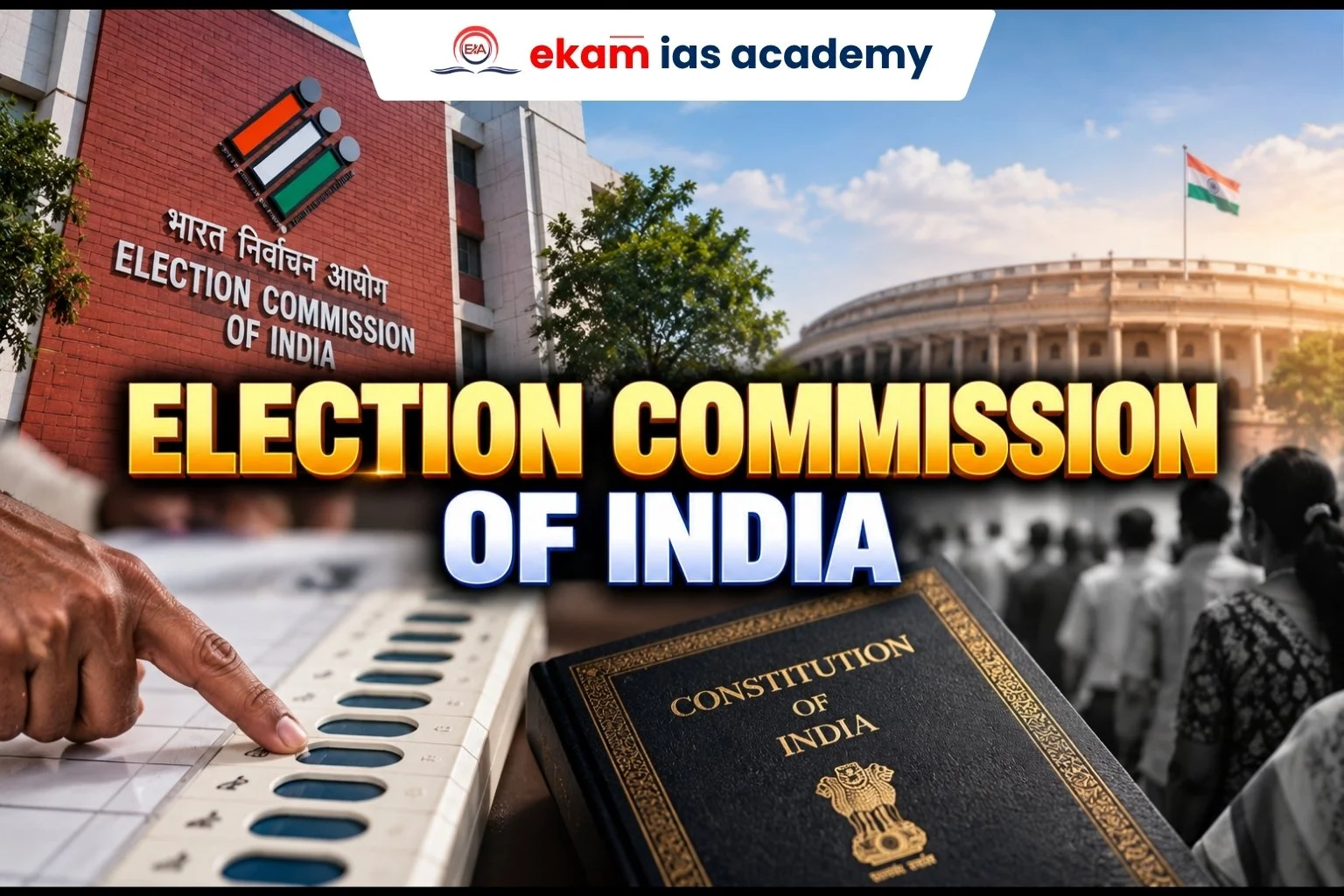
The Election Commission of India plays a central role in ensuring electoral integrity and democratic participation. The Special Intensive Revision (SIR) of electoral rolls has triggered debate over voter inclusion, procedural safeguards and Election Commission Accountability.
Constitutional Position of ECI
- Article 324 Election Commission vests superintendence, direction and control of elections in the Election Commission of India.
- Article 326 establishes elections based on universal adult suffrage, subject to constitutional and legal qualifications.
- The Constituent Assembly favoured an independent central election authority insulated from executive interference, highlighting the importance of Election Commission Independence.
- Free and fair elections form an essential component of India’s constitutional democracy and are central to the Election Commission and Free Fair Elections framework.
Electoral Roll Revision and Legal Framework
- Section 21, RPA 1950 governs preparation and revision of electoral rolls.
- Rule 25, Registration of Electors Rules, 1960 recognises intensive, summary and partly-intensive revisions.
- The ECI states that SIR derives authority from Article 324, Section 21 and applicable electoral laws.
- Thus, the article’s claim that SIR has no legal foundation is contested; its precise scope and procedures remain subjects of legal and constitutional debate.
Why Accurate Electoral Rolls Matter
- Electoral integrity: Duplicate, deceased or ineligible entries can undermine confidence in elections and affect Electoral Integrity in India.
- Universal participation: Eligible citizens should not face wrongful exclusion from electoral rolls.
- Due process: The RPA requires verification and reasonable opportunity of hearing before specified deletions.
- Political equality: Incorrect exclusions can disproportionately affect migrants, poorer citizens and other vulnerable groups.
- Public trust: Transparent procedures strengthen confidence in election administration and reinforce Election Commission Institutional Credibility.
Key Institutional Challenges
- Legal clarity: Large-scale revision exercises require clearly defined procedures and safeguards within the Election Commission Powers and Functions framework.
- Voter exclusion: Documentation requirements should not unintentionally disenfranchise eligible citizens.
- Internal decision-making: A multi-member constitutional institution benefits from consultation and recorded decisions.
- Perceived independence: Electoral authorities must remain institutionally and visibly impartial, strengthening Election Commission Independence.
- Transparency: Citizens require accessible mechanisms to verify, correct and challenge electoral-roll entries.
Way Forward
- Ensure notice, verification and hearing before deleting eligible voters from rolls.
- Publish clear methodology, deletion reasons and revision statistics for public scrutiny.
- Strengthen appeal and grievance mechanisms for rapid correction of wrongful exclusions.
- Improve consultation among Election Commissioners on major institutional and electoral decisions.
- Use technology for cleaner rolls while ensuring privacy and human oversight.
- Strengthen institutional independence alongside transparency, accountability and parliamentary oversight, forming an important part of Election Commission Electoral Reforms.
Conclusion
A credible Election Commission Constitutional Body must protect both electoral-roll integrity and every eligible citizen’s democratic participation through lawful, transparent and impartial processes. Understanding the Election Commission Constitutional Mandate, Election Commission Appointment Process, Election Commission Accountability and Election Commission of India UPSC perspective is important for Election Commission UPSC and Indian Polity UPSC preparation.