
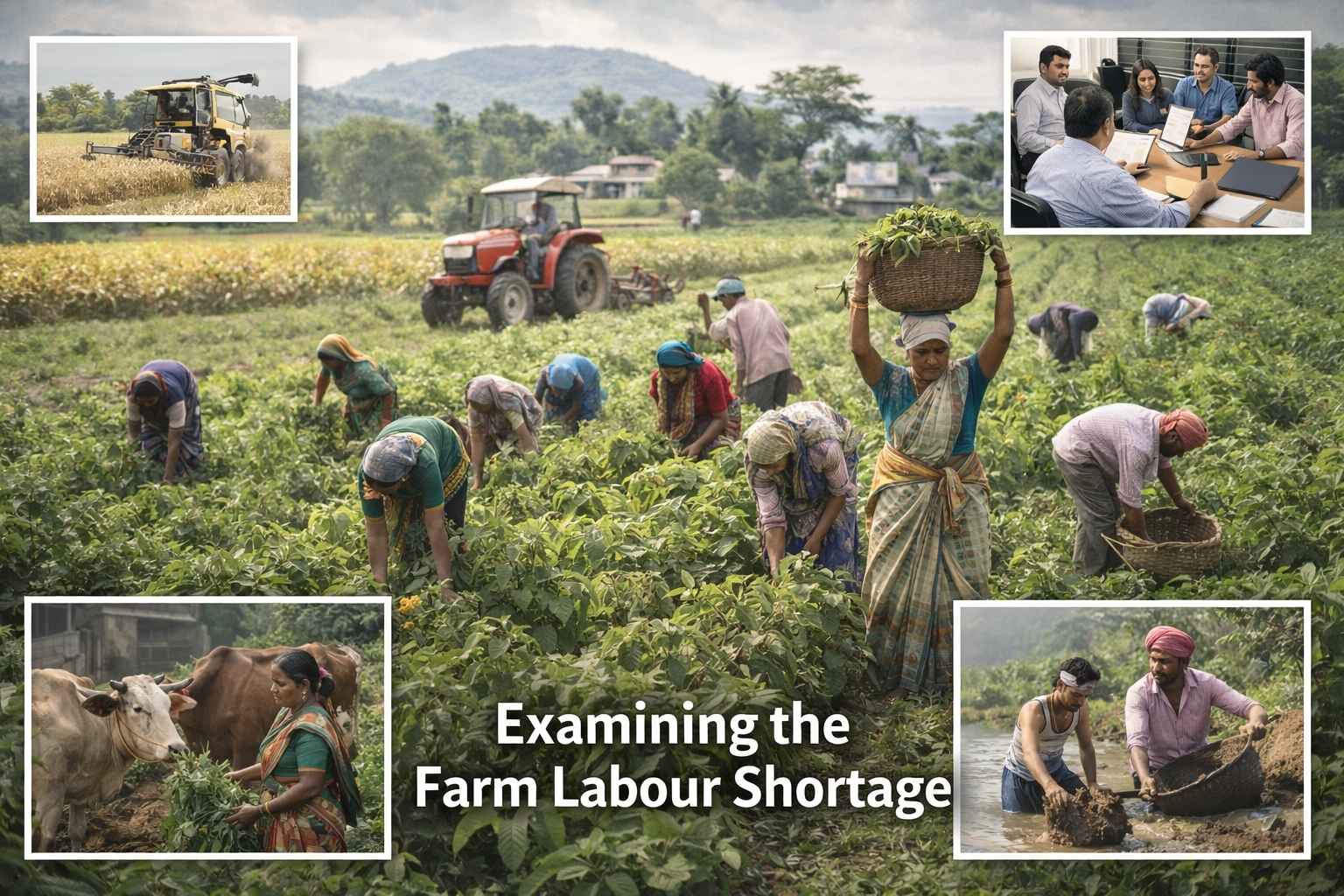
The proposed Viksit Bharat – Guarantee for Rozgar and Ajeevika Mission Gramin (VB-G RAM G) Bill has reignited the debate on rural labour availability by suggesting a temporary pause on rural employment works during peak agricultural seasons, citing concerns over farm labour shortages. This issue lies at the intersection of MGNREGS, agricultural wages, labour markets, and welfare policy, and is highly relevant for aspirants preparing GS-III through a UPSC Academy in Hyderabad.
MGNREGS and Rural Wages
- MGNREGS is often credited with strengthening workers’ bargaining power and tightening rural labour markets.
- However, Labour Bureau data across multiple states and occupations shows that:
- Nominal rural wage growth remained modest, averaging 3–6% annually over the last decade.
- In several years, wage growth was lower than inflation, resulting in declining real wages.
- Real wage growth exceeded 1% only once in the past decade.
- Agricultural wages performed slightly better than non-farm rural wages in most years, but still largely just matched inflation.
Why Has Rural Wage Growth Remained Weak?
- A major factor is the sharp rise in rural female labour force participation.
- According to PLFS data, rural female LFPR nearly doubled between 2017–18 and 2023–24.
- This significantly expanded labour supply, placing downward pressure on wages despite MGNREGS.
- Economically, this represents a rightward shift in labour supply, moderating wage increases.
Role of Government Welfare Schemes
The Economic Survey 2023–24 links the surge in female workforce participation to welfare interventions such as:
- Ujjwala Yojana (clean cooking fuel)
- Har Ghar Jal (tap water supply)
- Saubhagya (household electrification)
- Swachh Bharat Mission (sanitation)
By reducing unpaid domestic work, these schemes freed women’s time for paid employment, increasing labour availability in rural areas. This highlights how social infrastructure investments shape labour markets—an important analytical angle stressed in Best IAS Academy in Hyderabad.
Re-examining the Farm Labour Shortage Argument
- Available data does not strongly support the claim that MGNREGS has caused a widespread labour shortage.
- Increased participation of women, especially in nearby farm activities, may have compensated for workers opting for MGNREGS.
- Seasonal shortages exist, but blanket restrictions on MGNREGS during peak seasons lack robust empirical backing.
Other Reasons Behind Farm Labour Shortages
- Low farm wages compared to MGNREGS and non-farm jobs.
- Poor working conditions in agriculture, including health risks and hard physical labour.
- Rural-to-urban migration, a long-standing trend predating MGNREGS.
- Improved bargaining power of workers due to employment security, often perceived by farmers as a shortage.
Way Forward
- Better alignment of MGNREGS schedules with agricultural cycles
- Allowing select MGNREGS activities on farms during peak seasons
- Focus on raising farm wages, mechanisation, and improving working conditions
- Use data-driven evidence rather than assumptions to guide labour market reforms
Such calibrated reforms are essential for balancing livelihood security and farm productivity—an approach emphasised in IAS Coaching in Hyderabad.
Conclusion
The debate on farm labour shortages and MGNREGS reflects deeper structural transformations in rural labour markets, driven by rising female participation, welfare-led time release, and long-standing migration trends. Rather than restricting employment guarantees, balanced, evidence-based reforms are needed to protect rural livelihoods while supporting agricultural productivity.
For UPSC aspirants preparing GS-III economy and agriculture topics through platforms like the UPSC Academy in Hyderabad, this issue offers a high-value case study linking labour economics, welfare policy, and agricultural sustainability.
This topic is available in detail on our main website.