
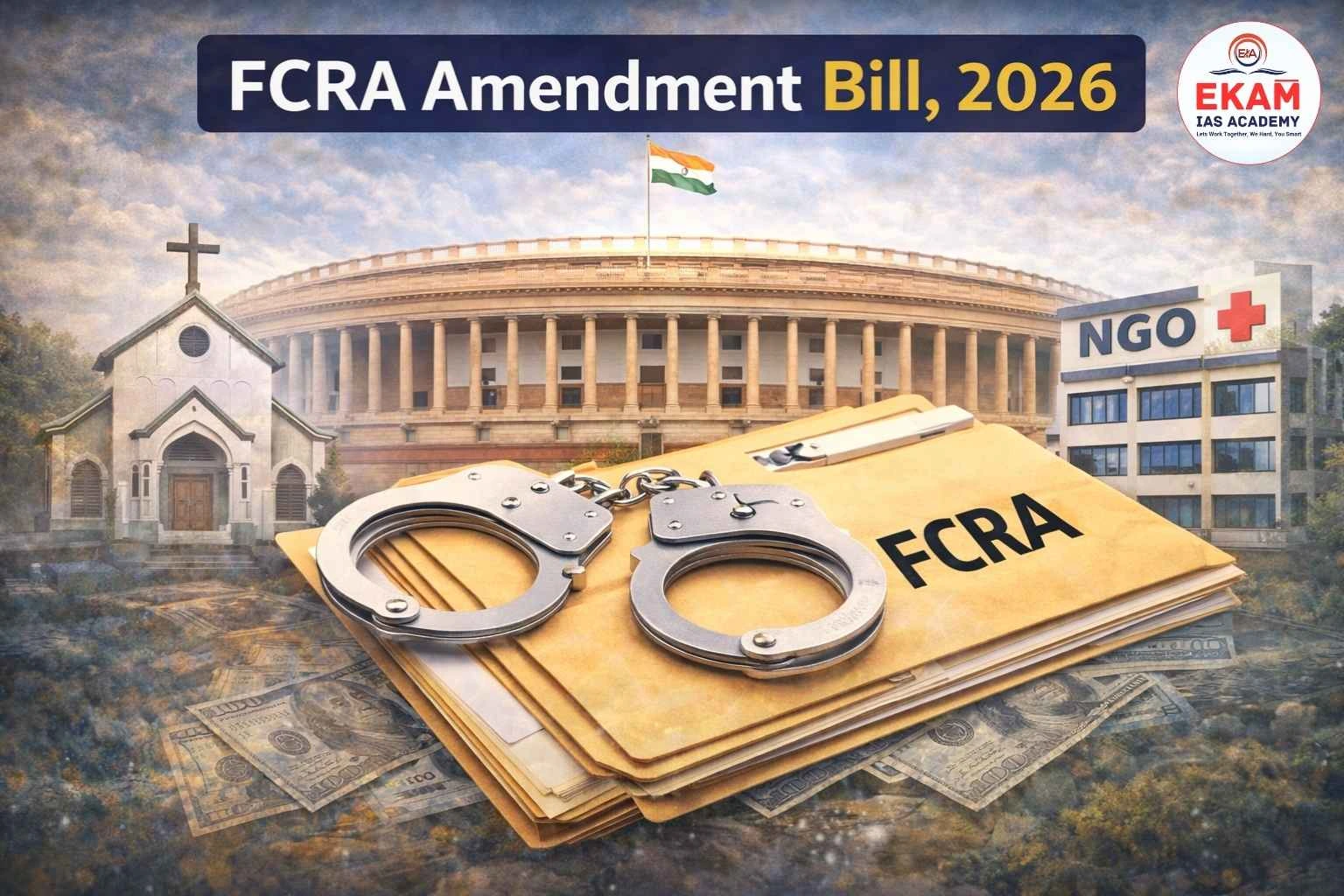
The Union government introduced the FCRA Amendment Bill, 2026 in the Lok Sabha and later deferred its discussion after widespread protests. Such governance and polity-related developments are important for aspirants preparing through IAS coaching in Hyderabad, UPSC online coaching, and other civil services preparation platforms.
Background
• The Foreign Contribution (Regulation) Act, 2010 governs how individuals, NGOs and associations receive and use foreign funds to protect national interest.
• The Act has been amended several times (notably 2016–2020) to tighten oversight of foreign funding.
• The 2026 Bill aims to plug perceived gaps in handling assets when FCRA registration is cancelled, surrendered, expired or not renewed.
Understanding such legislative frameworks is essential for students preparing through UPSC coaching in Hyderabad and Hyderabad IAS coaching institutes, especially for GS Paper 2.
Main Proposals of the Bill
• Designated authority: A government appointed body will take custody, supervise and manage foreign contributions and assets of organisations whose FCRA registration lapses or is cancelled.
• Temporary custody and return: Unused funds and assets may be returned if registration is later restored.
• Permanent takeover: If registration is not revived within a specified period or the organisation ceases to exist, assets may be transferred to government bodies or disposed of as prescribed.
• Special clause for places of worship: Management of a place of worship may be reassigned while preserving its religious character.
These provisions are often analysed in IAS coaching and civils coaching in Hyderabad for better understanding of governance and regulatory mechanisms.
Why the Government Supports It
• Legal clarity: To address ambiguity over asset management when registrations lapse.
• Prevent misuse: To stop foreign funds being used against national security, public order or sovereignty.
• Operational control: To provide a clear mechanism for custody and disposal of foreign funded assets.
Such aspects are frequently discussed in UPSC online coaching and structured UPSC coaching in Hyderabad programs.
Challenges
• Risk of arbitrary takeover: Delays or denials in renewal could lead to seizure of assets of functioning NGOs and religious bodies.
• Threat to minority institutions: Critics say the Bill may disproportionately affect minority run schools, hospitals and churches that rely on foreign funds.
• Due process gaps: Lack of an independent review or clear timelines raises natural justice concerns.
• Political timing: The debate has been politicised in Kerala ahead of elections, intensifying public opposition.
These challenges are important for aspirants studying through IAS coaching in Hyderabad and Hyderabad IAS coaching programs.
Challenges
• Unclear timelines for restoration and takeover.
• Capacity issues in managing diverse assets (educational, medical, religious).
• Potential misuse without strong safeguards and oversight.
Way Forward
• Set clear timelines for review and restoration before any takeover.
• Create an independent review panel to examine allegations and recommend action.
• Limit interim powers to custodial management with strict accountability.
• Protect religious and charitable assets through stakeholder consultation and judicial review options.
• Parliamentary oversight and transparent rules for disposal or transfer.
Such reforms are commonly covered in IAS coaching and civils coaching in Hyderabad for GS2 answer writing.
Conclusion
The Bill seeks to close legal gaps in FCRA asset management but raises serious governance and rights issues. Clear procedures, independent safeguards and political consensus are essential to balance national security with civil society autonomy. For aspirants preparing through IAS coaching in Hyderabad, UPSC coaching in Hyderabad, and UPSC online coaching, such topics are crucial for understanding governance, civil society, and constitutional balance in UPSC.
This topic is available in detail on our main website.