
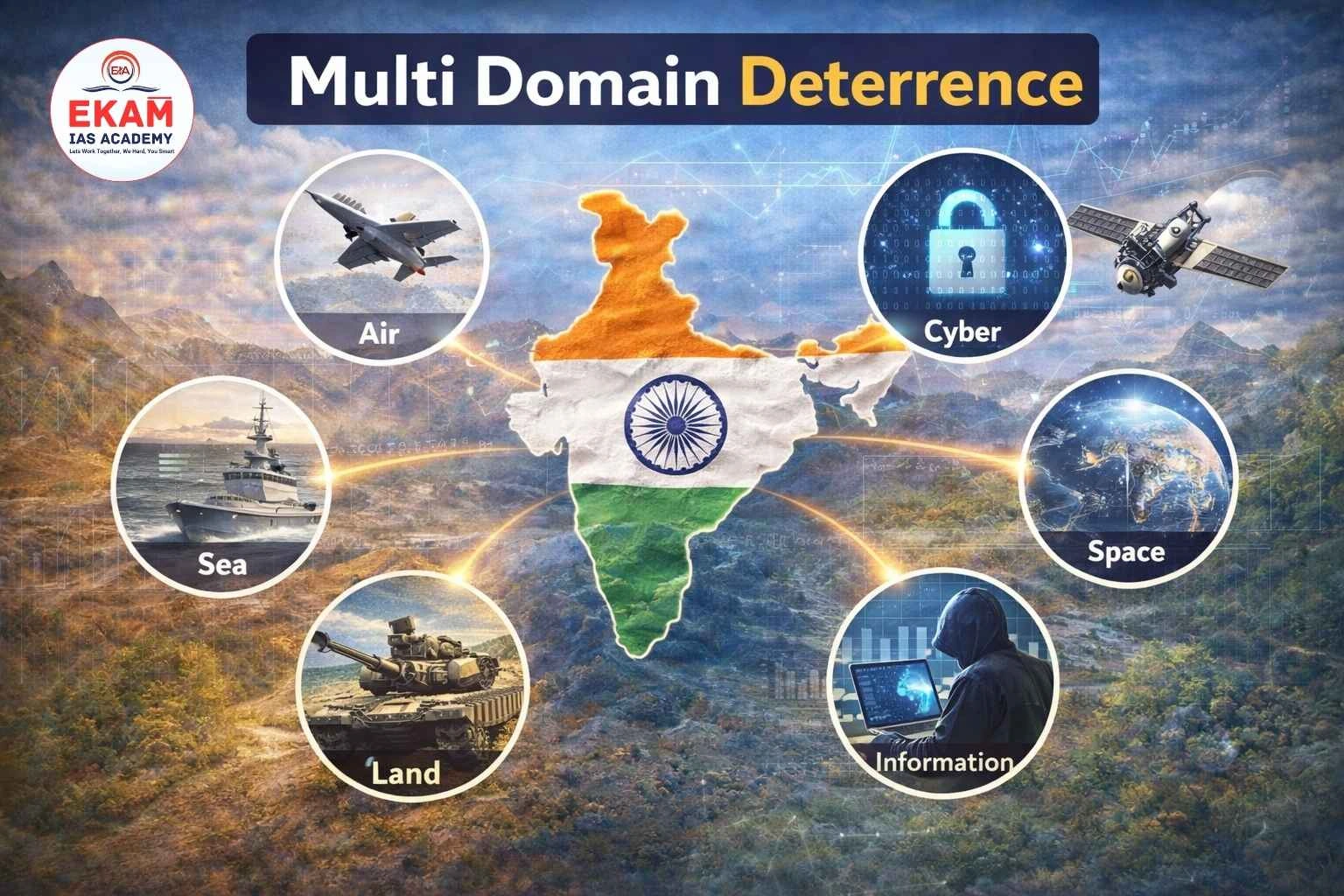
India is shifting to a Multi Domain Deterrence (MDD) approach to close a growing capability gap with China by integrating military and non military tools across land, sea, air, cyber, space and information domains. Such defence and security topics are important for aspirants preparing through IAS coaching in Hyderabad, UPSC online coaching, and other civil services preparation platforms.
What is Multi Domain Deterrence
• Definition: A holistic defence concept that fuses capabilities across Land, Air, Sea, Cyber, Space and Cognitive (information) domains to deter aggression.
• Core idea: Move from siloed services to a networked “system of systems” where sensors, shooters and decision makers are digitally linked for rapid, coordinated response.
• Deterrence by denial and cost imposition: Convince adversaries that operations will fail and incur unacceptable costs across multiple fronts.
Understanding such strategic concepts is essential for students preparing through UPSC coaching in Hyderabad and Hyderabad IAS coaching institutes, especially for GS Paper 3.
Why India Needs MDD
• China’s modernisation: PLA’s integration of satellites, AI and precision strike widens the capability gap.
• Two front reality: Simultaneous threats from China and Pakistan require cross domain force multiplication.
• Grey zone threats: Cyberattacks, disinformation and economic coercion demand non kinetic responses integrated with kinetic options.
These issues are often analysed in IAS coaching and civils coaching in Hyderabad for better understanding of national security.
Systemic Challenges
• Weak defence industrial base: Limited scale and slow delivery hinder rapid capability build up.
• Flawed procurement: Long cycles, red tape and service centric buys delay critical enablers (C4ISR, drones, missiles).
• Fragmented C4ISR and doctrine: Lack of unified command, data standards and inter service doctrine reduces operational synergy.
Such challenges are frequently discussed in UPSC online coaching and structured UPSC coaching in Hyderabad programs.
Way Forward
• Adopt a middle path strategy: Retain legacy platforms while rapidly building enabling layers—C4ISR, strike, logistics and close battle capabilities.
• Empower private industry: Use iDEX and long term contracts to scale production and innovation; reduce PSU monopoly.
• Operationalise theatre commands: Fast track integrated commands for unified planning and execution.
• Invest in attrition tolerant ISR and resilient networks: Field many affordable sensors and hardened communications to survive high intensity conflict.
• Institutional coordination: Align research, industry, services and political leadership with stable funding and outcome based plans.
These reforms are commonly covered in IAS coaching in Hyderabad and Hyderabad IAS coaching programs for GS3 answer writing.
Conclusion
India’s deterrence will be built over time as an integrated system, not by a single weapon. Urgent reforms in industry, procurement, doctrine and command are essential to keep the strategic window open. For aspirants preparing through IAS coaching in Hyderabad, UPSC coaching in Hyderabad, and UPSC online coaching, such topics are crucial for understanding national security and defence strategy in UPSC.
This topic is available in detail on our main website.