
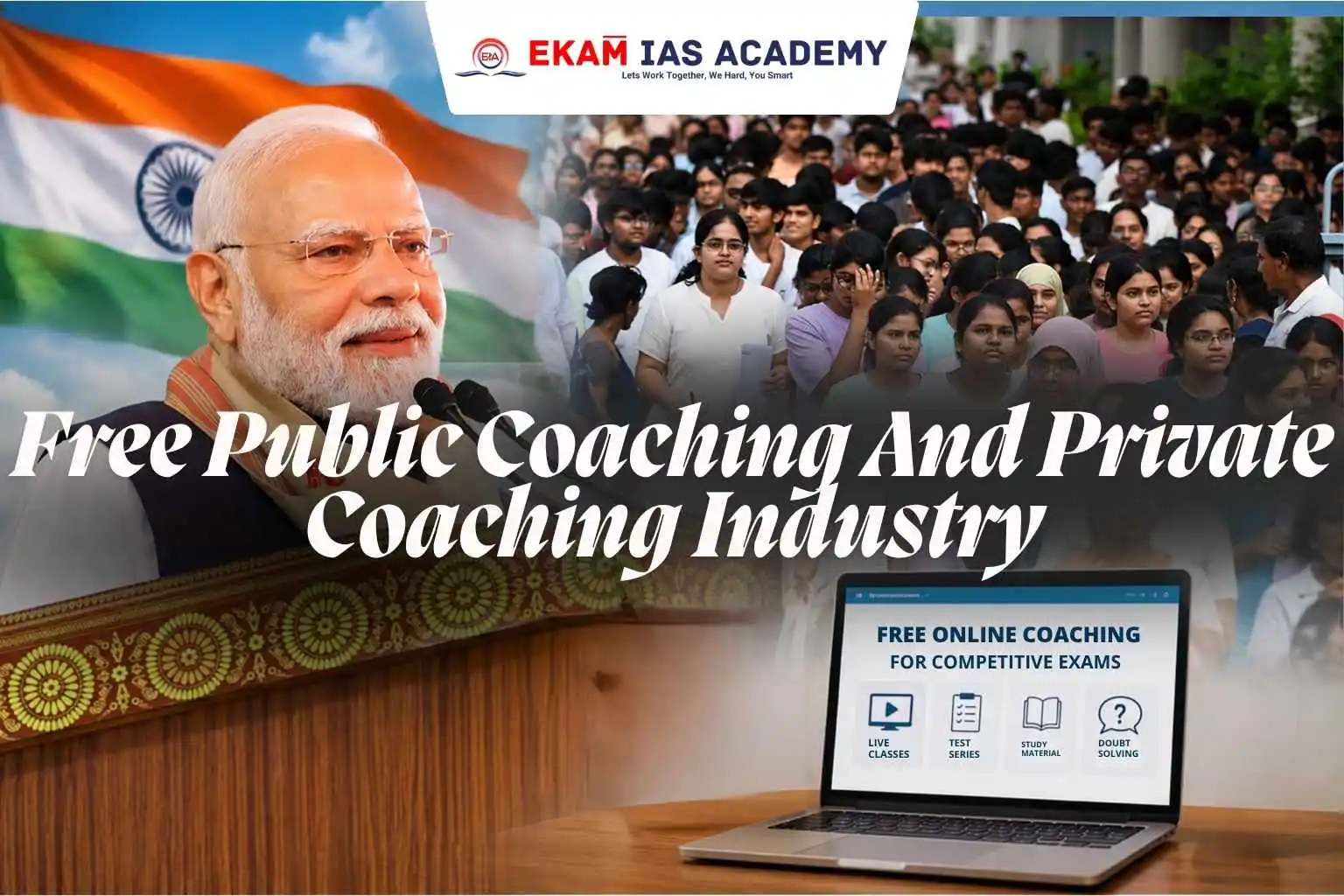
The announcement of free online coaching for competitive examinations through India’s Digital Public Infrastructure (DPI) has renewed debate on the role of public education platforms and the growing dependence on private coaching institutions. The move aims to democratise access to quality preparation for exams like NEET, JEE, and UPSC while addressing inequalities highlighted during recent examination controversies.This topic is important for aspirants preparing for Best IAS Coaching.
Background
- Digital Push: India already has platforms like SWAYAM and DIKSHA, but they remain underutilised.
- Coaching Dependency: Families spend ₹58,000 crore annually on coaching (NITI Aayog, 2024).
- Exam Pressure: Competitive exams like NEET, JEE, UPSC demand skills beyond school curricula, driving students to coaching hubs.
Dimensions of the Debate
- Equity in Education: Free coaching can reduce income‑based disparities, especially for rural and poor students.
- Technology Gap: Gen‑Z expects AI‑driven, mobile‑first, personalised learning; current platforms lack immersive features.
- School vs Exam Curriculum: Schools focus on conceptual learning, while competitive exams demand time‑bound problem solving and elimination strategies.
- Hybrid Model Need: Online lectures alone cannot replace peer competition, mentoring, and doubt‑solving forums offered by coaching centres.
Challenges
- Digital Divide: TRAI (2025) reports ~45 crore Indians lack reliable internet access, especially in rural areas.
- Quality Assurance: Without structured assessments and mentoring, free coaching risks becoming a video library.
- Curriculum Gap: NCERT notes mismatch between school syllabi and competitive exam requirements.
- Economic Impact: Coaching industry employs lakhs; sudden disruption may affect livelihoods.
Way Forward
- AI‑Enabled Learning: Develop adaptive platforms with personalised feedback, digital twins, and immersive content.
- Skill Hubs: NEP 2020 recommends school‑based skill hubs combining physical mentoring with online modules.
- Satellite Connectivity: Use LEO satellite tech to bridge last‑mile gaps in remote areas.
- Structured Pedagogy: Weekly tests, doubt forums, and peer interaction must be integrated into public platforms.
- Exam‑Specific Platforms: Instead of one common stack, create dedicated modules per exam to maintain quality.
Conclusion
Free public coaching can democratise exam preparation, but only if it evolves into a structured, AI‑enabled, hybrid model that matches the rigor of private coaching while ensuring inclusivity.