
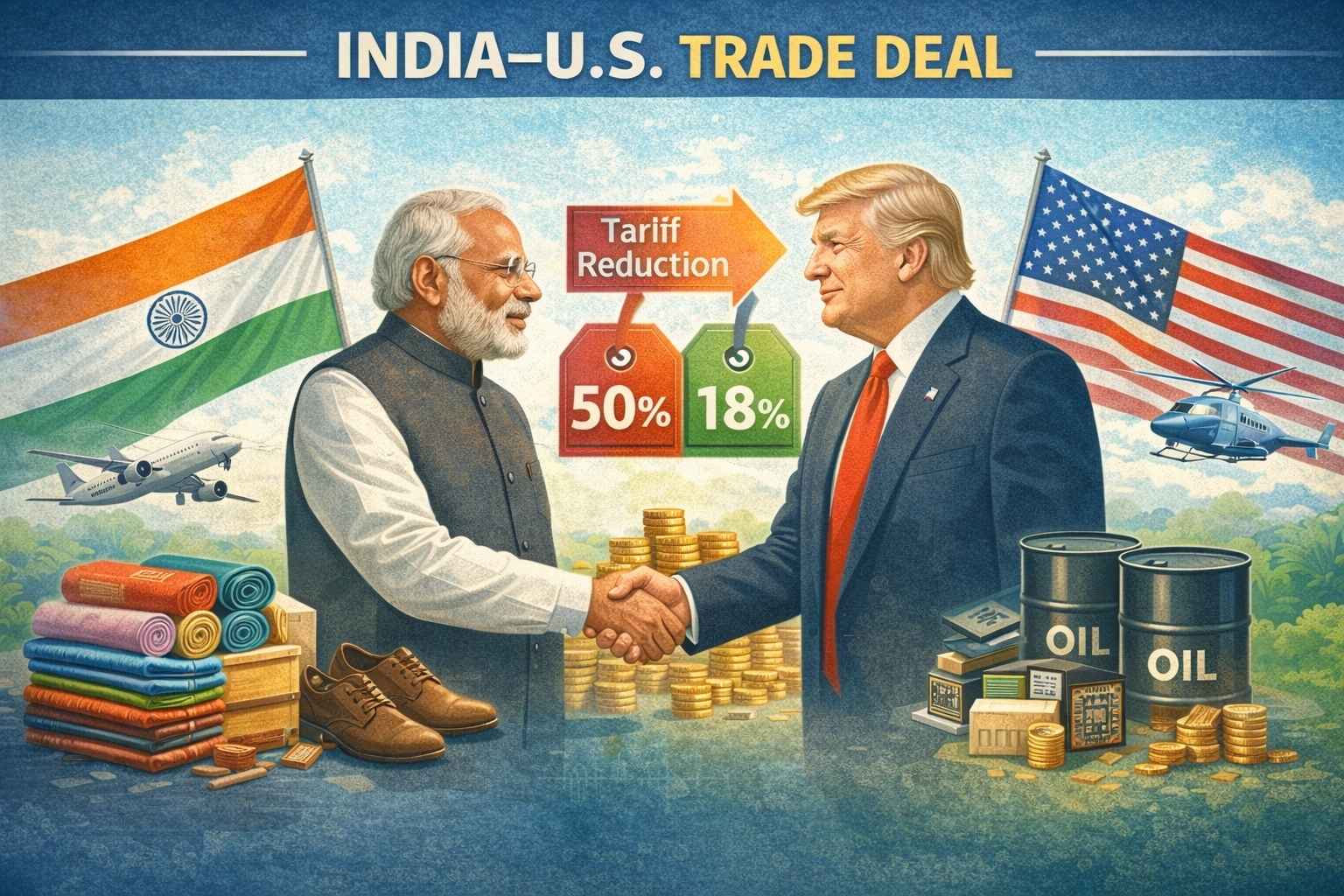
India and the United States have announced a new trade deal that reduces U.S. tariffs on Indian goods from 50% to 18%, bringing relief to several industries. The development has important implications for GS Paper III (Economy, International Trade) and is closely followed by aspirants preparing through UPSC coaching in Hyderabad.
Background
- The deal was announced jointly by Prime Minister Narendra Modi and U.S. President Donald Trump via social media, marking a departure from India’s usual formal channels.
- Commerce Minister Piyush Goyal later confirmed that sensitive sectors such as agriculture and dairy would be excluded from concessions.
- The U.S. agreed to reduce its reciprocal tariffs from 25% to 18% and remove the additional 25% penalty tariffs linked to India’s purchase of Russian oil.
Key Features of the Deal
- Tariff Reduction: Significant relief for Indian exports, especially in labour-intensive sectors such as textiles, footwear, leather, apparel, and engineering goods.
- Exclusion of Sensitive Sectors: Agriculture and dairy remain protected, ensuring domestic interests are safeguarded.
- Ambiguity in Commitments: No clarity yet on India’s concessions regarding investments, purchase orders, or oil imports.
Concerns and Challenges
- Implementation Timeline: While the U.S. President claimed tariffs would be cut “immediately,” India’s Commerce Minister indicated details would be shared “soon.”
- Russian Oil Issue: Reports suggest India may reduce or stop Russian oil imports, which currently account for nearly one-third of India’s crude supply. This could affect energy security and ties with Russia.
- Alternative Sources: Venezuelan crude presents refining challenges, while increased U.S. oil imports may raise costs.
- Competitiveness Gap: Even after tariff cuts, Indian exports may face slightly higher duties compared to Southeast Asian competitors enjoying MFN status—an issue often analysed in economy classes at Hyderabad IAS coaching.
Economic Impact
- Positive Market Reaction: Stock markets and the rupee strengthened following the announcement.
- Boost to Exports: Labour-intensive industries, already poised to benefit from the upcoming India–EU trade deal, are expected to gain additional competitiveness in the U.S. market.
- Budgetary Support: Targeted measures in the Union Budget 2026 are anticipated to help bridge remaining competitiveness gaps.
India–U.S. Trade (FY 2024–25)
- Total trade: $131.8 billion (the U.S. is India’s largest trading partner).
- India’s exports to U.S.: $86.51 billion (↑ 11.6% year-on-year).
- India’s imports from U.S.: $45.33 billion (↑ 7.4%).
- Trade surplus for India: $41 billion.
- Key exports: Textiles, engineering goods, pharmaceuticals, IT services.
- Key imports: Oil, aircraft parts, electronics, defence equipment.
Why Services Are Not Included in the Trade Deficit
- Goods vs Services: Trade deficits are usually calculated on merchandise trade, as goods are tangible and tracked at ports and customs.
- Measurement Issues: Services such as IT, finance, and tourism are harder to measure consistently across countries.
- Political Narrative: Goods deficits are more visible and easily linked to jobs and manufacturing.
- Reality Check: India runs a surplus in goods trade with the U.S.; inclusion of services would offset part of this gap, which is why services are often excluded.
Conclusion
The India–U.S. trade deal marks a significant step toward easing tariff burdens and boosting exports. However, unresolved questions around oil imports, competitiveness, and India’s reciprocal commitments underline the need for transparent communication and informed parliamentary debate before full implementation—an approach emphasised in civils coaching in Hyderabad.
This topic is available in detail on our main website.