
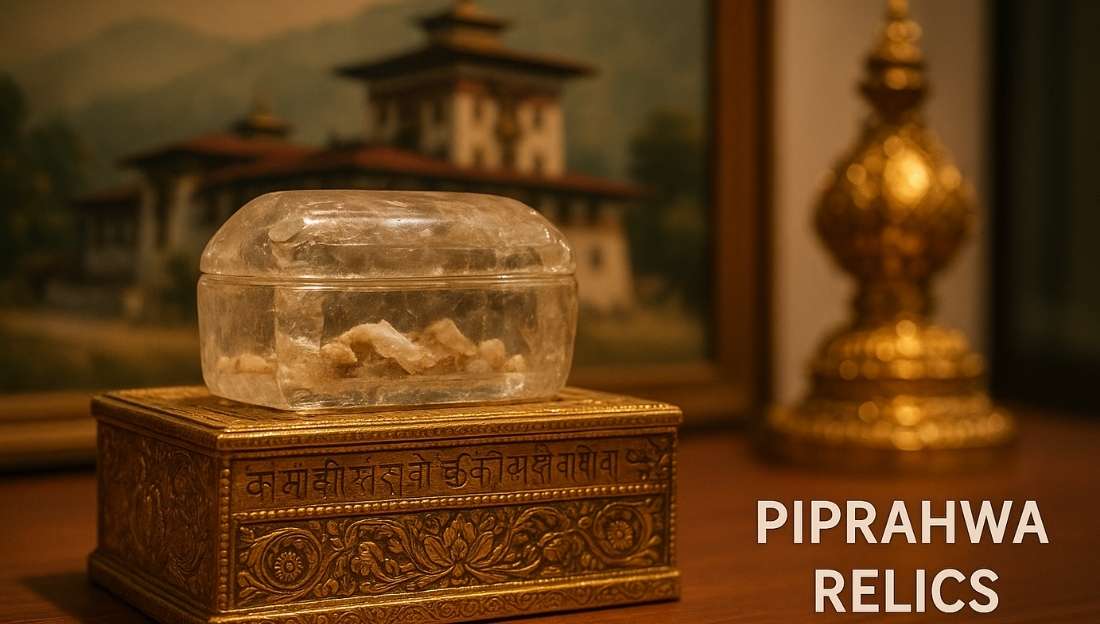
A portion of the Piprahwa Relics of Lord Buddha was recently enshrined at Tashichhodzong Monastery in Thimphu, Bhutan, strengthening cultural and spiritual ties between India and Bhutan.
About Piprahwa Relics
- The relics were discovered in 1898 at the Piprahwa Stupa, located in Siddharthnagar district, Uttar Pradesh, believed to be a site of ancient Kapilavastu, the homeland of Prince Siddhartha (Buddha).
- Excavation was conducted by William Claxton Peppé, revealing a stone coffer containing:
- Bone fragments
- Crystal reliquary
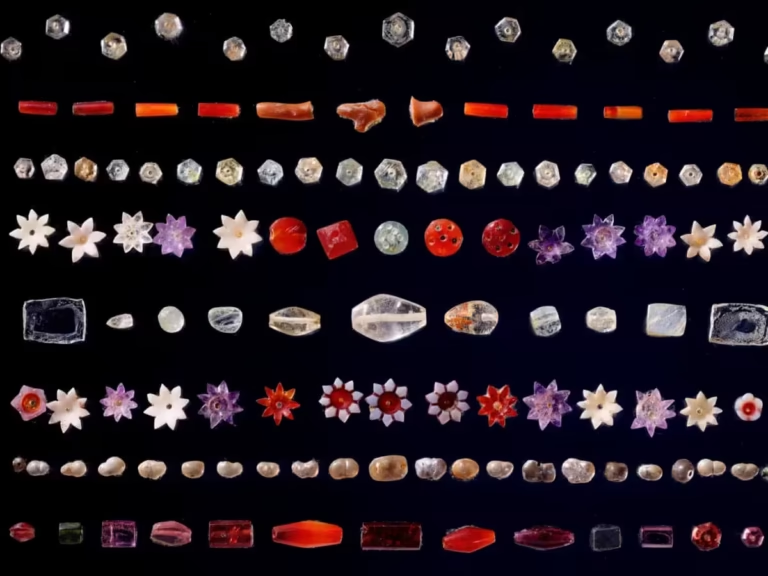
- Gold, gems, and ornaments
- A Brahmi inscription linked the relics to the Sakya clan, suggesting they were enshrined by Buddha’s own followers after his Mahaparinirvana in the 5th century BCE.
Custody and Preservation
- Many relics now reside in the Indian Museum, Kolkata, and the National Museum, New Delhi.
- Under Indian heritage law, the relics are classified as ‘AA’ antiquities, meaning they cannot be sold or exported.
- Recent diplomatic and cultural cooperation enabled the repatriation of relics previously held in private foreign possession.
Spiritual and Cultural Significance
- The relics hold deep importance for Theravada and Mahayana Buddhist communities.
- They symbolize:
- The historical presence of Buddha
- India’s role as the birthplace of Buddhism
- Shared civilizational bonds in South Asia.
Conclusion
The Piprahwa relics are not just archaeological objects—they are sacred heritage symbols. Their enshrinement abroad helps strengthen cultural diplomacy, enhance Buddhist tourism, and reinforce India’s identity as the cradle of Buddhism.
This topic is available in detail on our main website.