
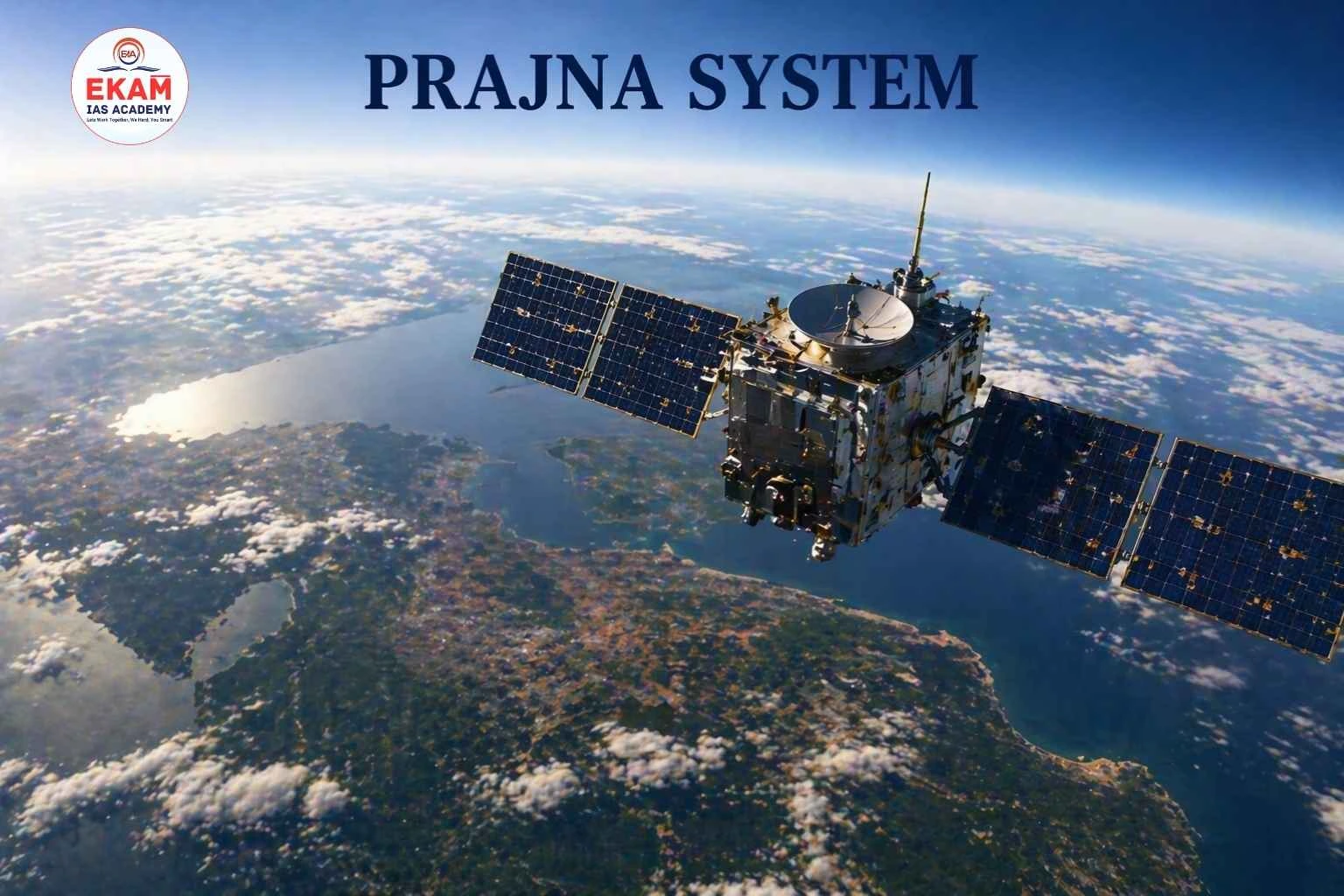
The Union Ministry of Home Affairs has recently received the indigenously developed AI-enabled satellite imaging system ‘Prajna’. This topic is important for aspirants preparing through IAS coaching in Hyderabad, UPSC coaching in Hyderabad, and UPSC online coaching.
Background
• Modern security challenges require real-time intelligence and surveillance.
• Conventional satellite imagery often produces large volumes of data that are difficult to process quickly.
• The Prajna System integrates artificial intelligence with satellite imaging to provide actionable insights faster and more accurately.
Such science and technology topics are frequently covered in Hyderabad IAS coaching and civils coaching in Hyderabad.
Features of Prajna System
• Indigenous Development: Built by DRDO’s CAIR, showcasing India’s self-reliance in advanced defence technology.
• AI Driven Analytics: Processes massive satellite data, identifies patterns, and flags anomalies.
• Real-Time Decision Support: Provides immediate inputs to security agencies during critical operations.
• Situational Awareness: Enhances monitoring of sensitive regions and border areas.
• Counter Terrorism Aid: Helps detect suspicious activities and supports rapid response.
These developments are crucial for GS3 preparation and are widely discussed in IAS coaching.
Strategic Importance
• Internal Security: Strengthens surveillance against terrorism, infiltration, and insurgency.
• Border Management: Improves monitoring of vulnerable zones along India’s borders.
• Disaster Response: Can be used for tracking floods, landslides, or other emergencies.
• Technological Edge: Reduces dependence on foreign imaging systems and enhances India’s defence preparedness.
Such security-related topics are important for aspirants preparing through UPSC coaching in Hyderabad.
Advantages Over Conventional Systems
• Speed: AI enables faster analysis compared to manual interpretation.
• Accuracy: Detects hidden or subtle patterns that human analysts may miss.
• Scalability: Capable of handling vast datasets from multiple satellites.
• Integration: Can be linked with other defence and intelligence platforms for holistic monitoring.
Challenges Ahead
• Ensuring data security and preventing misuse.
• Need for continuous AI training to adapt to evolving threats.
• Integration with existing defence infrastructure may require time and resources.
Conclusion
By combining satellite imagery with advanced analytics, it enhances situational awareness, internal security, and counter-terrorism capabilities. Its deployment reflects India’s push for indigenous innovation in strategic sectors, strengthening both national security and technological sovereignty. For students enrolled in UPSC online coaching and IAS coaching in Hyderabad, this topic is important for GS3 preparation.
This topic is available in detail on our main website.