
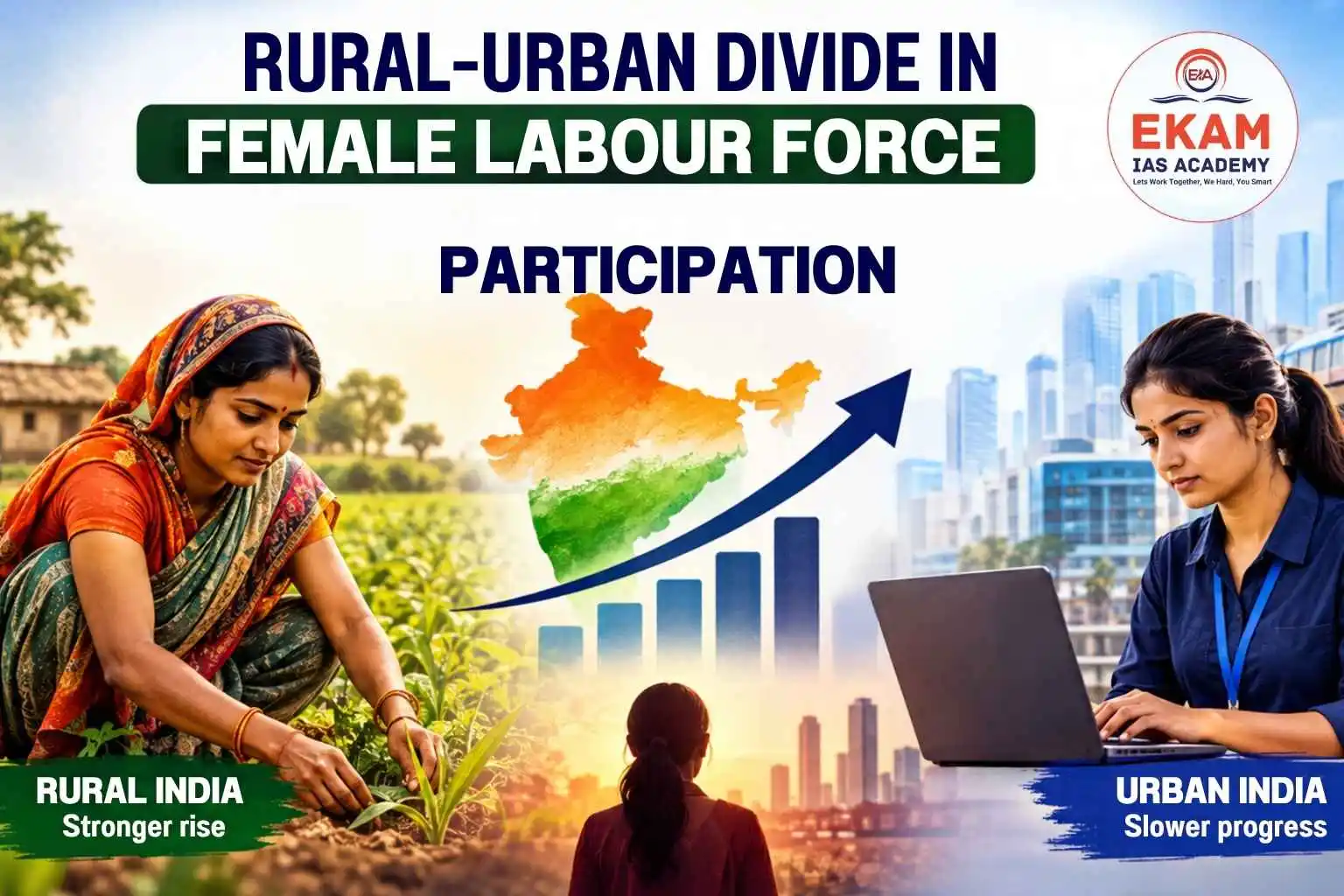
Recently, the Periodic Labour Force Survey (PLFS) 2025 highlighted a significant rise in Female Labour Force Participation Rate (FLFPR) in India, with rural areas showing a much sharper improvement compared to urban regions. This topic is important for aspirants preparing for IAS Coaching in Hyderabad.
National Trends
- Overall FLFPR (15+ years) rose from 30% in 2019‑20 to 40% in 2025.
- Rural FLFPR increased from 33% to 45.9%, showing significant improvement.
- Urban FLFPR rose modestly from 23.3% to 27.7%, reflecting slower progress.
- Improvement linked to post‑COVID livelihood shifts, agriculture absorption, and informal work expansion.
State wise Rural Trends
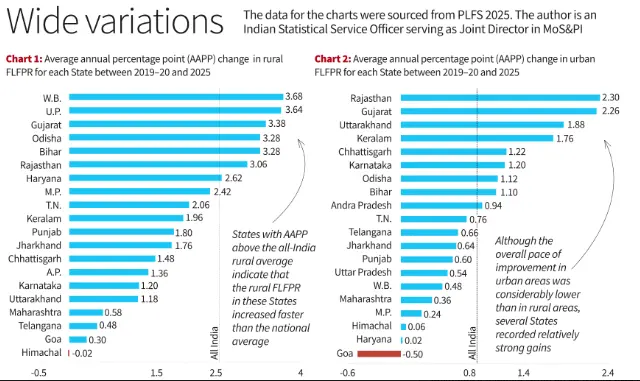
- Above‑average gains: West Bengal, Uttar Pradesh, Gujarat, Odisha, Bihar, Rajasthan, Haryana.
- Below‑average gains: Madhya Pradesh, Punjab, Jharkhand, Chhattisgarh, Uttarakhand, Maharashtra, Goa, Himachal Pradesh, southern States.
- States like Bihar and Uttar Pradesh started from low baselines but showed faster improvement.
- Odisha and Gujarat had higher baseline levels yet continued strong gains, proving growth is not base‑dependent.
State wise Urban Trends
- Strong gains: Rajasthan, Gujarat, Uttarakhand, Bihar (low baseline but above‑average pace).
- Moderate gains: Kerala, Karnataka, Chhattisgarh, Odisha, Andhra Pradesh (already higher baseline, yet improving).
- Slower progress: Uttar Pradesh, Jharkhand, Haryana, Punjab despite low starting levels.
- Urban participation remains constrained by limited formal jobs and social norms.
Key Insights
- Rural women increasingly engaged in agriculture, self‑help groups, and informal work.
- Urban women face barriers in formal sector entry, childcare, and workplace safety.
- AAPP (Average Annual Percentage Point change) must be read with baseline levels for accurate assessment.
- States with higher baseline FLFPR but slower AAPP still reflect saturation effects.
Challenges
- Quality of jobs remains poor; ILO 2024 report shows 70% women in informal work.
- Urban FLFPR stagnates due to low female representation in formal jobs (less than 20%).
- Skill mismatch persists; NSDC data highlights gaps in employability training.
- Social norms and safety concerns restrict women’s mobility in cities.
- Wage disparity continues; Gender Pay Gap Report 2025 shows women earn 20% less than men.
Way Forward
- Expand skill development and vocational training under Skill India Mission.
- Strengthen childcare and maternity support to enable urban participation.
- Promote women‑centric entrepreneurship schemes via Mudra and Stand‑Up India.
- Ensure safe transport and workplace conditions in urban centres.
- Enhance social security coverage for informal rural workers.
- Monitoring & evaluation through independent audits, student feedback, and performance tracking to ensure quality outcomes.
Working Age Population
- Refers to people aged 15 years and above (PLFS definition).
- Includes all individuals who are potentially available for work, whether employed or seeking employment.
Labour Force
- Comprises persons who are either employed or unemployed but actively seeking work.
- Excludes those not in labour force (students, homemakers, retired, disabled, etc.).
- Labour Force Participation Rate (LFPR) = (Labour Force ÷ Working Age Population) × 100.
Employment
- Persons engaged in economic activity (paid or unpaid) during the reference period.
- Includes self‑employed, regular wage/salaried, casual labour.
Unemployment
- Persons without work but seeking and available for employment.
- Unemployment Rate = (Unemployed ÷ Labour Force) × 100.
Not in Labour Force
- Individuals not seeking or not available for work.
- Includes students, homemakers, elderly, disabled, and discouraged workers.
Worker Categories
- Self‑employed: Own account workers, employers, unpaid family workers.
- Regular wage/salaried: Employees with fixed wages/salaries.
- Casual labour: Daily wage earners, contract workers.
Conclusion
Bridging the rural–urban divide in female labour participation is vital for inclusive growth and equitable development in India.