

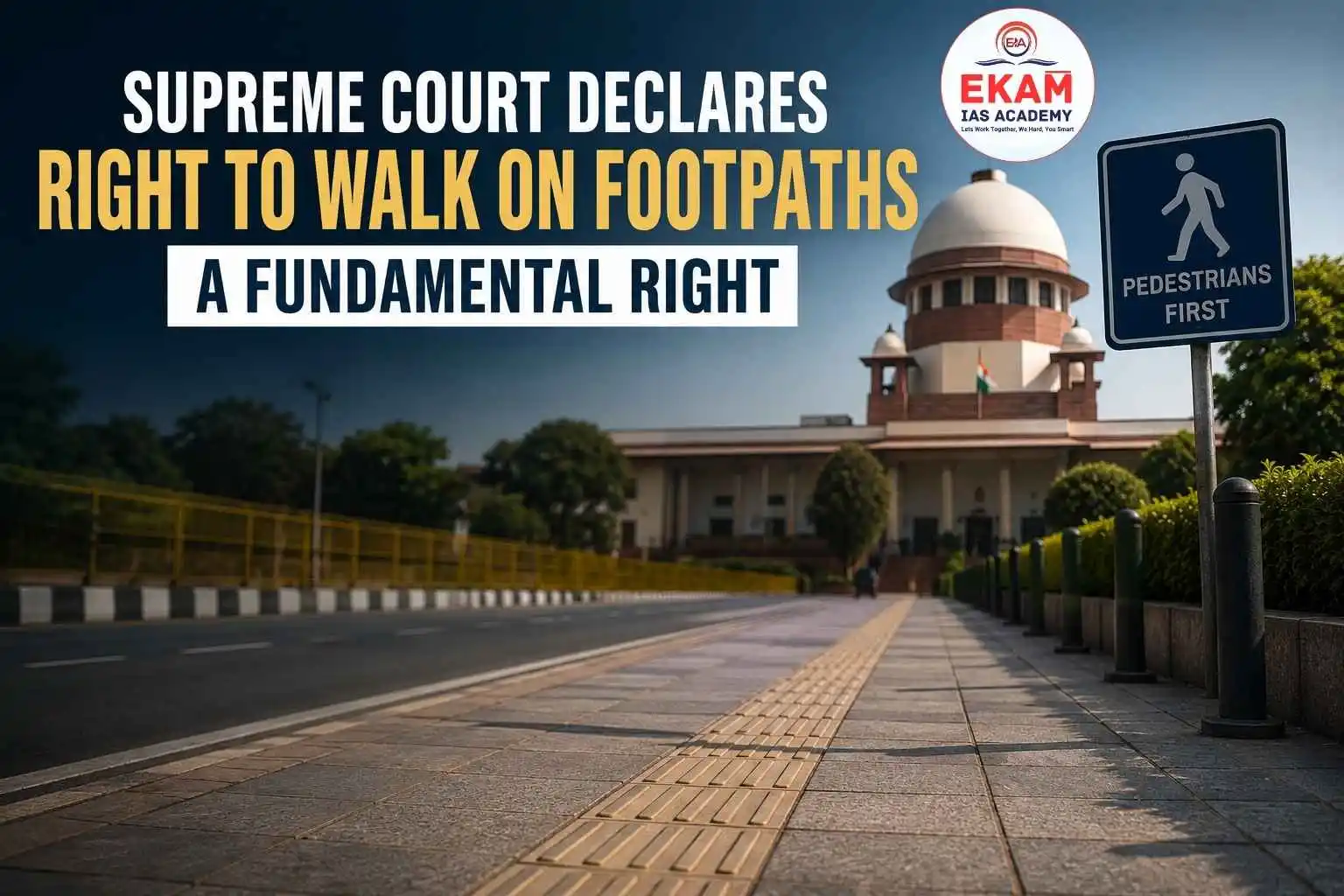
The Supreme Court in Maniyar Iliyaz @ Shaik Riyaz vs. P. Ayyappan declared that the right to walk on safe footpaths is a fundamental right under Article 21, prioritising pedestrians over motor vehicles. The case was triggered by the tragic death of a 5-year-old boy struck by a tanker while walking to school. This topic is important for aspirants preparing for GS2 Polity and urban governance issues through upsc online coaching.
Background
• Pedestrian Deaths Rising: Between 2015–2024, fatalities surged by 163%, from 13,894 to 36,526. Their share in total road deaths doubled to 20.61%.
• Structural Failure: Footpaths are often encroached by vendors, parked vehicles, garbage, or absent altogether.
• Motor Vehicles Act, 1988: Focuses on vehicles, treating pedestrians only as entities drivers must avoid hitting.
Court’s Observations
• Right to Life (Article 21): Safe footpaths are integral to living with dignity.
• Directive Principles (Article 39(b)): Footpaths are community resources; must serve the common good, not just motorised users.
• Tragedy of the Commons: Encroachment degrades shared pedestrian spaces.
• Democratic Freedoms: Walking linked to freedom of speech, protest, and association (e.g., Gandhi’s Dandi March).
• Critique of Elitism: Road design historically privileged vehicles, marginalising walkers.
Duty-Bearers
• Urban Local Bodies: Municipal corporations, panchayats, and development authorities are trustees of footpaths.
• Constitutional Responsibility: Failure to maintain or protect pedestrian space is a constitutional lapse, not just administrative negligence.
Court’s Directions
• Statutory Law: Parliament and States should enact dedicated laws, similar to the Right to Education Act, to enforce pedestrian rights.
• Dedicated Regulator: Establish a specialised body for planning, enforcement, and grievance redressal, akin to the National Commission for Protection of Child Rights.
• Compensation: In the case, compensation was raised to ₹11.44 lakh, recognising violation of pedestrian rights as a constitutional breach.
Way Forward
• Urban Planning: Inclusive road design under the Smart Cities Mission and National Urban Transport Policy is essential.
• Global Practices: Cities like London and Singapore prioritise pedestrian zones, providing models India can adopt.
• Environmental Angle: Promoting walking reduces carbon emissions and aligns with SDG 11 (Sustainable Cities).
• Public Health: Safe walking spaces encourage physical activity, reducing lifestyle diseases.
Conclusion
The judgment marks a paradigm shift in road hierarchy: pedestrians are no longer secondary but constitutionally prioritised, making safe footpaths a non-negotiable duty of the State.
One thought on “Supreme Court Declares Right To Walk On Footpaths A Fundamental Right”