
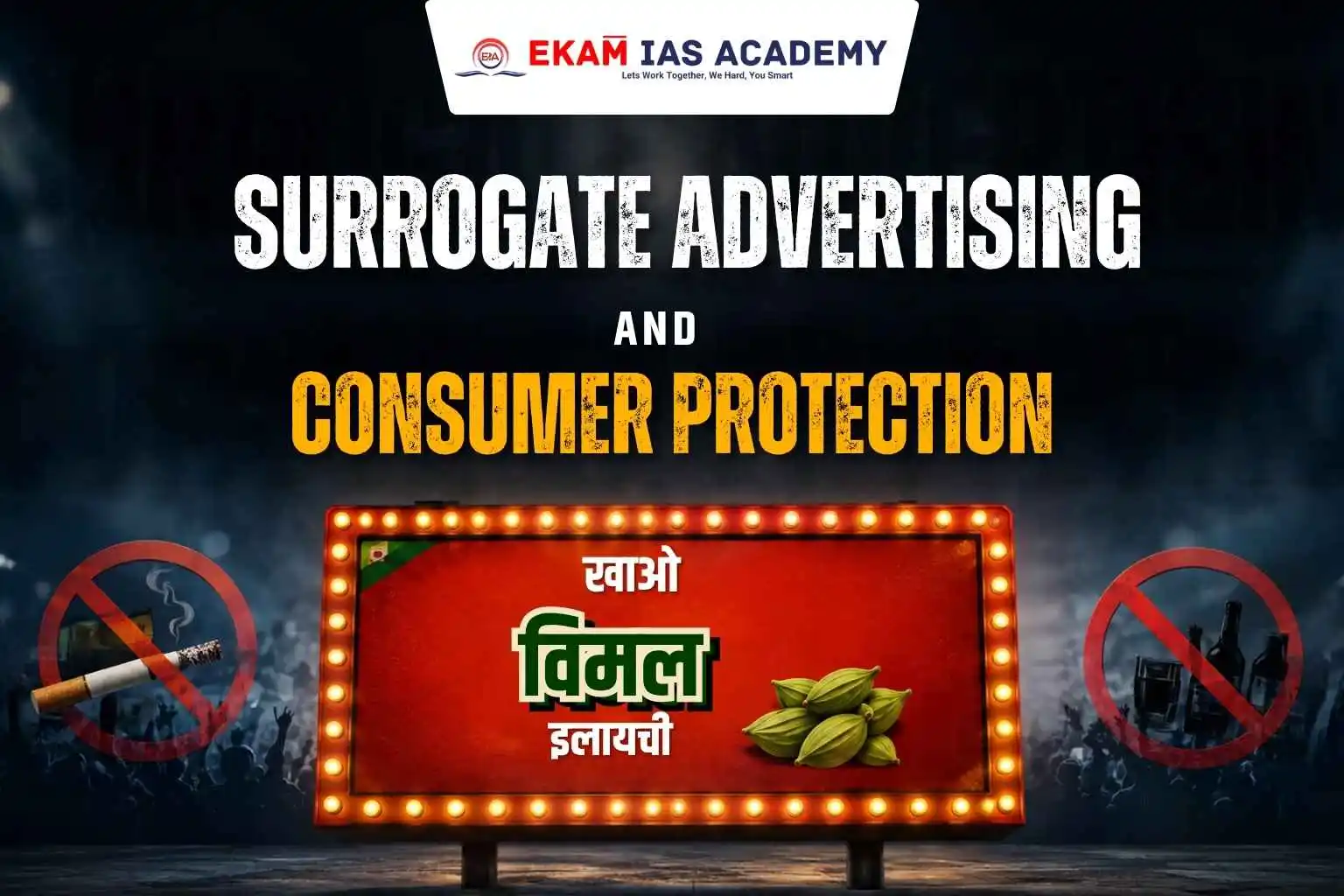
Advertising plays an important role in consumer choice, but the use of indirect promotion strategies for restricted products creates regulatory challenges. The recent action by the Maharashtra Food and Drug Administration (FDA) against celebrity endorsements of Vimal Elaichi has renewed debate on surrogate advertising, tobacco regulation, and consumer protection laws. This topic is important for aspirants preparing for Best IAS Preparation.
Surrogate Advertising in India
- Surrogate advertising means promoting a legally permitted product (e.g., elaichi, soda, music CDs) to indirectly advertise restricted goods such as tobacco or alcohol.
- It exploits loopholes in advertising laws to maintain brand recall.
- Legal Framework: The Cigarettes and Other Tobacco Products Act (COTPA), 2003 prohibits both direct and indirect promotion of tobacco products.
- Surrogate ads are treated as unfair trade practices under consumer protection laws.
- Judicial Precedent: In DGHS vs Som Pan Product Pvt. Ltd. (Delhi High Court, 2024), the Court held:
- The State must prove surrogate advertising with clear evidence.
- Mere brand registration or existence of a technically legal product is not sufficient proof.
- This ruling emphasised the need for evidence‑based enforcement rather than presumptions.
Key Issues
- Celebrity Endorsements: Stars like Shah Rukh Khan, Ajay Devgn, and Tiger Shroff face scrutiny under Consumer Protection Act 2019, which imposes endorser liability.
- Public Health Impact: India bears the highest global burden of oral cancer (ICMR data, 2025). Tobacco-linked surrogate ads worsen health risks.
- Fragmented Regulation: Multiple laws — COTPA, Food Safety and Standards Act (2006), Consumer Protection Act (2019) — create overlapping enforcement challenges.
Challenges
- Proof Burden: Regulators must establish clear evidence linking surrogate products to banned goods.
- Regulatory Overreach: Excessive bans risk judicial pushback and may weaken enforcement credibility.
- Market Practices: Companies exploit loopholes with products like elaichi, soda, or music CDs to sustain brand recall.
Way Forward
- Evidence-Based Enforcement: FDA must build strong cases under COTPA and FSS Act to withstand judicial scrutiny.
- Unified Framework: Consolidate fragmented laws into a single advertising regulation code.
- Celebrity Accountability: Enforce endorser liability with financial penalties and mandatory disclosures.
- Public Awareness: Campaigns to educate consumers about surrogate advertising’s health risks.
Conclusion
Effective regulation must curb surrogate advertising without overreach, ensuring consumer health protection while maintaining legal credibility.