
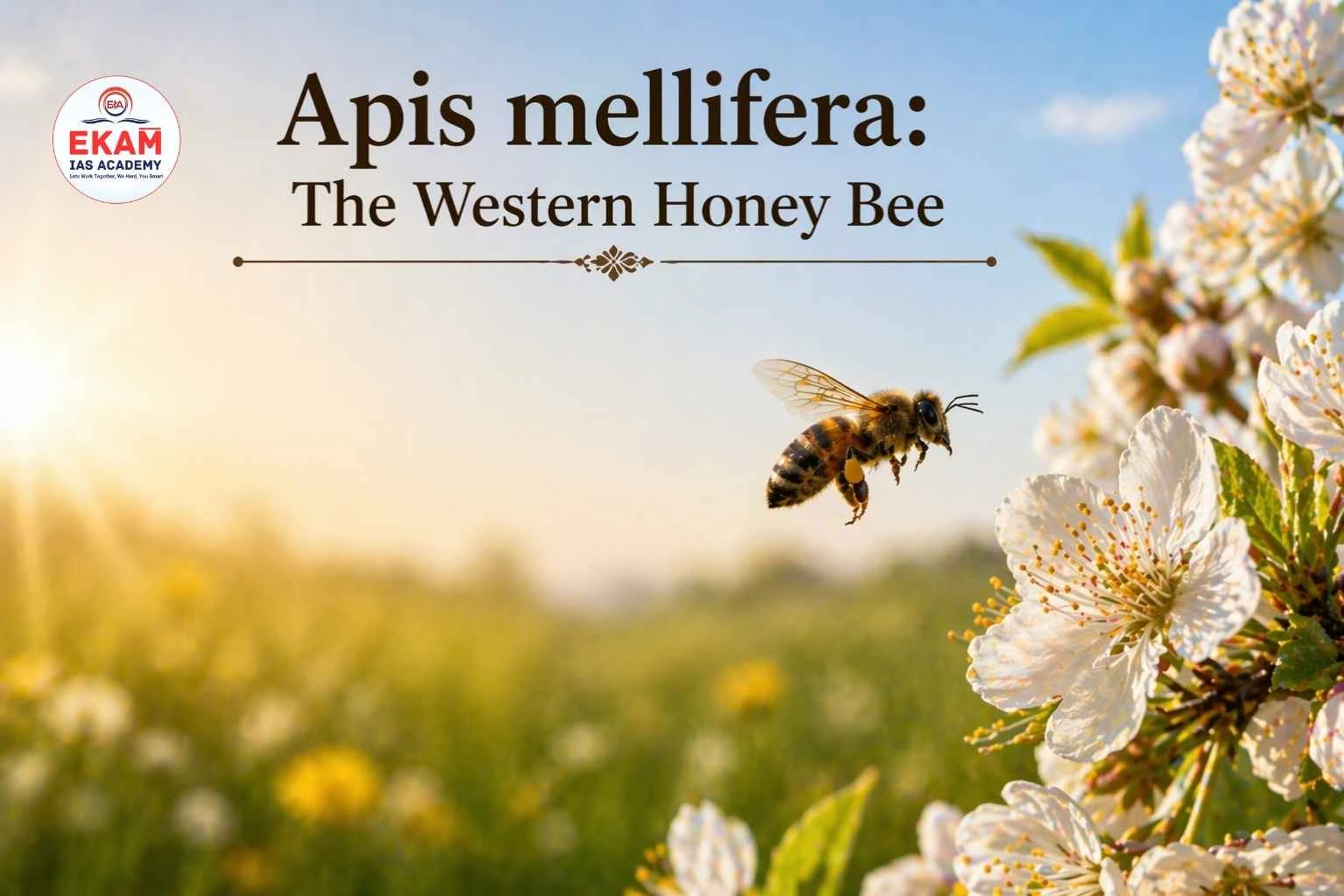
The CSIR Indian Institute of Integrative Medicine (IIIM), Pulwama has demonstrated that Apis mellifera (Western honey bee) can survive sub-zero temperatures, reducing the need for beekeepers to migrate hives to plains during winter. This topic is important for aspirants preparing through IAS coaching in Hyderabad, UPSC coaching in Hyderabad, and UPSC online coaching.
About Apis mellifera
• Commonly called the Western or European honey bee.
• Most widely domesticated insect species globally.
• Commercially important for honey, wax, propolis, and crop pollination.
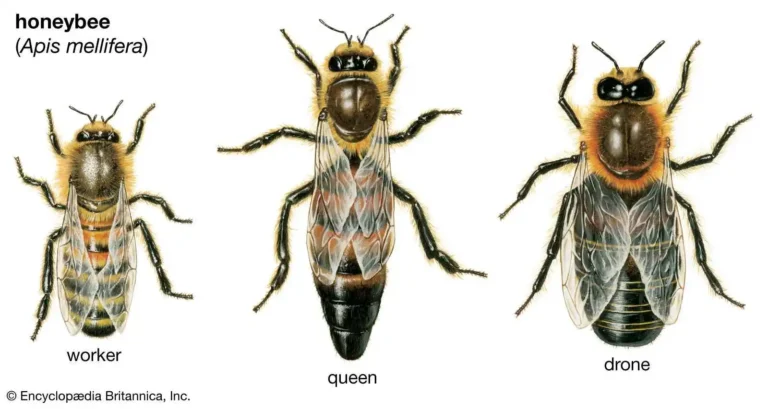
• Colonies are eusocial, with a queen, workers, and drones.
Such biodiversity topics are frequently covered in Hyderabad IAS coaching and civils coaching in Hyderabad for GS3 Environment.
Habitat and Distribution
• Native to Europe, Western Asia, and Africa.
• Introduced worldwide since the 17th century — now found in Asia, Australia, North & South America.
• Prefer flower-rich habitats like meadows, gardens, and open woodlands.
• Can adapt to grasslands, deserts, and wetlands if food and shelter are available.
• Nesting requires cavities such as hollow trees.
These ecological aspects are important for aspirants in IAS coaching and UPSC online coaching.
Features
• Appearance: Reddish brown to yellow with black bands and orange-yellow rings.
• Structure: Two pairs of wings, slender waist, hairy thorax and abdomen.
• Colony Size: Tens of thousands of bees.
• Stingers:
• Workers: Barbed stinger, fatal after use.
• Queen: Smooth stinger, can sting multiple times.
• Nest Architecture: Multi-comb structures made of beeswax inside protective cavities.
Significance in India
• Pollination: Crucial for agriculture and horticulture, enhancing crop yields.
• Livelihoods: Supports rural beekeepers through honey and wax production.
• Adaptability: Survival in cold climates reduces costs of hive migration, improving sustainability.
These topics are often discussed in UPSC coaching in Hyderabad.
Challenges
• Climate Stress: Extreme cold or heat affects survival.
• Diseases & Pests: Vulnerable to mites, viruses, and colony collapse disorder.
• Habitat Loss: Deforestation and pesticide use reduce bee populations.
• Competition: Native bee species sometimes displaced by Apis mellifera.
These environmental challenges are key discussion areas in IAS coaching in Hyderabad.
Way Forward
• Research & Innovation: Expand studies on cold climate survival and disease resistance.
• Training for Beekeepers: Promote scientific methods of hive management.
• Policy Support: Encourage apiculture under rural development schemes.
• Sustainability: Balance use of Apis mellifera with conservation of native bee species.
Conclusion
The breakthrough in Apis mellifera survival under sub-zero conditions is a major step for Indian apiculture, reducing costs and strengthening rural livelihoods. As pollinators, these bees are vital for food security, biodiversity, and sustainable agriculture. For aspirants preparing through IAS coaching in Hyderabad, UPSC coaching in Hyderabad, and UPSC online coaching, this topic is highly relevant for GS3 environment.
This topic is available in detail on our main website.