
Why in News?
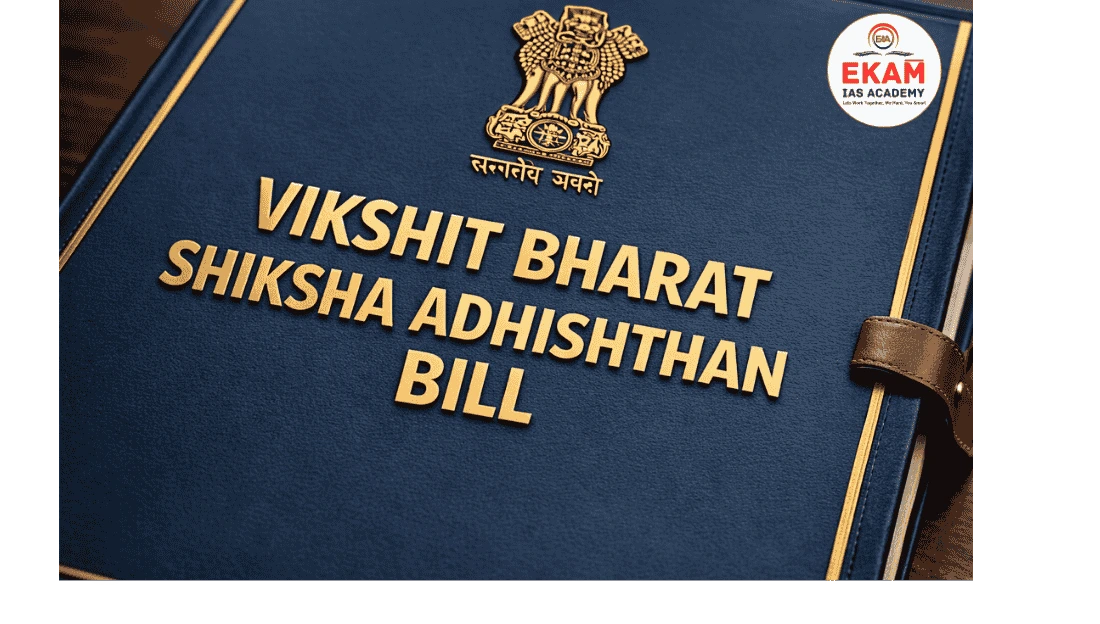
The University Grants Commission (UGC) and All India Council for Technical Education (AICTE) recently supported the Vikshit Bharat Shiksha Adhishthan (VBSA) Bill, 2025 before a Joint Parliamentary Committee — an important governance reform often analysed in UPSC coaching in Hyderabad while studying education policy and institutional reforms.
Key Provisions of the VBSA Bill
The VBSA Bill proposes major structural reforms in higher education governance.
1. Creation of a Single Umbrella Body
• Establishment of Vikshit Bharat Shiksha Adhishthan (VBSA) as the central regulatory authority.
• It will replace existing regulators such as UGC, AICTE, and NCTE.
2. Consolidation of Regulatory Functions
The new body will oversee:
• Regulation
• Accreditation
• Standard setting
• Funding and institutional development
3. Unified Regulatory Framework
• VBSA aims to create a simplified governance structure for universities and colleges.
• Institutions will deal with one regulator instead of multiple agencies.
4. Alignment with National Education Policy (NEP) 2020
• The reform aligns with the NEP 2020 vision of reducing regulatory fragmentation.
• NEP had proposed establishing the Higher Education Commission of India (HECI) with different verticals — a topic frequently discussed in IAS coaching in Hyderabad while preparing governance and education reforms.
Objectives of the Bill
The legislation intends to achieve several policy goals:
• Simplification of the higher education regulatory environment
• Improving transparency and accountability in institutions
• Encouraging academic innovation and interdisciplinary education
• Reducing bureaucratic delays and compliance burdens
• Strengthening quality assurance and accreditation systems
Current Higher Education Regulatory Structure
India currently has multiple regulatory bodies responsible for different aspects of higher education:
- UGC (University Grants Commission) – regulates universities and maintains academic standards.
- AICTE (All India Council for Technical Education) – supervises technical and professional education institutions.
- NCTE (National Council for Teacher Education) – regulates teacher training programmes.
- Other sectoral regulators exist for fields like architecture, medicine, and law.
Concerns and Criticisms
1. Centralization of Power
• Critics argue that a single authority may lead to excessive concentration of regulatory control.
2. Impact on Institutional Autonomy
• Universities fear that strong central oversight may limit academic independence.
3. Federalism Issues
• Education falls under the Concurrent List, meaning both Union and State governments share responsibilities.
• Some states worry about reduced role in higher education governance.
4. Implementation Challenges
• Transitioning from multiple bodies to a single regulator may create administrative complexities during the initial phase.
Significance for India’s Education System
If implemented effectively, the reform could:
• Improve coordination in higher education governance
• Promote global competitiveness of Indian universities
• Enhance quality assurance and academic standards
• Facilitate ease of doing research and innovation in institutions
India currently has over 1,100 universities and more than 40,000 colleges, making efficient regulation crucial for maintaining quality and accessibility.
Way Forward
• Ensure balanced regulation that protects academic autonomy.
• Provide clear institutional roles within the new regulatory framework.
• Strengthen consultation with states and educational institutions.
• Implement reforms gradually to ensure smooth transition from existing bodies — issues often analysed in UPSC online coaching and civils coaching in Hyderabad while preparing governance topics.
Conclusion
The VBSA Bill represents a major attempt to modernize India’s higher education governance by reducing regulatory fragmentation. Its success will depend on maintaining institutional autonomy while ensuring strong standards and transparent regulation.
This topic is available in detail on our main website.