
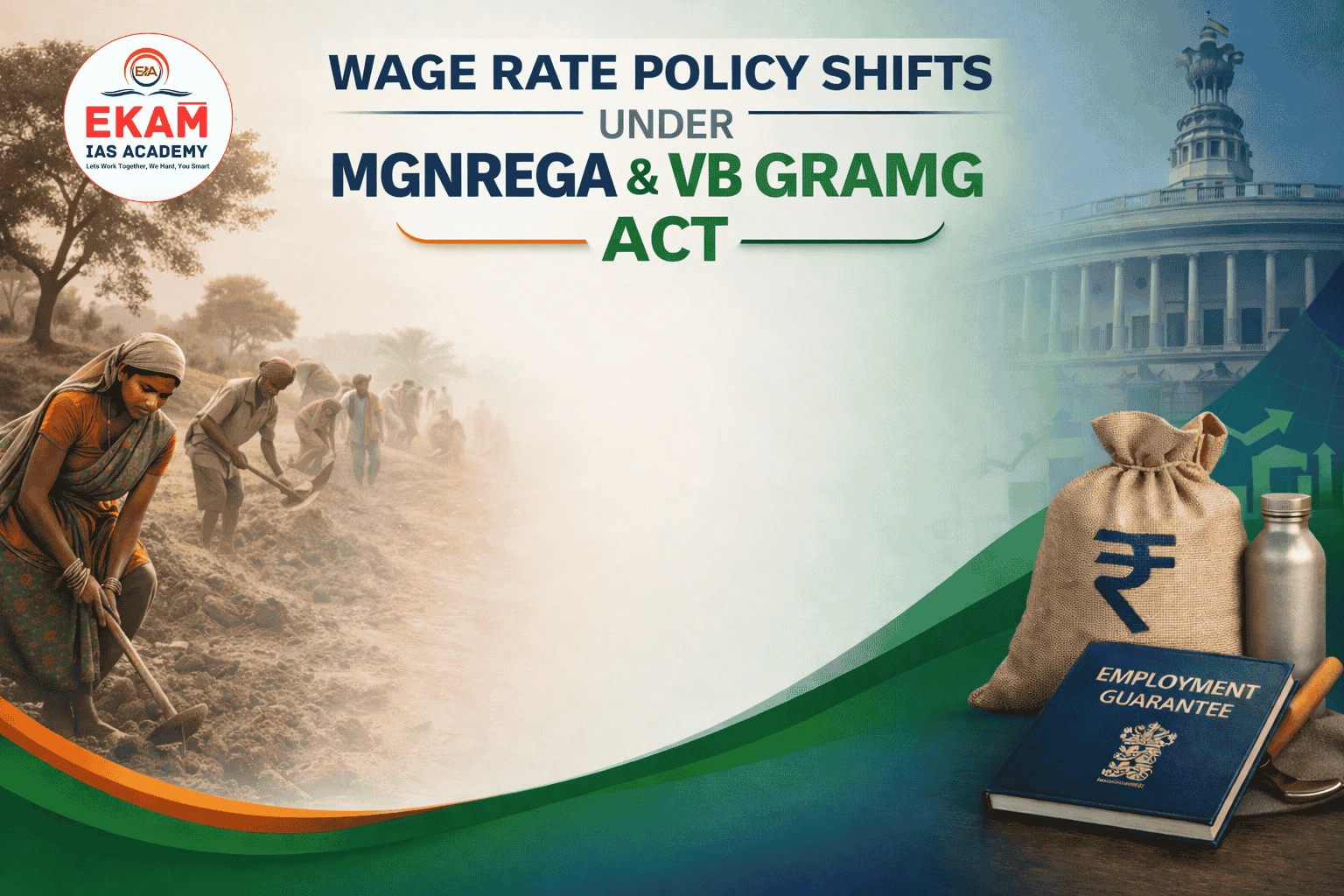
Recently, the Viksit Bharat – Guarantee for Rozgar and Ajeevika Mission (VB GRAMG) Act replaces the earlier MGNREGA framework and retains central powers to set wages. Such governance and welfare policy topics are important for aspirants preparing through IAS coaching in Hyderabad, UPSC online coaching, and other civil services preparation platforms.
Why wage rates matter
• Wage is a core parameter: Higher wages raise worker interest and programme uptake; low wages can suppress demand and allow gradual programme erosion.
• Cost and coverage link: Wage levels directly affect programme costs and the political will to fund it.
• Economists opined that this is a missed chance to guarantee minimum wages and that a long-running real wage freeze has already reduced the scheme’s effectiveness.
Understanding such socio-economic issues is essential for students preparing through UPSC coaching in Hyderabad and Hyderabad IAS coaching institutes, especially for GS Paper 2.
What VB GRAMG does
• Retains central power to set wages (Section 10) rather than restoring the earlier rule that linked payments to State minimum wages; cost sharing is now 60:40 Centre:State.
• Legal ambiguity: The removal of the earlier “non obstante” clause raises questions about whether paying below State minimums is lawful.
These policy changes are often analysed in IAS coaching and civils coaching in Hyderabad to understand welfare schemes and governance challenges.
How wages were set under MGNREGA
• Initial rule (2006–2009): Until 2009, State minimum wages for agricultural labourers applied to MGNREGA work, which helped make the scheme popular in many States.
• Central notification (2009): The Centre then began notifying a uniform MGNREGA wage (about ₹100/day at the time), which later froze in real terms.
Such historical policy evolution is frequently discussed in UPSC online coaching and structured UPSC coaching in Hyderabad programs.
Consequences
• MGNREGA wages fell behind State minimums and market wages, reducing the scheme’s role in sustaining rural pay levels.
• Payment delays and technical failures (Aadhaar/payment systems) discouraged workers and lowered participation.
• Corruption and leakages rose as worker vigilance fell, further reducing real employment outcomes.
These governance challenges are important for aspirants studying through IAS coaching in Hyderabad and Hyderabad IAS coaching programs.
Way Forward
• Centre should notify wages at or above State minimums across all States to remove legal doubt and raise real pay.
• Ensure timely payments: Fix technical bottlenecks and strengthen payment guarantees to prevent delays.
• Restore demand-driven design: Link wages to local labour markets so the scheme sustains rural wage floors rather than undermining them.
Such recommendations are widely covered in IAS coaching and civils coaching in Hyderabad, helping aspirants write better UPSC answers.
Conclusion
The VB GRAMG Act misses a chance to secure minimum rural wages. Retaining central control and a real wage freeze risks weakening income protection unless the Centre commits to paying at least State minimums and ensuring timely, corruption-free payments. For aspirants preparing through IAS coaching in Hyderabad, UPSC coaching in Hyderabad, and UPSC online coaching, such topics are crucial for understanding welfare governance and policy analysis.
This topic is available in detail on our main website.