
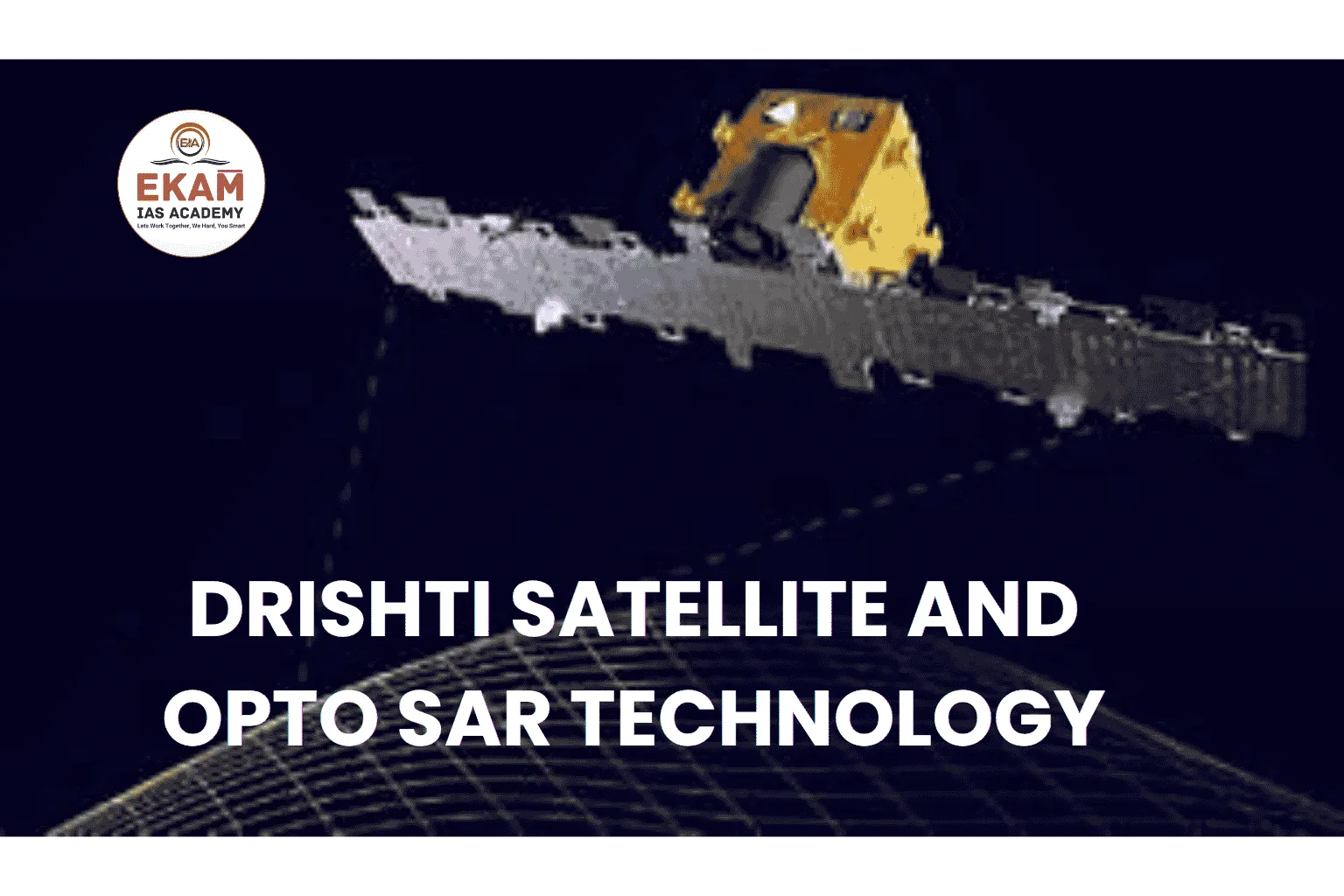
Indian start up GalaxEye launched its first satellite ‘Drishti’ aboard a SpaceX Falcon 9 (CAS500 2 mission). It is the world’s first satellite with Opto SAR technology, capable of capturing optical and radar images simultaneously. This science and technology topic is important for aspirants preparing through IAS coaching in Hyderabad, UPSC coaching in Hyderabad, and UPSC online coaching.
Space Imaging
• Definition: Collecting visual/electromagnetic data from space for Earth monitoring and astronomy.
• Technologies Used:
• Optical sensors → clear photographs.
• Synthetic Aperture Radar (SAR) → all weather imaging.
• Infrared/Thermal → heat signatures.
• Hyperspectral → chemical composition analysis.
• AI & Cloud → real time processing.
Limitations of Existing Systems
• Optical Imaging: Clear, intuitive; fails in clouds/night.
• SAR Imaging: Works in all conditions; but images are complex, requiring expert interpretation.
• Fusion Challenge: Current practice combines data from separate satellites → misaligned angles, timing differences → inaccurate results.
What Makes Drishti Unique
• Opto SAR Technology: Optical + SAR sensors synchronised to capture same location at same time. Proprietary stack ensures perfect alignment.
• AI Integration: If optical blocked by clouds, AI regenerates optical like images from SAR data.
• Indian Context: Tropical cloud cover makes optical satellites unreliable. Drishti solves this India specific problem by ensuring continuous, user friendly imagery.
Applications
• Civilian: Agriculture monitoring, disaster management, urban planning, infrastructure tracking.
• Military: Border surveillance, defence intelligence.
• Scientific: Climate studies, environmental monitoring.
India’s Space Start up Ecosystem
• GalaxEye: Opto SAR innovation.
• Agnikul Cosmos: 3D printed rocket engine.
• Skyroot: First private Indian rocket.
• Pixxel, Dhruva Space, Bellatrix: Advanced satellite technologies.
• Enabled by Indian Space Policy 2023, which opened end to end space activities to private players.
Significance
• Global First: Positions India at the forefront of imaging innovation.
• Strategic Edge: Combines clarity + continuity in one satellite.
• Economic Impact: Strengthens India’s private space sector.
• Policy Relevance: Supports self reliance and global competitiveness in space technology.
Conclusion
Drishti’s Opto SAR technology bridges the gap between optical clarity and SAR’s all weather reliability. It represents a breakthrough tailored to India’s tropical challenges, with wide civilian and defence applications, marking a milestone in India’s private space journey.
For aspirants preparing through IAS coaching and civils coaching in Hyderabad, this topic is highly relevant for GS3 Science & Technology, Space Technology, and Internal Security.
This topic is available in detail on our main website.