
India and China held their first Corps Commander-level meeting in the Eastern Sector of the Line of Actual Control (LAC) at the Vacha–Damai Border Personnel Meeting Point in Arunachal Pradesh. The development marks an important milestone in India China Military Talks in Arunachal Pradesh and reflects efforts to strengthen dialogue through India China LAC Talks and wider India China Border Talks.
India–China Relations
- Ancient cultural exchanges took place through Buddhism, with monks like Xuanzang visiting India. Trade via the Silk Route connected India with China for centuries.
- Border Disputes: India and China share a 3,488 km-long border across Ladakh, Himachal Pradesh, Uttarakhand, Sikkim, and Arunachal Pradesh. The Line of Actual Control India China remains central to bilateral security concerns.
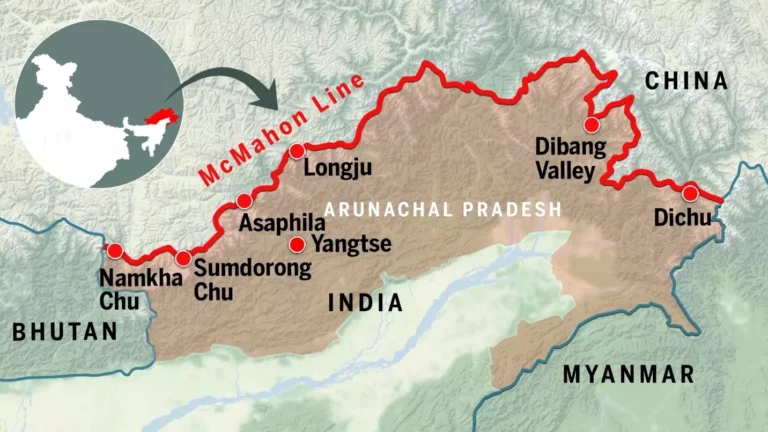
- Disputes exist in Aksai Chin (claimed by India, controlled by China) and Arunachal Pradesh (claimed by China as “South Tibet”), making the Arunachal Pradesh LAC Dispute a major component of the wider boundary question.
- The 1962 Sino-Indian War was fought over border disputes.
- Later agreements include 1993 (Maintenance of Peace & Tranquility), 1996 (Confidence Building Measures), and 2005 (Political Parameters for Boundary Settlement).
- China is one of India’s largest trading partners.
- Both countries are members of BRICS, SCO, and G20 and cooperate in multilateral forums.
- Military tensions at the LAC, including the Galwan clashes of 2020, coexist with dialogue mechanisms such as the WMCC and Special Representatives’ talks.
- The continuing border issue is important for understanding India China Relations UPSC, India China Border Dispute UPSC, and broader India China Defence Relations.
- Search discussions around India China Border Ten also broadly relate to continuing tensions and military developments along the disputed boundary.
Key Developments
- The Indian side was led by Lt. Gen. Girish Kalia, Commander of the 3 Corps (Spear Corps), headquartered at Rangapahar, Nagaland. The delegation included officers from the Indo-Tibetan Border Police (ITBP).
- The 3 Corps and 4 Corps (Tezpur) are responsible for the frontier in Arunachal Pradesh.
- The talks precede the BRICS Summit (Sept 11–13, New Delhi), where Chinese President Xi Jinping is expected to attend.
- Backdrop: Reports of Chinese incursions and military activity in Taksing (Upper Subansiri district) prompted the meeting.
- The meeting therefore adds a new dimension to India China LAC Arunachal Pradesh engagement and the evolving framework of India China Military Talks.
- The presence of senior military commanders highlights the importance of Corps Commander Talks India China in managing tensions along sensitive border areas.
Significance
- Traditionally, Corps Commander-level talks were held at Chushul–Moldo (Ladakh). Extending this mechanism to the Eastern Sector reflects India’s intent to institutionalize dialogue across all sensitive border areas.
- This expansion of Corps Commander Talks India China strengthens mechanisms for managing the Line of Actual Control India China across multiple sectors.
- The meeting follows the 36th WMCC (Aug 6, 2026) and the 25th Special Representatives’ talks (Aug 26, Beijing), where both sides signed an eight-point outcome document.
- Establishment of two new Border Personnel Meeting Points in the Eastern and Central Sectors.
- Creation of new hotlines for better communication.
- Army Chief Gen. Dhiraj Seth recently reviewed combat readiness at 3 Corps HQ, underlining India’s focus on strengthening infrastructure and surveillance in Arunachal Pradesh.
- These developments demonstrate how India China Defence Relations combine military preparedness with institutional dialogue.
- The issue is highly relevant for India China Current Affairs UPSC, particularly under GS Paper 2 themes related to bilateral relations, border management, national security, and diplomacy.
Conclusion
By extending high-level military dialogue beyond Ladakh, India signals its determination to safeguard sovereignty while keeping communication channels open. The outcome reflects a pragmatic strategy: strengthening operational readiness, institutionalizing dialogue, and balancing security with diplomacy.
The India–China Military Talks in Arunachal Pradesh could strengthen confidence-building along the eastern LAC while addressing concerns surrounding the Arunachal Pradesh LAC Dispute. Continued India China Border Talks and structured India China LAC Talks will remain critical for maintaining stability and managing long-standing territorial differences.