
Nuclear Arsenal
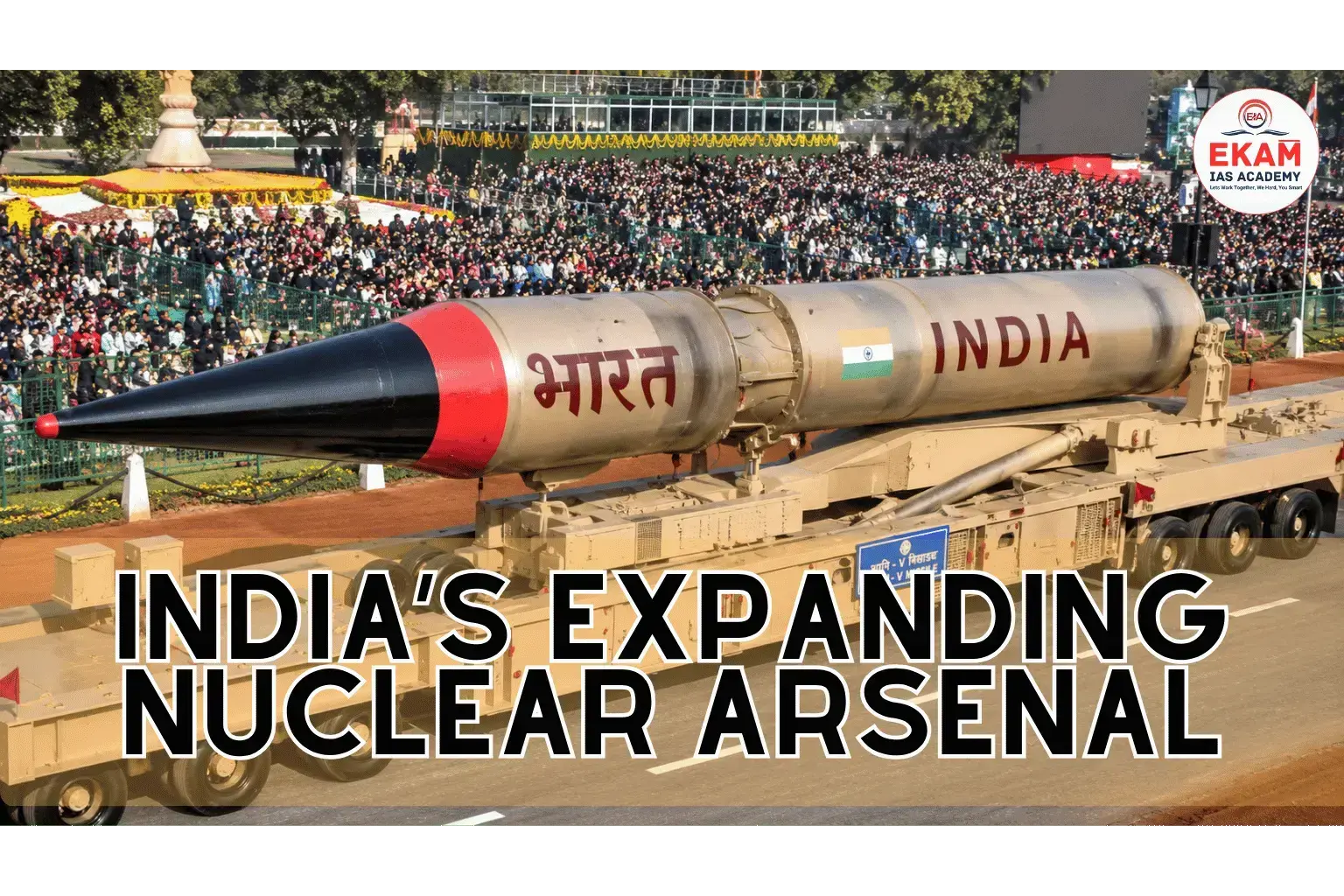
The Stockholm International Peace Research Institute (SIPRI) Yearbook 2026 reported that India expanded its nuclear arsenal in 2025, raising its estimated stockpile to around 190 warheads, alongside continued modernization of delivery systems. This topic is important for aspirants preparing for GS2 Polity and international security-related issues through Hyderabad IAS coaching.
What is SIPRI?
• The Stockholm International Peace Research Institute (SIPRI) is an independent global think tank based in Sweden.
• It publishes the SIPRI Yearbook annually, covering global security, arms control, military expenditure, and nuclear forces.
• SIPRI data is widely used by the United Nations, governments, and defence analysts for policy and research.
Key Findings of SIPRI Yearbook 2026
• India’s Nuclear Arsenal: Estimated at 190 warheads, up from 180 in 2025.
• Modernization Drive: India continues developing new delivery systems, including land based missiles, air launched weapons, and sea based deterrents under the triad capability.
• Defence Spending: India’s military expenditure reached USD 92.1 billion in 2025, an 8.9% increase from 2024, ranking fourth globally after the United States, China, and Russia.
• Global Nuclear Context: Nine nuclear armed states collectively held 9,575 warheads ready for potential use.
• Regional Tensions: SIPRI referenced Operation Sindoor as an unusually severe military crisis between India and Pakistan, underscoring South Asia’s nuclear volatility.
Strategic and Policy Dimensions
• Strategic Deterrence: India’s modernization aligns with its credible minimum deterrence doctrine.
• Regional Security: Expansion reflects India’s response to evolving threats from China and Pakistan.
• Global Standing: India’s position as the fourth largest defence spender reinforces its role in the global security architecture.
• Arms Control Debate: SIPRI warns of weakening international arms control regimes amid rising geopolitical tensions.
Global Treaties on Nuclear Weapons
• Nuclear Non Proliferation Treaty (NPT): Adopted in 1968, it prevents the spread of nuclear weapons, promotes peaceful nuclear energy, and commits states to eventual disarmament. India is not a signatory.
• Comprehensive Nuclear Test Ban Treaty (CTBT): Adopted in 1996, it bans all nuclear explosions. It has not entered into force because key states, including India, the United States, China, and Pakistan, have not ratified it.
• Treaty on the Prohibition of Nuclear Weapons (TPNW): Entered into force in 2021, it completely bans the development, testing, stockpiling, and use of nuclear weapons. Nuclear armed states, including India, have not joined it.
What are Nuclear Weapons?
Weapons that derive destructive force from nuclear fission (splitting atoms) or fusion (combining atoms).
Nuclear Weapon States in the World
- Recognized under NPT (Non‑Proliferation Treaty): United States, Russia, United Kingdom, France, China.
- Other nuclear‑armed states (outside NPT): India, Pakistan, Israel (undeclared), North Korea.
- Global Stockpile (SIPRI 2026): Around 9,575 warheads in military stockpiles, with the US and Russia holding over 90%.
India’s Nuclear Triad (All 3 Forces Capability)
- Land‑based Missiles: Agni series (Agni‑I to Agni‑V) with ranges up to 5,000+ km. Canisterised missiles like Agni Prime enhance survivability.
- Air‑based Delivery: Fighter aircraft such as Mirage‑2000, Jaguar, Su‑30MKI, Rafale
Sea‑based Submarines: INS Arihant and INS Arighat (SSBNs) equipped with K‑15 (700 km) and K‑4 (3,500 km) submarine‑launched ballistic missiles.
Conclusion
The SIPRI 2026 report highlights India’s steady nuclear modernization and growing defence capability. It signals India’s pursuit of strategic autonomy, credible deterrence, and security stability in an increasingly uncertain global order.