
The National Family Health Survey 6 (NFHS 6) results were recently released by the Ministry of Health and Family Welfare (MoHFW), Government of India, and conducted by the International Institute for Population Sciences (IIPS), Mumbai. This topic is important for aspirants preparing for GS2 Health and social development-related issues through best IAS coaching in Hyderabad.
What is NFHS?
• The National Family Health Survey is a large scale, multi round survey conducted by the Ministry of Health and Family Welfare with support from the International Institute for Population Sciences.
• It provides nationally representative data on health, nutrition, fertility, mortality, and family planning, guiding policy decisions.
• NFHS 6, conducted during 2023–24, is the latest round following NFHS 5, which was conducted during 2019–21.
• NFHS is India’s primary health data source and is used for SDG monitoring and schemes like POSHAN Abhiyaan and Ayushman Bharat.
• NFHS 6 surveyed over 6 lakh households across States and Union Territories.
• It captures inter state variations, helping policymakers design targeted interventions.
Key Findings
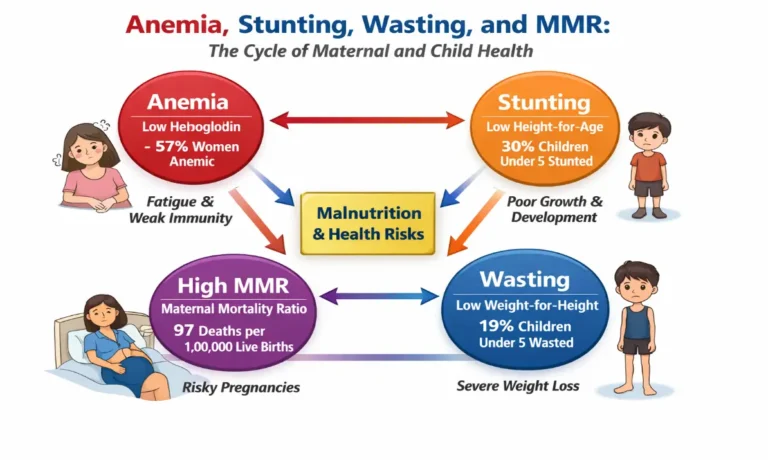
• Child Nutrition: Stunting declined nationally, but over 30% of children under 5 remain stunted, while wasting rates hover around 19%.
• Maternal Care: Institutional births rose to 89%, showing the success of Janani Suraksha Yojana and LaQshya programme.
• Women’s Internet Use: Female internet usage increased to 57%, narrowing the digital gender gap.
• Anemia: Anemia remains high, with over 50% of women aged 15–49 being anemic, impacting health and workforce productivity.
• Mortality Rates: Infant mortality reduced to 32 per 1,000 live births, but disparities remain across states.
Significance
• Policy Planning: NFHS data supports schemes like POSHAN 2.0 and Mission Shakti.
• Social Empowerment: Rising internet use among women boosts participation in digital governance and e commerce.
• Health Equity: NFHS helps track SDG 3, Good Health and Well Being, and SDG 5, Gender Equality.
• Regional Focus: States like Bihar and Uttar Pradesh show higher malnutrition, requiring state specific interventions.
Challenges
• Persistent Malnutrition: Despite progress, India still has one of the world’s largest numbers of stunted children.
• High Anemia Burden: Anemia weakens maternal health, child development, and workforce productivity.
• Inter State Disparities: Southern states outperform northern states in most health and nutrition indicators.
• Data Utilization: Translating survey findings into effective ground level action remains uneven.
Way Forward
• Strengthen nutrition programmes with fortified foods and community kitchens.
• Expand digital literacy initiatives for women, especially in rural areas.
• Enhance maternal health services with better monitoring and outreach.
• Focus on state specific strategies to reduce disparities.
• Integrate NFHS data into real time dashboards for policy evaluation.
Conclusion
The NFHS 6 reflects India’s mixed progress. While maternal care and digital access have improved, malnutrition and anemia remain pressing challenges. Turning data into action is the key to achieving inclusive health outcomes.