
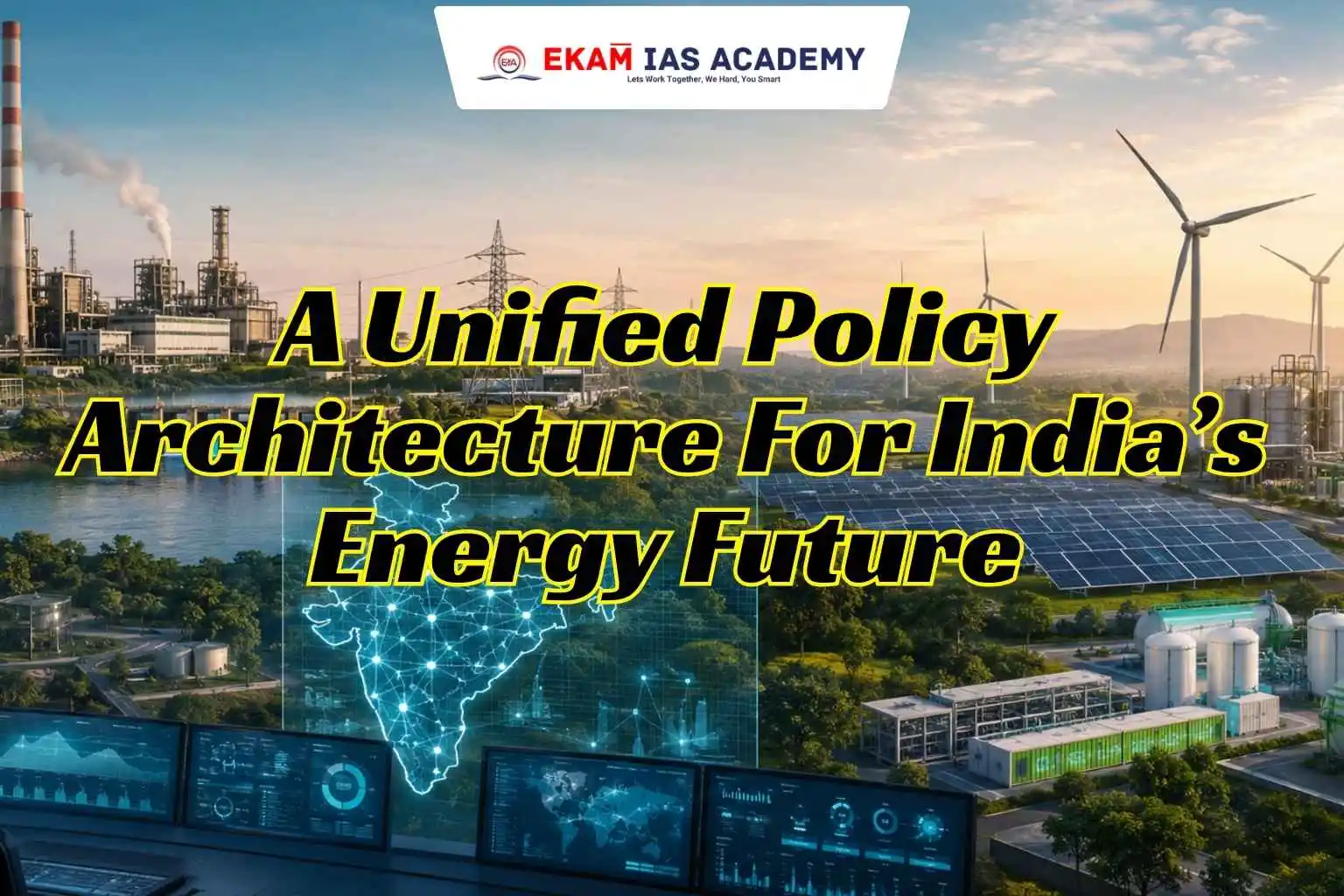
The Indian National Science Academy (INSA) released a policy brief (May 2026) proposing a unified national energy framework to align India’s diverse energy resources and institutions with long-term goals of energy self-reliance (2047) and net zero emissions (2070). This topic is important for aspirants preparing for GS3 Economy and energy policy through civils coaching in Hyderabad.
India’s Energy Landscape
• Achievements: Near universal electrification (Saubhagya), clean cooking fuel access (Ujjwala), and renewable capacity growth from 40 GW (2015) to 260 GW (2025).
Challenges:
- Dependence on imported oil and gas.
- Rising demand from industrialisation and urbanisation.
- Need to balance energy security, affordability, and sustainability.
Framework Pillars Proposed by INSA
• Adequacy: Reliable, diversified supply through conventional + emerging sources, modern grids, storage, and digital technologies.
• Access: Equitable services, stronger last-mile delivery, decentralised solutions for rural areas.
• Affordability: Innovative financing, efficient markets, and consumer safeguards to keep transition inclusive.
• Appropriate Sustainability: Context-specific solutions aligned with India’s socio-economic priorities, workforce development, and regional pathways.
Cross-Cutting Enablers
• Circular Economy: Recycling, reuse, and resource efficiency.
• Carbon Capture & Storage (CCUS): Reduce emissions from hard-to-abate industrial sectors.
• Green Hydrogen: Emerging technology for clean industrial fuel.
Phased Approach
• Near Term Priorities: Strengthen infrastructure, accelerate renewables, expand storage, and institutional coordination.
• Medium Term: Integrate low-carbon technologies, bio resources, and regional transition pathways.
• Long Term: Build a resilient, interconnected energy ecosystem with diversified sources (coal, renewables, biomass, natural gas, waste-to-energy).
Strategic Significance of Coal-to-DME
• Energy Security: Strengthens India’s resilience by reducing dependence on LPG imports, saving nearly ₹34,000 crore annually in foreign exchange.
• Inclusive Growth: Ensures affordable energy access for households and rural communities, supporting equitable development.
• Climate Commitments: Aligns with India’s Paris Agreement goals and the net-zero pledge for 2070, promoting cleaner fuels like DME.
• Innovation Ecosystem: Encourages collaboration between research labs, industry, and government, building a robust domestic innovation framework for energy transition.
Conclusion
India’s energy future requires a unified, integrated policy architecture that balances adequacy, access, affordability, and sustainability, ensuring resilience, equity, and long-term growth.