
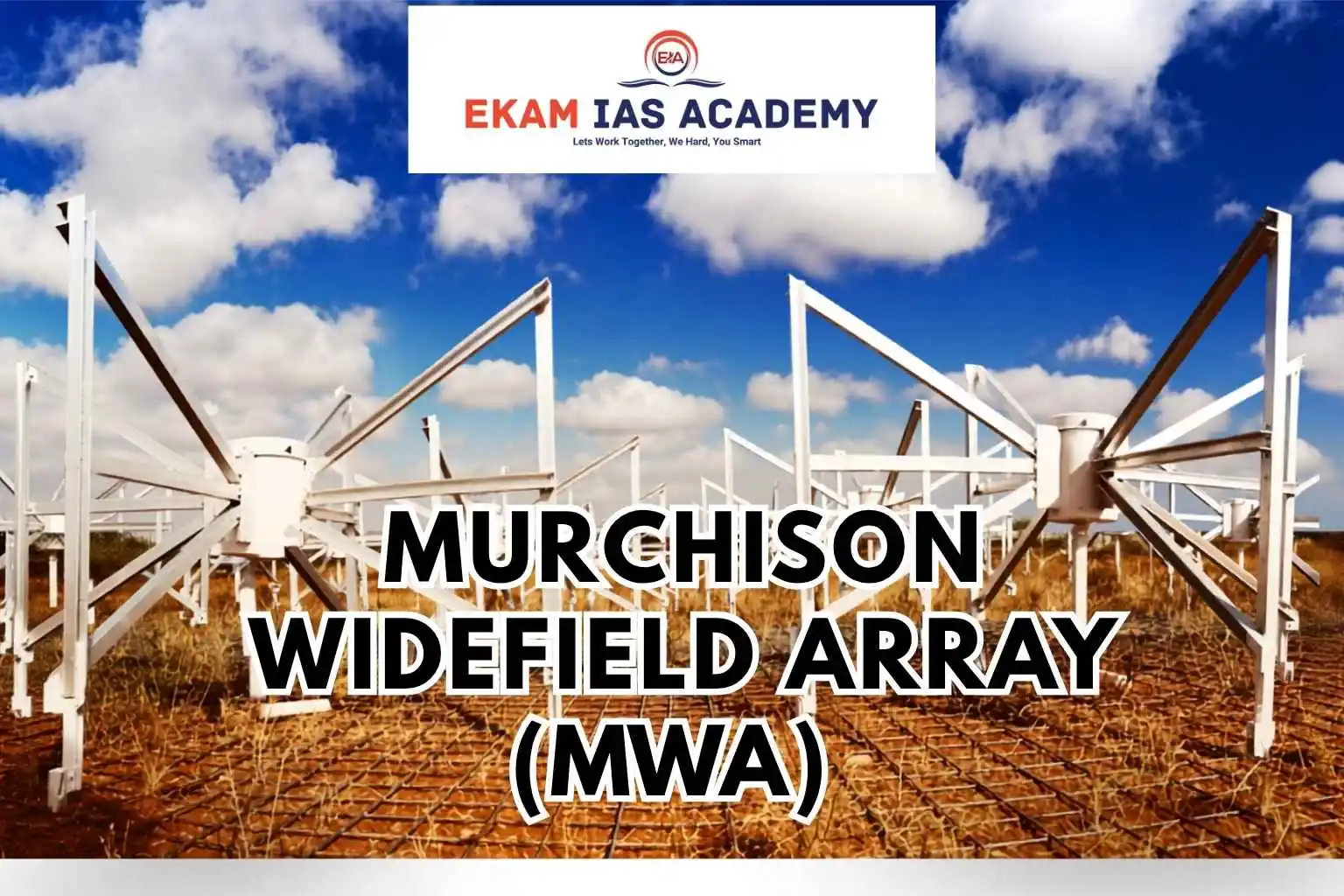
Astronomers using the Murchison Widefield Array (MWA) in Western Australia discovered a new millisecond pulsar under the Southern-sky MWA Rapid Two-metre (SMART) survey. This topic is important for aspirants preparing for GS3 Science & Technology through upsc online coaching.
About MWA
• Location: Situated at the Murchison Radio-astronomy Observatory, Western Australia.
• Collaboration: Involves 20 institutions from Australia, Canada, China, Japan, and the US; led by Curtin University.
• Structure: Comprises 4,096 spider-like antennas tuned to 70–300 MHz.
• Special Features: Wide field of view, nanosecond time resolution, digital pointing agility.
• Uses: Studies Epoch of Reionization, galaxy evolution, Sun & space weather, pulsars, fast radio bursts, and cosmic magnetism.
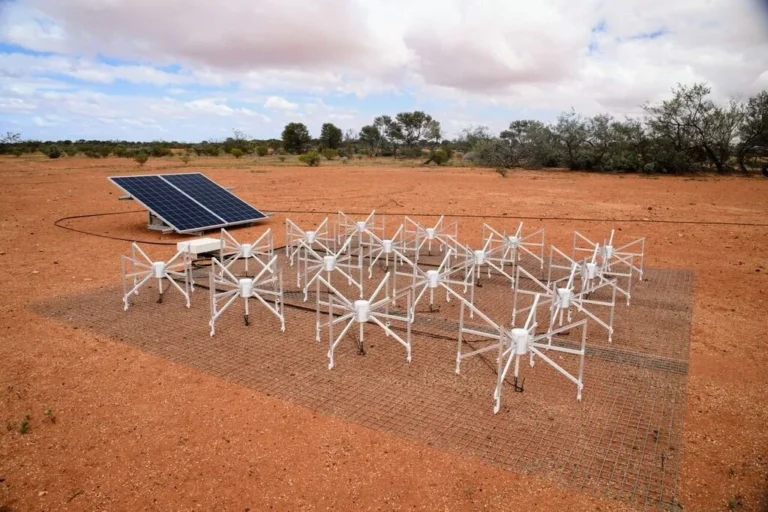
SMART Pulsar Survey
• Scope: Only low-frequency pulsar survey in the Southern Hemisphere (140–170 MHz).
• Expected Outcome: Hundreds of new pulsars to be identified.
• Significance: Provides baseline data for future Square Kilometre Array (SKA) pulsar searches.
Square Kilometre Array (SKA)
• Largest Radio Telescope: International project co-located in Australia (SKA-Low) and South Africa (SKA-Mid).
• Construction: Began on 5 December 2022; HQ in UK.
• Members: Includes India (joined Dec 2022), Australia, South Africa, UK, Canada, China, France, Germany, Italy, and others.
• Objective: To study galaxy formation, cosmic origins, and search for life.
Pulsars
• Definition: Rapidly rotating neutron stars emitting radiation pulses at intervals of seconds to milliseconds.
• Properties: Mass ~1.35 times the Sun, strong magnetic fields, beams of light sweeping Earth’s line of sight.
• Observation: Primarily detected at radio wavelengths; crucial for astrophysics and navigation studies.
Conclusion
The MWA’s pulsar discovery under the SMART survey strengthens India’s and global astronomy’s roadmap towards SKA, enhancing our ability to probe the universe’s origins and rare cosmic phenomena.