
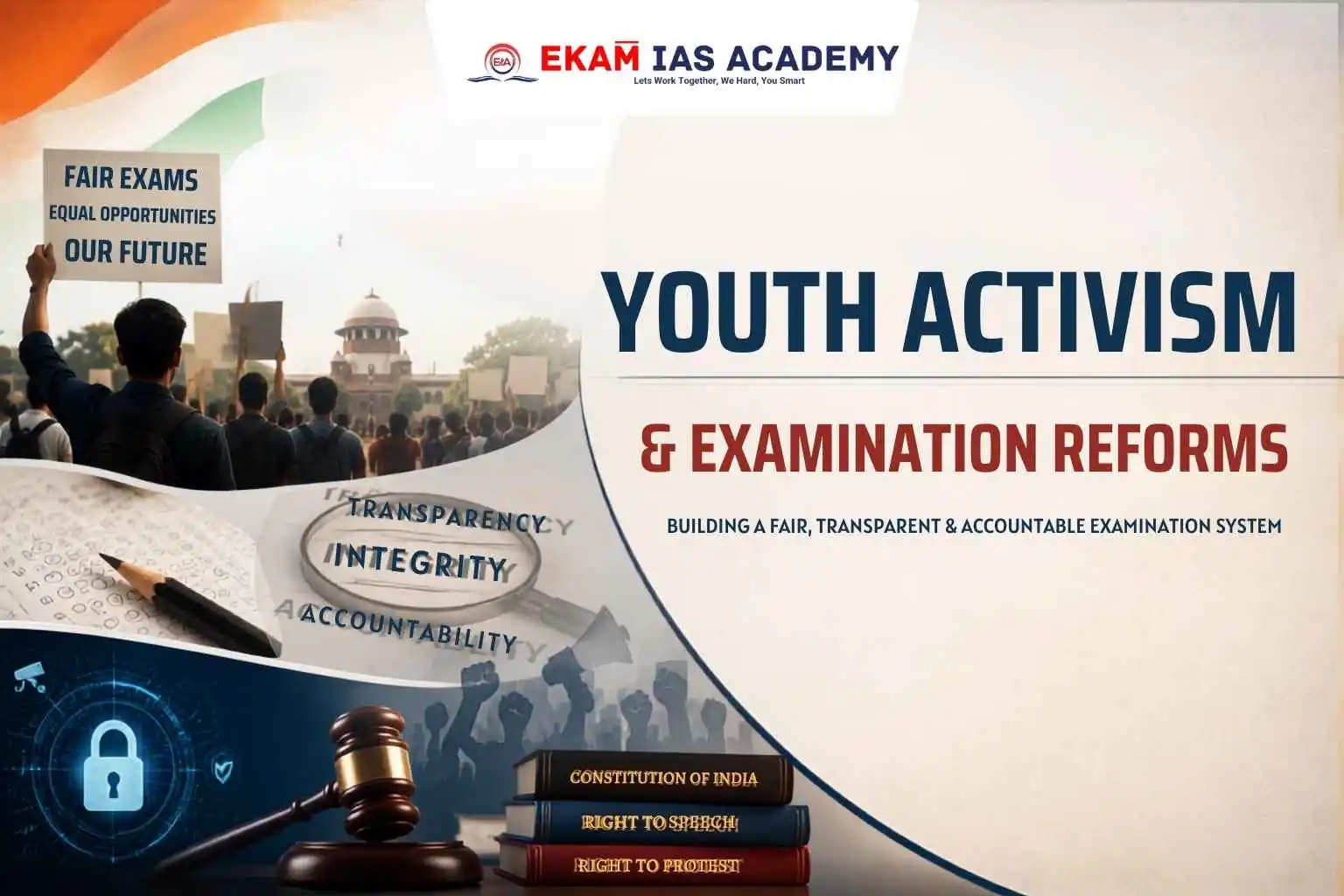
Innovator and activist Sonam Wangchuk completed a 26-day hunger strike demanding reforms in India’s public examination system. The government responded by announcing fast-track courts and stronger measures to ensure examination integrity in exams like NEET. This topic is important for aspirants preparing for governance, education reforms, and current affairs through upsc coaching in hyderabad.
Background
• India’s examination system has faced repeated controversies involving paper leaks, corruption, and administrative inefficiencies.
• Youth groups and the Citizens’ Front of Public Examinations (CFPE) raised concerns regarding fairness and transparency.
• Wangchuk’s protest highlighted the need for examination reforms and connected education integrity with broader accountability goals.
Key Concerns
1. Paper Leaks
• NEET and other competitive examinations have witnessed irregularities affecting lakhs of students.
• Such incidents weaken trust in merit-based selection systems.
2. Corruption and Malpractice
• Allegations of bribery and unfair practices undermine institutional credibility.
• Transparent recruitment processes are essential for public confidence.
3. Skill Development Gap
• Weak examination systems may fail to identify genuine talent.
• This affects workforce quality and human capital development.
4. Youth Discontent
• Student protests reflect growing concerns over fairness, accountability, and equal opportunities.
Government Response
• Fast Track Courts: Aim to complete paper leak cases within five months through speedy investigation and trial.
• Public Examinations Act, 2024: Provides strict penalties, including fines up to ₹10 crore and imprisonment up to 10 years for organised examination crimes.
• NTA Restructuring: Recruitment of professionals in information security, vigilance, and psychometrics.
• Institutional Strengthening: Focus on improving examination security and transparency.
Broader Implications
• Education Integrity: Fair examinations ensure merit-based selection for UPSC, SSC, NEET, and other competitive exams.
• Youth Empowerment: Peaceful protests demonstrate democratic participation and demand for accountability.
• Governance Dimension: Supports Digital India and Skill India objectives through transparent systems.
• Global Learning: Countries like South Korea and Singapore maintain strong examination integrity mechanisms.
Way Forward
• Strengthen digital security with AI-based monitoring of examination centres.
• Ensure independent oversight of examination agencies.
• Improve transparency in recruitment and evaluation systems.
• Promote skill-based assessments beyond rote learning.
• Integrate examination reforms with National Education Policy (NEP) 2020.
RIGHT TO SPEECH
- Constitutional Basis: Guaranteed under Article 19(1)(a) of the Indian Constitution.
- Scope: Citizens can freely express opinions, criticize policies, and share ideas through speech, writing, art, or digital platforms.
- Reasonable Restrictions: Article 19(2) allows limits in the interest of sovereignty, public order, morality, defamation, contempt of court, and national security.
- Judicial Safeguards: Courts have upheld free speech as essential for democracy.
- Example: In Shreya Singhal v. Union of India (2015), the Supreme Court struck down Section 66A of the IT Act for curbing online speech.
- Global Context: Free speech is also protected under Article 19 of the Universal Declaration of Human Rights (UDHR).
RIGHT TO PROTEST
- Constitutional Basis: Protected under Article 19(1)(b) – right to assemble peacefully without arms.
- Purpose: Allows citizens to raise grievances, demand accountability, and influence policy decisions.
- Restrictions: Subject to Article 19(3) – reasonable limits for public order, sovereignty, and morality.
- Judicial View: Peaceful protest is a fundamental right.
- Example: In Ramlila Maidan Case (2012), the Supreme Court ruled excessive police force against protestors unconstitutional.
- Democratic Significance: Protests act as a check on government power and give marginalized groups a platform.
- Global Examples:
- Hong Kong (2019): Mass protests against extradition law.
- Arab Spring (2011): Demonstrations across 17 countries reshaped governance.
INTERRELATION OF SPEECH & PROTEST
- Free speech enables citizens to voice dissent, while the right to protest provides a collective platform to act on that dissent.
- Both rights are cornerstones of democracy, ensuring accountability and participation.
Misuse (violent protests or hate speech) can invite restrictions, but genuine exercise strengthens democratic values.
Conclusion
Sonam Wangchuk’s protest highlights how youth participation can become a catalyst for systemic reforms, ensuring that India’s examination system becomes fair, transparent, and future-ready while strengthening democratic values.