

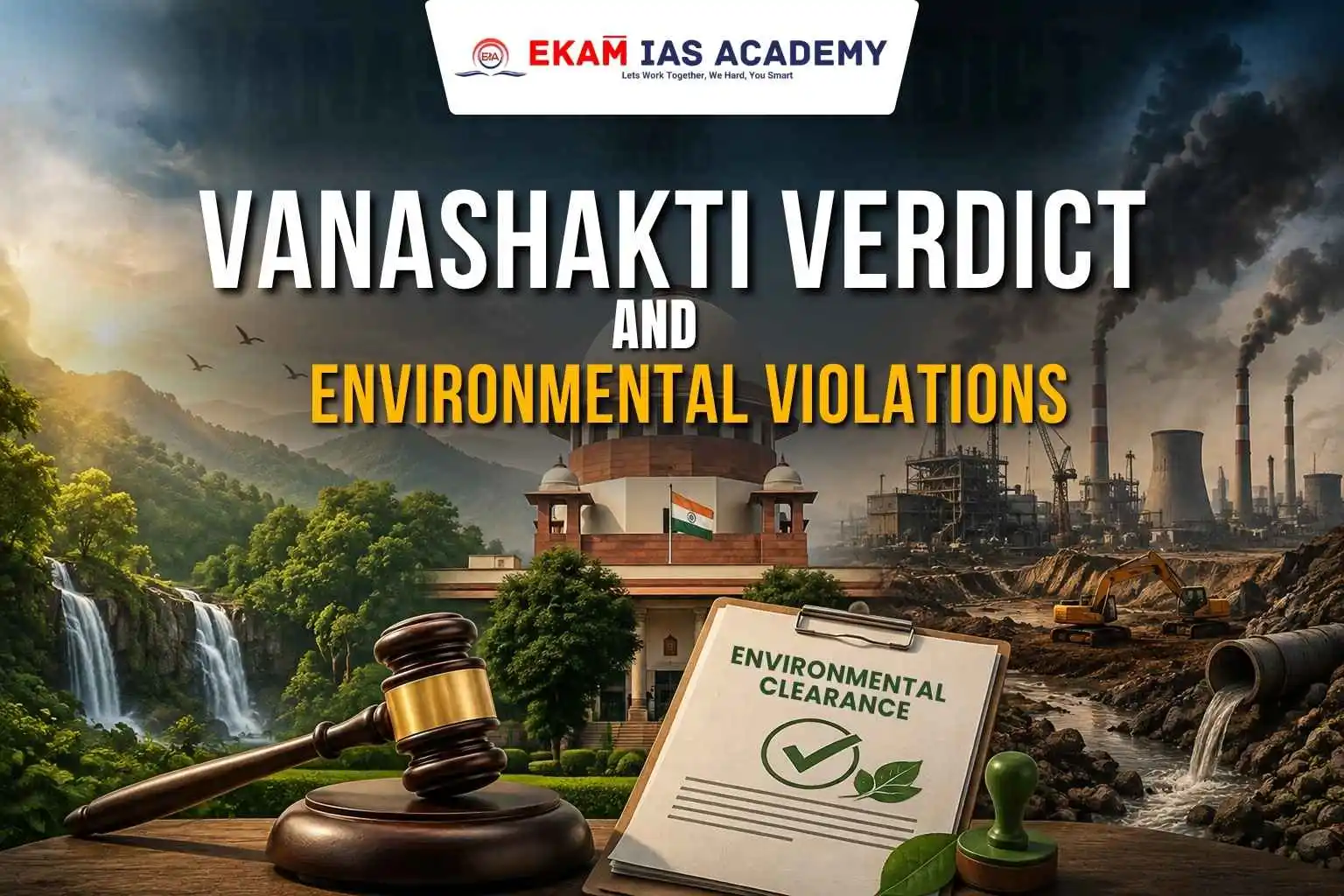
The Supreme Court’s judgment in Vanashakti vs Union of India (July 29, 2026) reaffirmed that Environmental Clearance (EC) must be obtained before commencement of projects. The verdict strengthens India’s environmental governance by preventing industries from regularising violations through administrative shortcuts.This topic is important for aspirants preparing for UPSC Preparation.
Key Highlights of the Judgment
- Mandatory Prior EC: The Court reaffirmed that projects must obtain EC before starting operations under the EIA Notification, 2006.
- Invalidation of Past Mechanisms: The 2017 Notification and 2021 Office Memorandum allowing post‑facto approvals were struck down for fresh cases.
- Statutory Power Retained: Section 3 of the Environment Protection Act, 1986 empowers the government to frame a fresh statutory scheme if required in public interest.
- Administrative vs Statutory Distinction: Office memoranda cannot override law, but statutory notifications remain permissible if backed by legislation.
- Balanced Approach: The Court acknowledged practical realities—many projects remain in violation—but insisted that any future scheme must be one‑time, transparent, and environmentally robust.
Wider Policy Impact
- Industrial & Infrastructure Projects: Thousands of units across real estate, mining, and public utilities face uncertainty due to past violations.
- Regulatory Clarity: The verdict closes the door on routine post‑facto approvals but leaves scope for a lawful one‑time framework.
- Public Interest Safeguards: Any future scheme must include damage assessment, remediation, compensation, and strict compliance checks.
Challenges
- Frequent Violations: CAG (2025) reported that over 35% of projects in India began without prior EC, reflecting weak enforcement.
- Institutional Capacity: MoEFCC has limited manpower—only ~200 officers nationwide to monitor thousands of projects.
- Investor Pressure: Industry bodies argue that closure of projects worth ₹50,000 crore could harm employment and growth.
- Public Trust: Communities often feel excluded from decision‑making; NITI Aayog notes low participation in Gram Sabha consultations during EIAs.
Way Forward
- Strengthen Enforcement: Adopt digital monitoring tools (satellite imagery, AI compliance checks).
- One‑Time Statutory Window: Government may design a limited scheme with strict safeguards, similar to EU’s Environmental Liability Directive.
- Capacity Building: Expand MoEFCC manpower; train state pollution boards.
- Community Participation: Strengthen Gram Sabha role in EIAs; ensure transparency through public disclosure portals.
- Diversified Development: Balance industrial growth with ecological sustainability; integrate SDG‑13 (Climate Action) into national planning.
Conclusion
The Vanashakti verdict ensures that environmental law remains strict yet pragmatic, mandating prior EC while allowing space for a lawful, one‑time solution to legacy violations.