


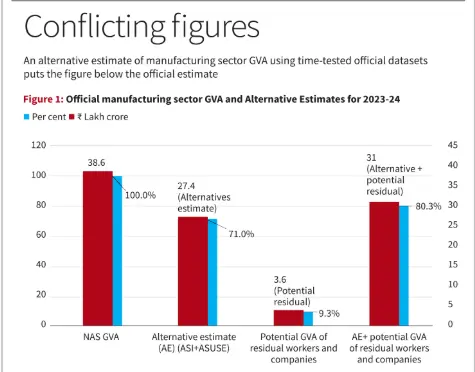
The National Accounts Statistics (NAS) 2023-24 reported Manufacturing Sector GVA at ₹38.6 lakh crore, while the Alternative Estimate (AE) showed ₹27.4 lakh crore, highlighting a significant Manufacturing GVA Gap. The discrepancy raises important questions about the measurement of Manufacturing GVA in India, the performance of the Manufacturing Sector in India, and the reliability of national accounts data.
What is GVA and GDP
- Gross Value Added (GVA): Measures the value of goods and services produced in a sector minus intermediate consumption. It reflects sectoral contribution to the economy and is crucial for understanding Manufacturing Share in GVA.
- Gross Domestic Product (GDP): Sum of GVA across all sectors plus taxes on products minus subsidies. It represents the overall economic output.
- Difference: GVA is sector-specific, while GDP is economy-wide. GVA helps track sectoral performance; GDP shows aggregate national growth.
- Understanding this distinction is important for analysing Manufacturing Share in GDP India and the role of the Indian Manufacturing Sector in overall economic growth.
The GAP in Estimates
- NAS Estimate (2023-24): ₹38.6 lakh crore.
- Alternative Estimate (ASI + ASUSE): ₹27.4 lakh crore.
- Gap: 40.9% higher in NAS, indicating a substantial Manufacturing GVA Gap.
- Residual Workers: PLFS shows 697.5 lakh employed; ASI + ASUSE cover only 532.9 lakh. Contribution of 164.6 lakh residual workers may explain part of the gap.
- Residual Companies: MCA-21 database includes 2,72,534 companies not covered in ASI. Their contribution is estimated at ₹3.6 lakh crore.
- Adjusted Potential GVA: ₹31.0 lakh crore — still 24.5% below the NAS figure, leaving ₹7.6 lakh crore unexplained.
- The gap complicates assessment of Manufacturing Growth in India and the actual contribution of the Manufacturing Industry India to the economy.
Issues in Estimation
- Methodological Differences: NAS relies on MCA-21 corporate filings, while AE uses ASI/ASUSE surveys.
- Overestimation Risk: Scaling up sample estimates of active companies may inflate output and distort estimates of Manufacturing GVA in India.
- Employment Mismatch: PLFS vs ASI/ASUSE definitions differ, complicating validation.
- Unaccounted Activities: NSO claims ASI misses value addition outside factory premises such as marketing and R&D, though evidence is limited.
- These methodological concerns form part of broader Manufacturing Sector Challenges India, particularly in assessing the true scale of Manufacturing Sector Growth India.
Way Forward
- Transparency: Make MCA-21 datasets and NSO methodologies publicly available for independent verification.
- Integration: Harmonize ASI, ASUSE, PLFS, and MCA data for consistency.
- Validation: Use employment-based technical ratios to cross-check sectoral GVA.
- Capacity Building: Strengthen statistical institutions to reduce discrepancies.
- Policy Implication: Reliable manufacturing GVA is crucial for industrial policy, investment planning, and employment strategies.
- Better estimation will help policymakers assess Manufacturing and Economic Growth India, improve industrial planning, and understand the actual Manufacturing Share in GVA and Manufacturing Share in GDP India.
Conclusion
India’s Manufacturing Sector GVA shows large statistical gaps; transparent methods, harmonized datasets, and independent checks are vital to ensure credible national accounts and sound policymaking. Accurate data is essential for evaluating the performance of the Indian Manufacturing Sector, strengthening Manufacturing Sector Growth India, and framing policies for long-term industrial development.
The issue is also important for Manufacturing Sector UPSC, Manufacturing GVA UPSC, and Manufacturing Sector Current Affairs, particularly under GS Paper 3 topics related to economic growth, industrial development, national income accounting, employment, and statistical systems.