

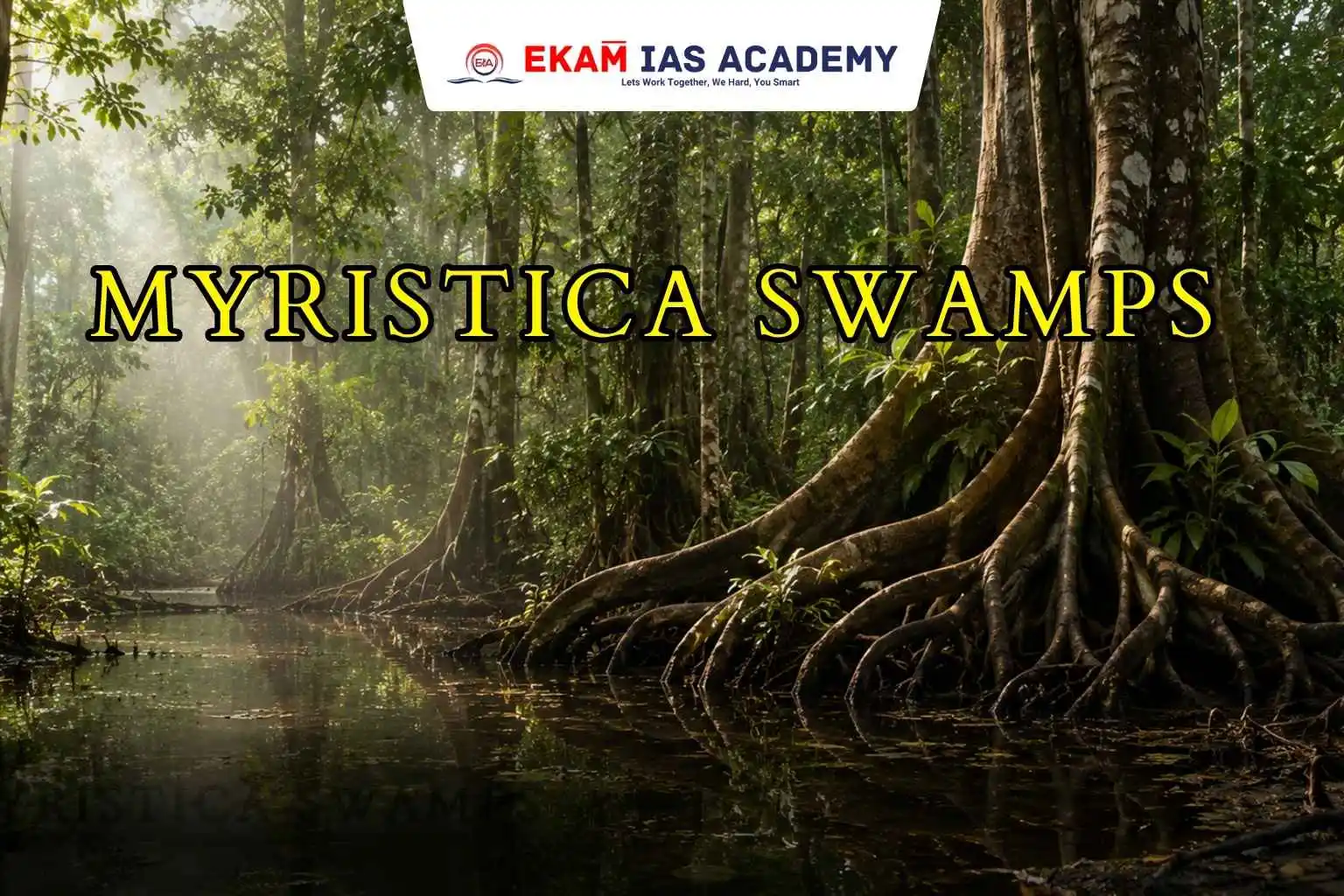
A recent study has warned that Myristica Swamps are on the verge of extinction, raising serious concerns about biodiversity loss. The decline of the Myristica Swamp Ecosystem is particularly significant for the Western Ghats, one of the major Biodiversity Hotspots India and an ecologically sensitive region.
About
- Myristica Swamps are freshwater swamp forests dominated by evergreen trees of the Myristicaceae family.
- These Freshwater Swamp Forests India are known as living fossils, representing primitive plant forms dating back nearly 500 million years.
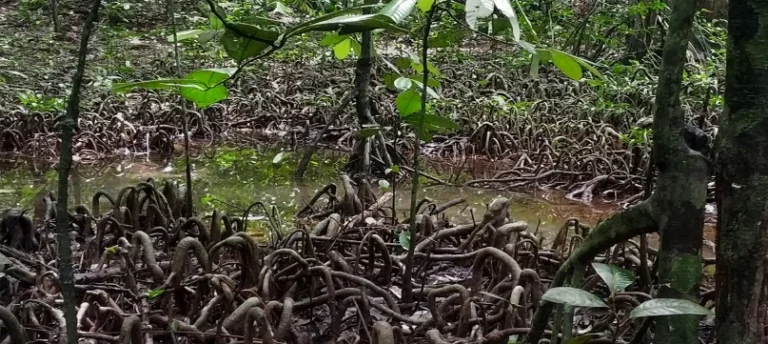
- They are characterised by trees with large protruding roots in waterlogged soils that remain inundated year-round.
- The distinctive hydrology and vegetation make Myristica Swamps Ecology different from surrounding non-swamp forests.
- The Myristica Swamp Ecosystem supports specialised plant and animal communities adapted to permanently wet conditions.
Distribution
- Myristica Swamps in India are found mainly in the Western Ghats.
- Myristica Swamps Western Ghats are especially important because of their restricted distribution and ecological sensitivity.
- Myristica Swamps Kerala constitute some of the best-known surviving patches of these rare swamp forests.
- Smaller patches exist in the Andaman & Nicobar Islands and Meghalaya.
- These ecosystems form an important component of the Wetlands of Western Ghats.
- Globally, freshwater swamp forests occupy only 2.1% of Earth’s surface.
- Their restricted distribution also makes them important habitats for Endemic Species Western Ghats.
Climatic Conditions
- Occur in tropical regions with fertile alluvial plains.
- Thrive in waterlogged soils with perennial moisture.
- Continuous water availability is essential for sustaining Myristica Swamps Ecology and the functioning of the broader wetland ecosystem.
- Such climatic and hydrological conditions make these swamps an important part of the Wetlands of Western Ghats.
Ecological Role
- Flood regulation: Act as natural buffers against floods by storing excess water.
- Groundwater recharge: Maintain perennial freshwater flow and support regional water security.
- Carbon sequestration: Store more carbon than non-swampy forests, contributing to climate regulation.
- Biodiversity hotspot: Support diverse vertebrate and invertebrate species.
- The rich Myristica Swamp Biodiversity includes species adapted to highly specialised swamp conditions.
- Protection of these habitats contributes to conserving Endemic Species Western Ghats and strengthening broader Wetland Conservation India efforts.
- Myristica Swamp Conservation is therefore important for biodiversity, freshwater security, flood control, and climate resilience.
Conclusion
The Myristica Swamps are rare, ancient ecosystems with immense ecological importance. Their decline threatens biodiversity, water security, and climate resilience. Urgent Myristica Swamp Conservation measures are needed to preserve these living fossil habitats and their unique ecological services.
Protecting Myristica Swamps in India should form part of wider strategies for Wetland Conservation India and conservation of the Western Ghats. The topic is also important for Myristica Swamps UPSC and Western Ghats UPSC, particularly under GS Paper 3 themes related to biodiversity, wetlands, ecosystems, and environmental conservation.