
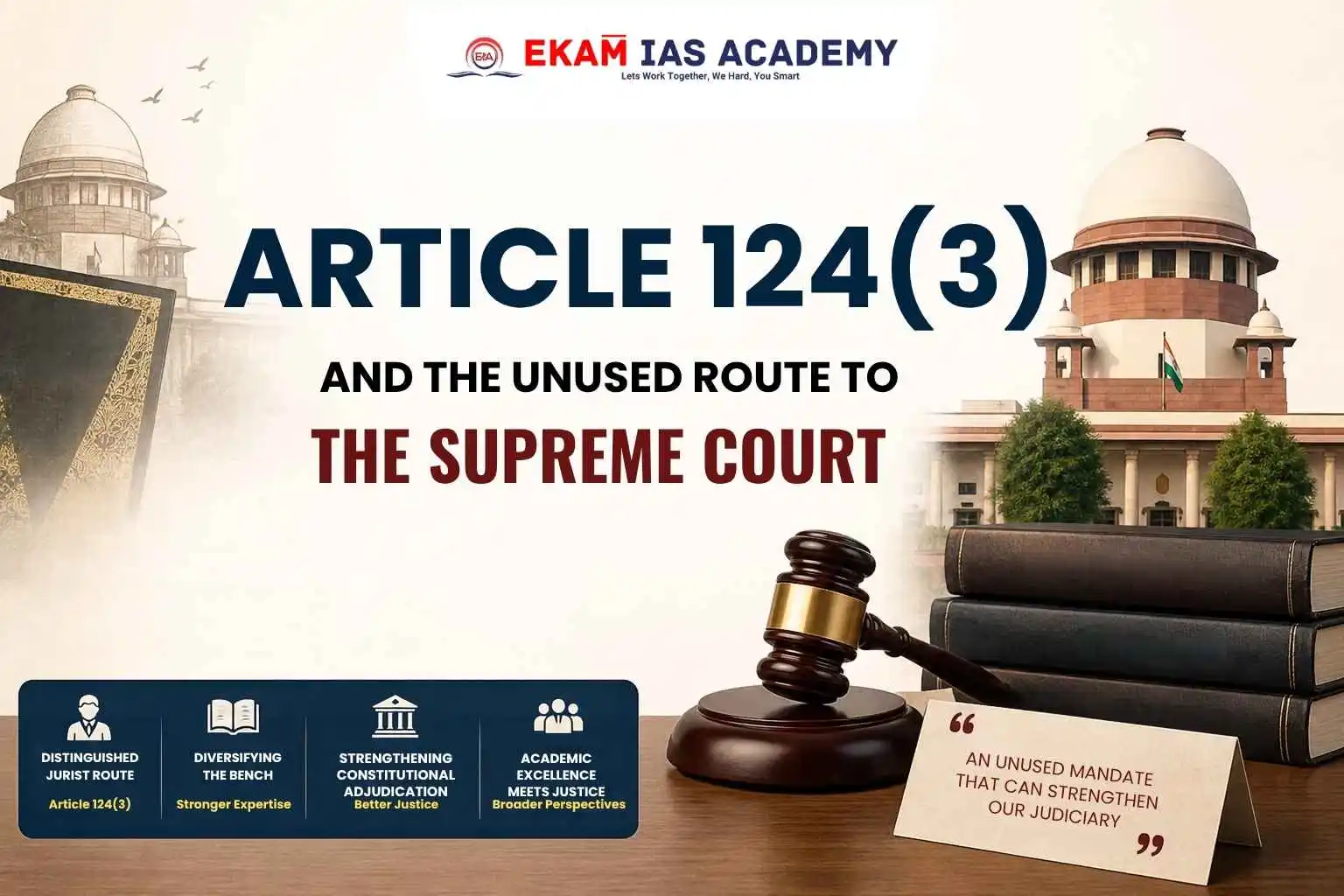
More than seven decades after the Constitution came into force, Article 124(3) — which permits the appointment of a “distinguished jurist” directly as a Supreme Court judge — remains unused. Justice Ujjal Bhuyan recently termed this an “unused mandate” and urged serious consideration of its revival to diversify the Bench. The issue is important for understanding the Article 124(3) Constitution of India, Judicial Appointments in India, and broader debates on Judicial Reforms in India.
Constitutional Provision
- Article 124(3) outlines three routes to the Supreme Court:
- High Court Judge for at least five years.
- Advocate of a High Court for at least ten years.
- Distinguished Jurist, in the opinion of the President.
- These conditions form the core of Supreme Court Judge Qualifications and the Eligibility for Supreme Court Judge under the Constitution.
- Traditionally, judges are elevated from High Courts or appointed from the Bar. The jurist route has never been exercised.
- The provision is central to understanding the Appointment of Supreme Court Judges, Supreme Court Judges Appointment India, and wider Constitutional Provisions on Judiciary.
Constituent Assembly Debates
- H.V. Kamath: Advocated broadening the talent pool beyond judges and lawyers, citing the International Court of Justice.
- M. Ananthasayanam Ayyangar: Emphasised the need for constitutional expertise, noting practising lawyers may lack exposure to complex public law.
- B.R. Ambedkar: Accepted the principle but questioned the terminology of “distinguished.”
- The framers intended to allow eminent scholars and academics entry into the apex court.
- These debates remain relevant to the evolution of the Higher Judiciary in India and contemporary discussions on the Appointment of Judges UPSC.
Who is a Distinguished Jurist?
- Constitution does not define the term.
- Broadly includes legal academics, researchers, and scholars with exceptional expertise.
- Institutional difficulty: Bar Council rules restrict full-time law teachers from practising, limiting litigation exposure.
- The ambiguity around the term also creates uncertainty within the framework of Supreme Court Judge Qualifications and Eligibility for Supreme Court Judge.
Why Unused?
- Perceived lack of suitable candidates in academia.
- Collegium dominance: Though Article 124(3) mentions the President, appointments today require collegium recommendation under the Supreme Court Collegium System.
- Lack of exploration: Neither government nor judiciary has seriously considered this route.
- Example: Legal scholar Upendra Baxi was reportedly considered but never appointed.
- The continued non-use of this route highlights larger concerns surrounding Judicial Appointments in India and the functioning of the Higher Judiciary in India.
Why Revive the Provision?
- Diversifies the Supreme Court Bench.
- Strengthens expertise in constitutional and public law.
- Introduces perspectives from legal scholarship and academia.
- Enhances capacity to address complex socio-legal and institutional issues.
- Revival of the provision could become part of wider Judicial Reforms in India by expanding the talent pool available for the Appointment of Supreme Court Judges.
- It may also enrich debates around the Supreme Court Collegium System and institutional diversity in the judiciary.
Conclusion
Article 124(3) remains unused; revival could diversify the Supreme Court, strengthen constitutional adjudication, and align with global jurist appointment practices. The provision remains highly relevant for understanding Article 124 UPSC, Indian Judiciary UPSC, Supreme Court of India UPSC, and Appointment of Judges UPSC, especially under GS Paper 2 topics relating to the Constitution, judiciary, judicial appointments, and reforms.