
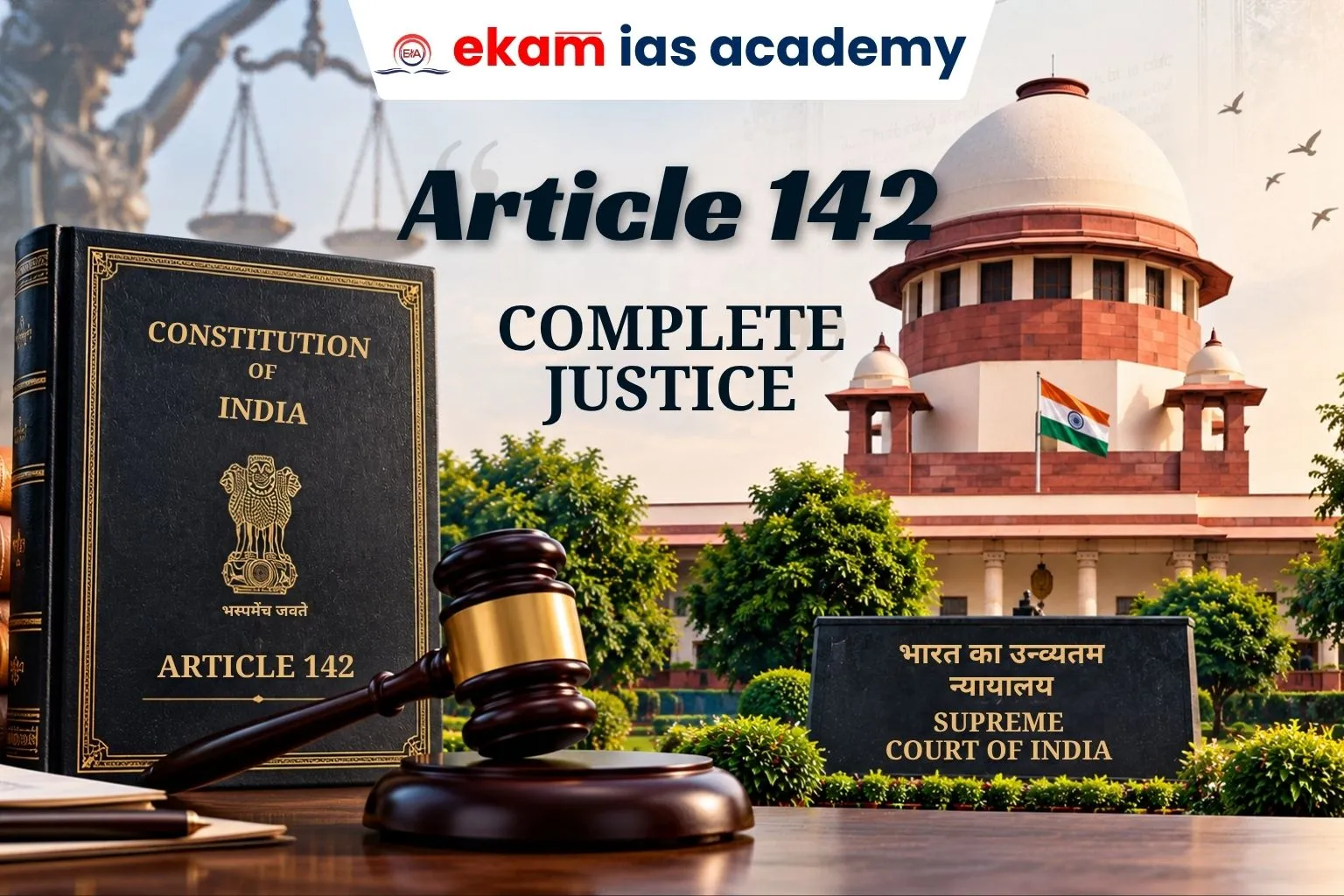
The Supreme Court invoked Article 142 to quash FIRs against protestors in the NEET-UG 2026 exam leak protests led by the Cockroach Janta Party (CJP). Nearly all FIRs were quashed except those involving individuals with serious criminal antecedents. The case has renewed debate over Supreme Court Extraordinary Powers, Article 142 and Judicial Activism, and the limits of Supreme Court Constitutional Powers.
About Article 142
- Article 142 of Indian Constitution grants the Supreme Court power to pass orders necessary for “complete justice” in any case.
- The idea of Supreme Court Complete Justice allows the Court to issue directions where ordinary legal remedies may be insufficient.
- Origin: Section 210, Government of India Act 1935 and colonial practice of “justice, equity and good conscience.”
- Drafted as Article 118 in the Draft Constitution, adopted in 1949 without major debate.
- Scope left open for judicial interpretation, making it one of the Court’s most flexible tools.
- The provision is central to understanding Complete Justice Article 142 and broader Supreme Court Powers in India.
Past Uses
- Bhopal Gas Tragedy (1989): Secured $470 million settlement, quashed criminal cases. This remains one of the most discussed examples under Article 142 Bhopal Gas Tragedy.
- Ayodhya Title Dispute: Applied to resolve ownership, awarding land to Muslim side. The use of Article 142 Ayodhya Judgment demonstrated the Court’s ability to fashion extraordinary remedies.
- A.G. Perarivalan (2022): Ordered release of convict in Rajiv Gandhi assassination case.
- Used in divorce cases, public interest matters, and governance reforms.
- Study (1950-2023): 1,579 references, 791 direct invocations, mostly civil matters.
- These cases form an important part of Article 142 Landmark Judgments and illustrate the expanding scope of Supreme Court Extraordinary Powers.
Judicial Limits
- Prem Chand Garg (1962): Orders must respect fundamental rights and existing law.
- Supreme Court Bar Association (1998): Can fill statutory gaps but not override statutes.
- Despite caution, Court often expands its scope, reinforcing its global reputation as a powerful constitutional court.
- This tension lies at the centre of debates on Article 142 and Judicial Activism and Article 142 and Judicial Overreach.
- The provision differs from High Court powers under Article 226, making Article 142 vs Article 226 an important constitutional comparison.
Concerns in CJP Case
- FIRs quashed collectively, bypassing individual scrutiny under Bharatiya Nagrik Suraksha Sanhita.
- Scholars argue this overrides criminal law provisions, turning judicial discretion into negotiated settlement.
- Raises fears of Article 142 and Judicial Overreach and bypassing established legal processes.
- The case also raises questions about how far Supreme Court Powers in India can extend while preserving statutory procedures and the rule of law.
Recurring Controversy
- Critics call Article 142 a “nuclear missile” (Jagdeep Dhankhar) or “Kamdhenu” (K.K. Venugopal) granting unlimited powers.
- Suggestions include restricting invocation to five-judge Constitution Benches for consistency.
- The controversy reflects the broader constitutional debate over balancing Supreme Court Complete Justice with judicial restraint.
- Clearer standards may help distinguish legitimate Article 142 and Judicial Activism from excessive Article 142 and Judicial Overreach.
Conclusion
Article 142 empowers the Supreme Court to deliver justice beyond statutory limits, but its open-ended nature risks judicial overreach. The CJP case underscores the tension between extraordinary powers and constitutional boundaries, reviving calls for clearer guidelines to balance complete justice with rule of law.
The topic is especially important for Article 142 UPSC, Article 142 Indian Polity UPSC, Article 142 Landmark Judgments, and Supreme Court Constitutional Powers, particularly under GS Paper 2 themes related to the judiciary, separation of powers, judicial activism, constitutional interpretation and rule of law.