
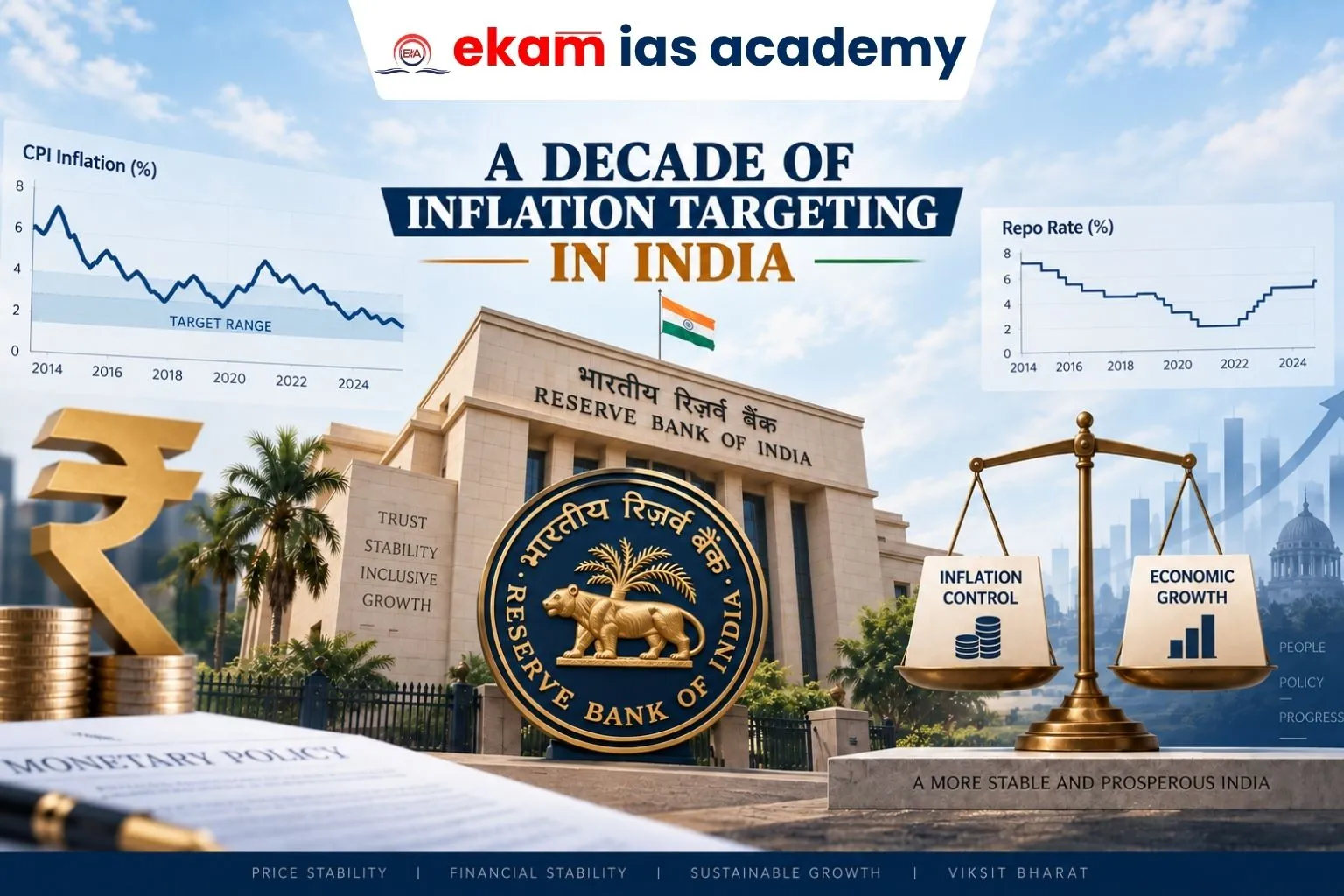
India has completed ten years of inflation targeting (IT) as a formal policy framework of the Reserve Bank of India (RBI). A Decade of Inflation Targeting in India highlights how the central bank has used a Flexible Inflation Targeting India framework to maintain inflation at 4% ± 2%. However, recent studies suggest India’s Phillips curve is flat, raising doubts about the effectiveness of Inflation Targeting in India and the broader RBI Inflation Targeting Framework.
Inflation targeting in India
- Adoption: Inflation Targeting in India was formally institutionalised through an amendment to the RBI Act, 1934 in May 2016.
- Mandate: RBI’s primary objective is to maintain price stability while keeping growth in mind, forming the basis of the Inflation Targeting Framework India.
- Target: CPI inflation at 4% ± 2% (i.e., between 2% and 6%). This is commonly referred to as the 4% Inflation Target India framework and forms the core of the CPI Inflation Target India regime.
- Review: The target is set by the Central Government in consultation with RBI once every five years under Section 45ZA.
- Renewal: In March 2026, the government extended the framework till March 2031 with the same parameters.
- The framework is therefore central to understanding RBI Inflation Targeting, Flexible Inflation Targeting India, and Inflation Targeting India UPSC.

Key Considerations of MPC in Inflation Targeting
- Consumer Price Index (CPI): Primary measure of inflation, with focus on food and fuel components. CPI remains central to the RBI Inflation Targeting Framework.
- Core Inflation: Excludes volatile items like food and fuel to assess underlying price trends.
- Supply Shocks: Impact of monsoon, agricultural output, global oil prices, and supply chain disruptions.
- Growth Trade-off: Balances inflation control with GDP growth and employment generation, making Inflation Targeting and Economic Growth a key policy concern.
- Inflation Expectations: Household and business expectations influence wage negotiations and pricing behaviour.
- These considerations form an important part of RBI Monetary Policy and the wider Inflation Targeting Framework UPSC.
Comparative Perspective
- Advanced Economies: IT works better due to strong wage-price linkages, mature labour markets, and reliable household survey data.
- India’s Reality: Informal employment and weak wage bargaining dilute the assumptions behind IT, limiting its effectiveness.
- This difference explains why the success of Inflation Targeting in India must be evaluated in the context of India’s labour market, structural constraints, and growth priorities.
Challenges of Inflation Targeting in India
- Headline Inflation Focus: Overemphasis on headline CPI ignores supply shocks, food, and fuel volatility.
- Growth Trade-off: Monetary tightening disproportionately hurts output, investment, and employment generation.
- Weak Labour Data: Lack of reliable data on job quality, wages, and productivity hampers policy design.
- Fiscal Coordination Gap: Inflation targeting works in isolation without adequate fiscal support for infrastructure, agriculture, and welfare.
- Expectation Mismatch: Household inflation expectations remain consistently higher than RBI projections, reducing credibility.
- These challenges underline the debate around Inflation Targeting and Economic Growth, the effectiveness of RBI Inflation Targeting, and the limitations of the existing Inflation Targeting Framework India.
MONETARY POLICY COMMITTEE
The Monetary Policy Committee (MPC) is India’s statutory body within the Reserve Bank of India
(RBI) that decides the country’s benchmark interest rate (repo rate) to manage inflation and
support growth. It was formally established in 2016 under amendments to the RBI Act, 1934, as
part of India’s inflation-targeting framework.
Composition of MPC
1. RBI Governor: Chairperson of the committee.
2. RBI Deputy Governor: In charge of monetary policy.
3. One RBI official: Nominated by the Central Board.
4. Three external members: Appointed by the Government of India.
5. Tenure: External members serve for 4 years, not eligible for immediate reappointment.
6. Decision Rule: Each member has one vote; in case of a tie, the RBI Governor has a casting
vote.
Conclusion
Inflation targeting disciplines policy, but India’s flat Phillips curve and mismatched expectations demand a broader approach combining growth, employment, structural reforms, and sustainable stability.
After A Decade of Inflation Targeting in India, the policy debate increasingly focuses on whether the existing Flexible Inflation Targeting India framework can effectively balance price stability with employment and economic growth. The issue is especially important for Inflation Targeting Current Affairs, Inflation Targeting India UPSC, and broader GS Paper 3 themes related to monetary policy, inflation, growth, and macroeconomic stability.