
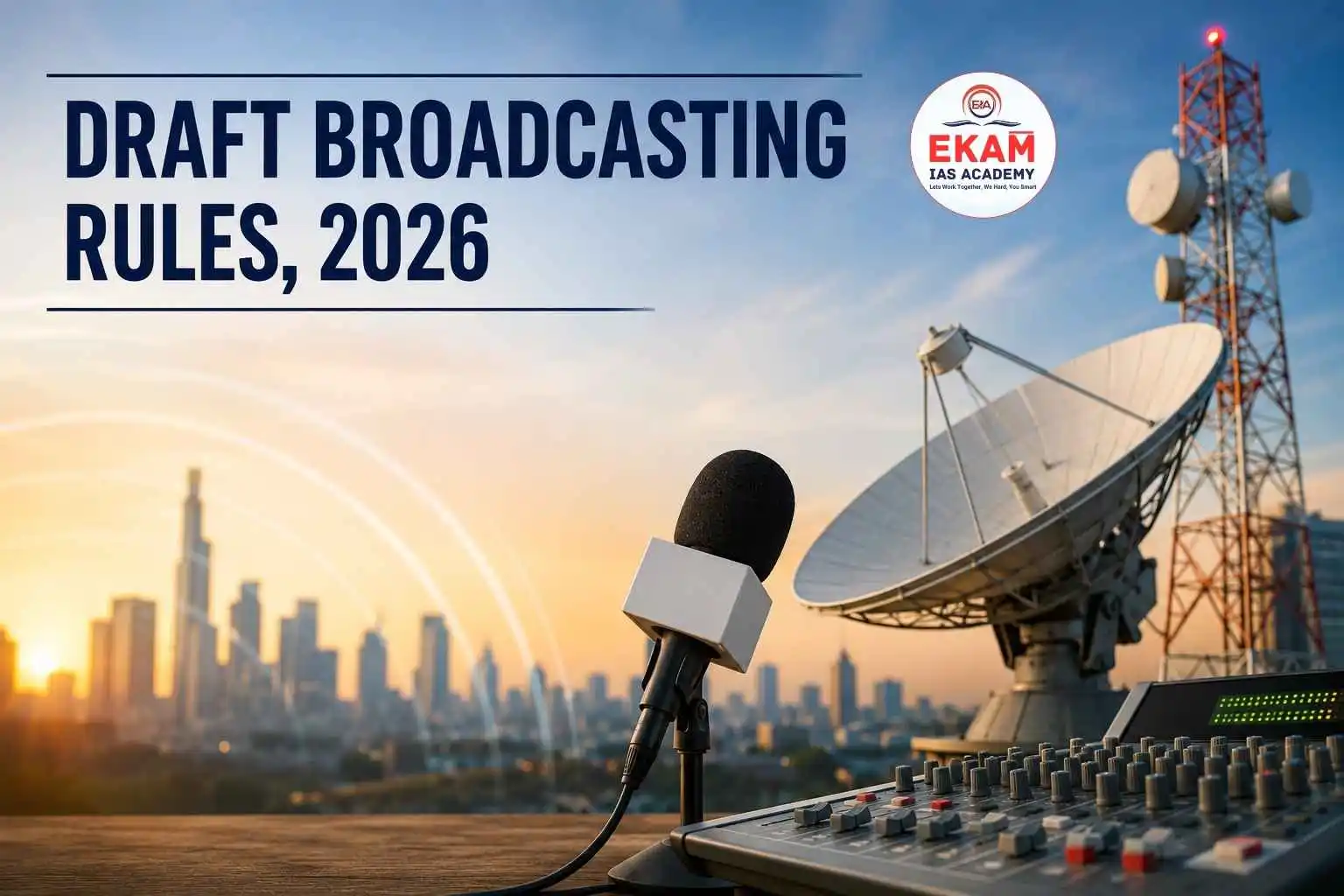
The Ministry of Information and Broadcasting (MIB) has released the Draft Telecommunications (Television, Radio and Associated Services) Rules, 2026, for consultation, aiming to create a single regulatory framework for broadcasting services in India. This topic is important for aspirants preparing for GS3 Economy and media regulation-related issues through IAS coaching in Hyderabad.
Broadcasting Regulation in India
• Definition: Broadcasting covers TV, radio, DTH, IPTV, and digital platforms.
• Historical Context: Earlier governed by fragmented guidelines under the Indian Telegraph Act, 1885.
• New Legal Basis: The Telecommunications Act, 2023 replaced colonial laws, requiring harmonised broadcasting rules.
Need for Unified Framework
Multiple Guidelines: TV uplinking, DTH, FM radio, IPTV, and community radio had overlapping compliance requirements.
Challenges:
- Overlapping approvals.
- Multiple licensing systems.
- Higher compliance burden.
- Lack of consistency across platforms.
Draft Broadcasting Rules 2026
• Consolidation: Merges earlier guidelines such as TV uplinking (2022), DTH (2001), FM radio (2011), IPTV (2008), Community Radio (2024), and HITS (2009).
• Coverage: Applies to TV channels, FM radio, community radio, DTH, IPTV, and HITS platforms.
• Public Service Broadcasting:
- TV channels: 30 minutes daily (6 AM–11 PM) on national/social themes.
- Private radio: 1 hour daily on similar themes.
- Mandatory (“shall”) instead of optional (“may”).
- Themes include education, agriculture, health, women & child welfare, science, environment, national integration, and weaker sections.
- Exemptions: Foreign audience channels may be exempt if national security is unaffected.
Ease of Doing Business Reforms
• Digital authorisation for licensing.
• Removal of Grant of Permission Agreement (GOPA) in some cases.
• Streamlined dispute resolution.
• Greater clarity for multi-service broadcasters.
• Expected to reduce compliance costs and boost investor confidence.
Way Forward
• Ensure balanced regulation that protects editorial freedom.
• Provide incentives/subsidies for public service content.
• Use digital monitoring tools for compliance.
• Strengthen stakeholder consultation before finalising rules.
• Align broadcasting reforms with Digital India and National Education Policy (NEP 2020) goals.
Conclusion
The Draft Broadcasting Rules 2026 mark a shift towards a modern, unified, and socially responsible broadcasting framework, balancing ease of business with national priorities.