
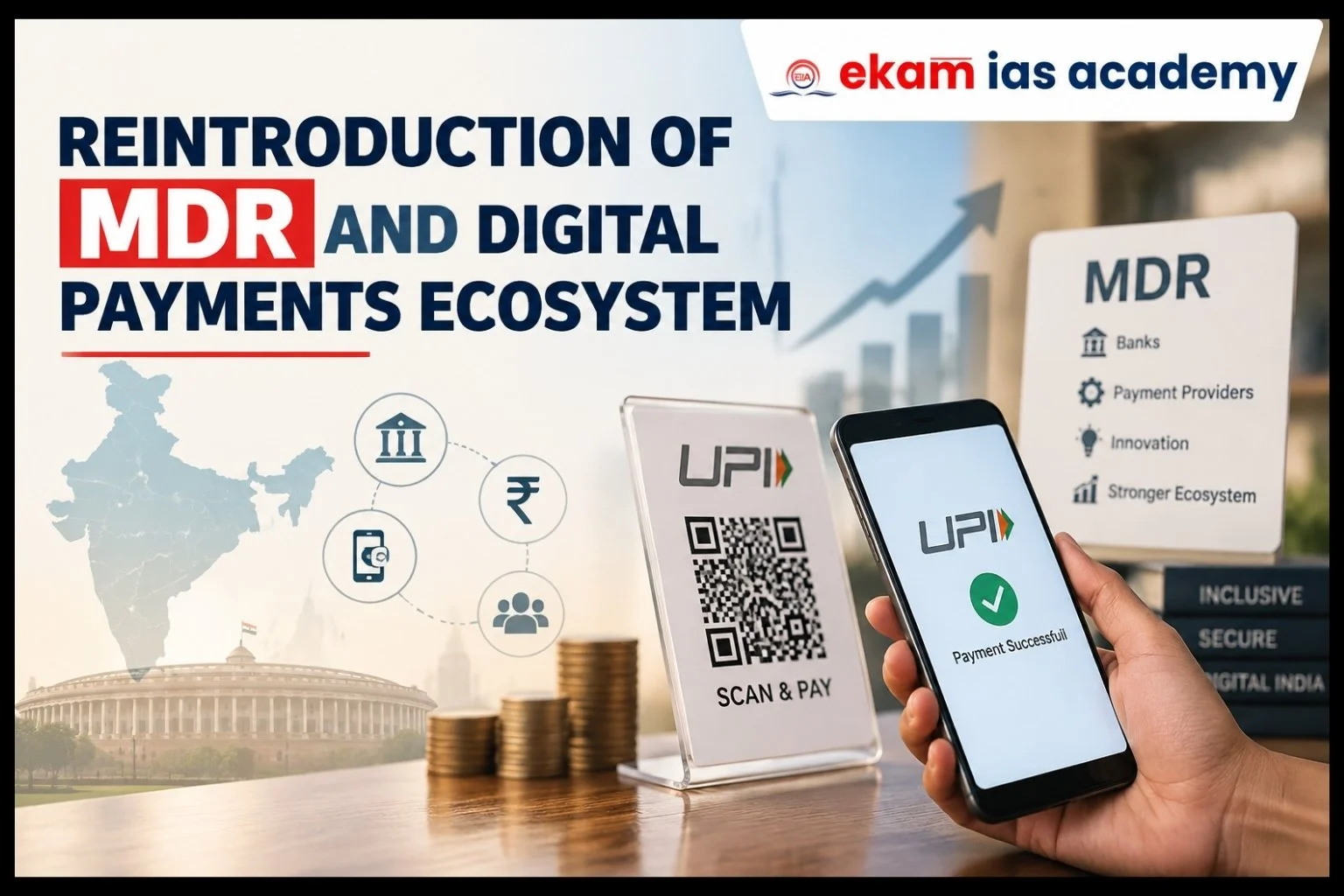
The National Payments Corporation of India (NPCI) has announced the Reintroduction of MDR on certain Unified Payments Interface (UPI) transactions. The move has renewed discussions around Merchant Discount Rate, MDR in India, and the sustainability of the rapidly expanding Digital Payments Ecosystem India.
Merchant Discount Rate (MDR)
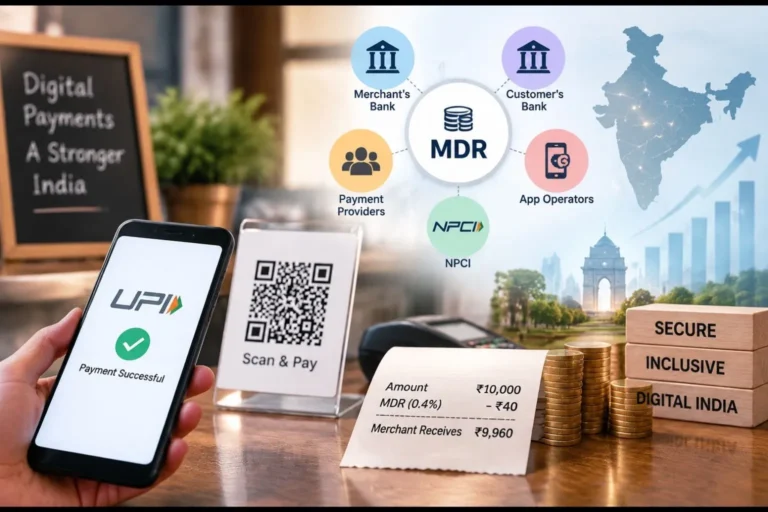
- Merchant Discount Rate (MDR) is a fee paid by a merchant to banks and payment service providers whenever a customer makes a digital payment. It is an important component of the Merchant Payment System India.
- How it Works: Suppose a customer purchases goods worth ₹10,000 and pays through UPI.
- MDR rate = 0.4%
- MDR charge = ₹10,000 × 0.4% = ₹40
- The merchant receives ₹9,960, while the ₹40 is shared among:
- Merchant’s bank (Acquiring Bank)
- Customer’s bank (Issuing Bank)
- Payment service providers/app operators
- NPCI and other ecosystem participants
Why is MDR Charged?
- Payment processing costs
- Banking infrastructure maintenance
- Fraud prevention and cybersecurity
- Technology upgrades
- Expansion of digital payment networks
The charges support the long-term sustainability of Digital Payments in India by helping financial institutions and payment providers maintain secure and efficient systems.
Key Provisions
- MDR of 0.4% applicable on Person-to-Merchant (P2M) UPI transactions above ₹2,000 under the new UPI MDR Charges framework.
- Person-to-Person (P2P) transactions remain completely free.
- Small vendors under the P2PM classification, receiving up to ₹1 lakh per month through UPI QR codes, are exempt.
- Transactions up to ₹2,000 through UPI or RuPay debit cards continue to attract zero MDR.
- MDR is capped at ₹300 per transaction for payments above ₹75,000.
- Essential sectors such as railways, telecom, insurance, fuel, and agricultural inputs will pay a flat MDR of ₹5 per transaction above ₹2,000.
- Payments related to mutual funds, securities, and stock brokers will attract a concessional MDR of 0.02%, capped at ₹300.
These provisions define the framework of UPI Transaction Charges and UPI Merchant Charges while ensuring accessibility for small users.
Rationale Behind the Move
- Supports banks, payment service providers, and fintech companies in maintaining digital infrastructure.
- Creates a long-term revenue model for payment networks.
- Generates resources for extending digital payment services in rural and semi-urban regions.
- Retains free transactions for the majority of users while imposing charges only on high-value merchant payments.
The policy reflects the importance of UPI Payment Economics, balancing transaction affordability with ecosystem sustainability.
Significance
- The new MDR framework seeks to strike a balance between financial sustainability and financial inclusion.
- While preserving free digital payments for consumers and small businesses, it provides necessary incentives for stakeholders maintaining India’s rapidly expanding UPI network.
- The move reflects the government’s effort to ensure that the world’s largest real-time payment system remains efficient, scalable, and innovation-driven.
- The development highlights the evolving nature of MDR and Digital Payments in India and the need to maintain a sustainable Digital Payment Charges India framework.
Conclusion
The Reintroduction of MDR on select UPI transactions represents a calibrated policy shift. The measure aims to sustain India’s digital payment revolution without undermining its accessibility and inclusiveness.
The debate around UPI and MDR highlights the challenge of balancing zero-cost digital transactions with the financial requirements of banks, fintech companies, and payment networks.
For UPSC aspirants, Digital Payments UPSC remains an important topic under the Indian economy, financial inclusion, digital infrastructure, and payment system reforms.