

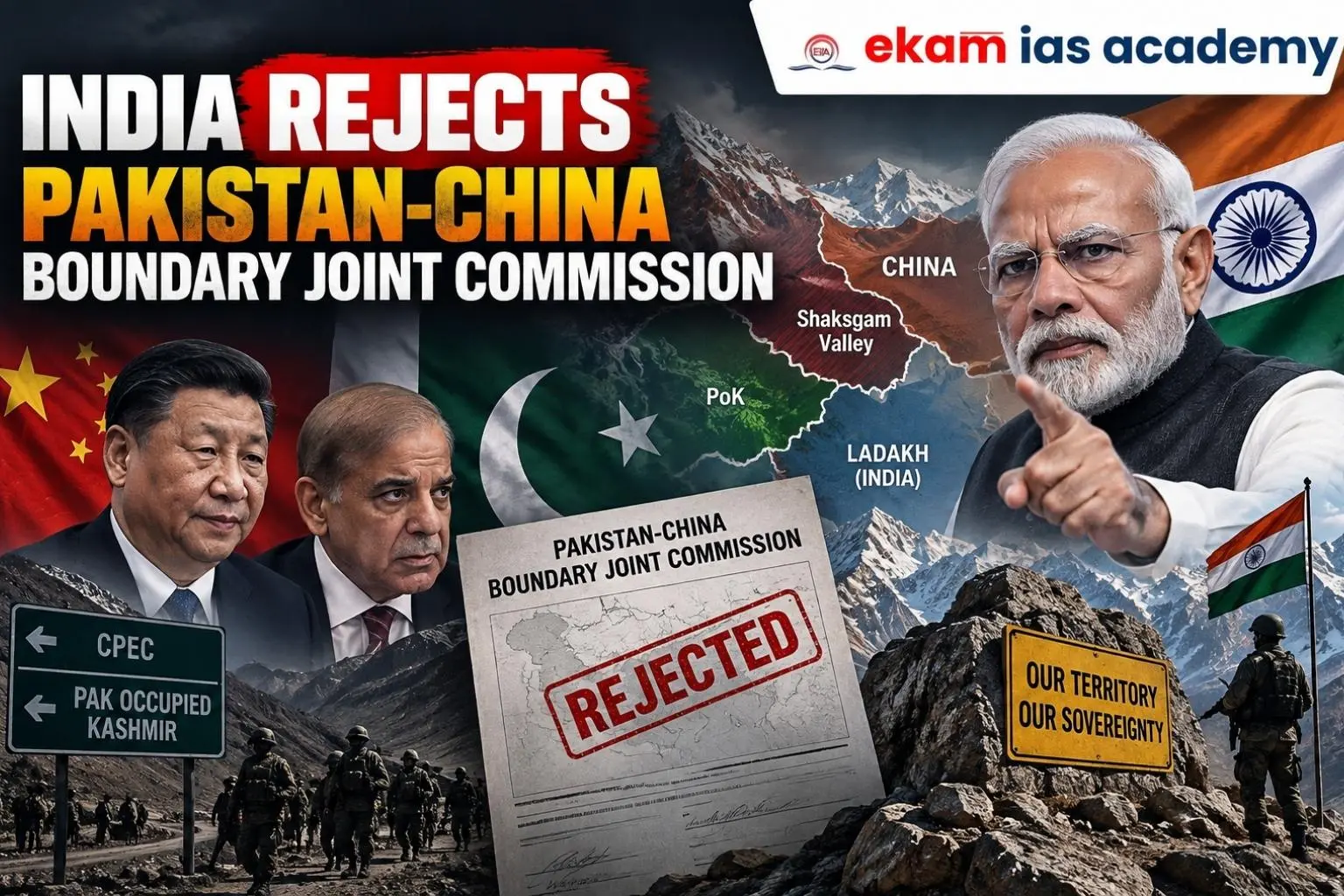
India has rejected the newly formed Pakistan China Boundary Joint Commission 2026, stating that it has no legal standing to make arrangements concerning territories that are integral parts of India but remain under Pakistan’s illegal occupation. The development is linked to the broader India Pakistan China border dispute and the Jammu Kashmir Ladakh territorial dispute.
Why Has India Rejected the Commission?
- The entire territories of Jammu & Kashmir and Ladakh are integral parts of India.
- Pakistan had no legal authority to transfer any portion of Indian territory to China.
- Any bilateral arrangement between China and Pakistan concerning these areas is legally invalid and cannot affect India’s sovereignty.
- Thus, India considers the commission an attempt to institutionalize an illegal territorial arrangement.
- India’s position also relates to the Pakistan China Boundary Joint Commission and the broader China Pakistan boundary dispute.
The Shaksgam Valley Dispute
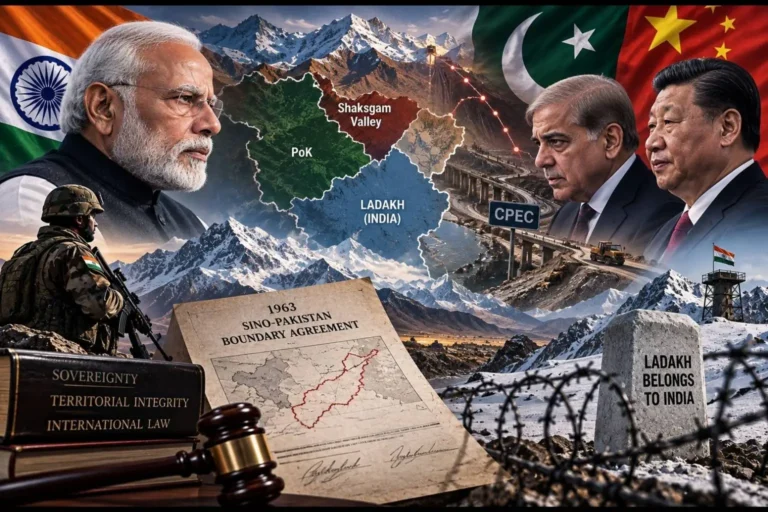
- The controversy originates from the 1963 China Pakistan Boundary Agreement, under which Pakistan ceded approximately 5,800 sq. km. of the Shaksgam Valley to China.
- Located north of the Karakoram Range.
- Lies between China’s Xinjiang region and Pakistan-occupied Gilgit-Baltistan.
- Close to the strategic Siachen-Karakoram zone.
- Forms a critical link in the China-Pakistan strategic corridor.
- Its location gives both China and Pakistan strategic depth in the western Himalayas.
- The Shaksgam Valley dispute remains an important element of the India China Pakistan territorial dispute.
Strategic Implications for India
- Threat to Territorial Sovereignty: The commission could indirectly reinforce the legitimacy of the 1963 agreement and strengthen Chinese presence in territory claimed by India.
- Strengthening the China-Pakistan Axis: Institutionalized cooperation in border administration, mapping, and connectivity deepens the strategic partnership between Beijing and Islamabad.
- Security Concerns: Enhanced infrastructure and logistics near India’s northern frontiers could improve military mobility and coordination between China and Pakistan.
- Connection with CPEC: The development complements the China-Pakistan Economic Corridor (CPEC), which passes through Pakistan-occupied Kashmir and remains a major point of contention for India.
- The issue is closely connected with the India Pakistan occupied Kashmir dispute and India’s territorial claims.
India's Response
- Rejects the Pakistan China boundary agreement of 1963 as legally invalid and unacceptable.
- Opposes all China-Pakistan arrangements involving Indian territories under occupation.
- Reaffirms Jammu & Kashmir and Ladakh as integral Indian territories.
- Lodges diplomatic protests against activities violating India’s sovereign claims.
- Challenges CPEC projects traversing through Pakistan-occupied Jammu and Kashmir.
- Maintains consistent legal position across bilateral and multilateral forums.
- India’s position remains central to the India Pakistan China border dispute and the Jammu Kashmir Ladakh territorial dispute.
Conclusion
India’s rejection of the Pakistan-China Boundary Joint Commission reflects concerns over sovereignty, security, and the growing strategic convergence between China and Pakistan. The Shaksgam Valley dispute, the 1963 China Pakistan Boundary Agreement, and developments involving Pakistan-occupied territories remain significant aspects of the India China Pakistan territorial dispute.