
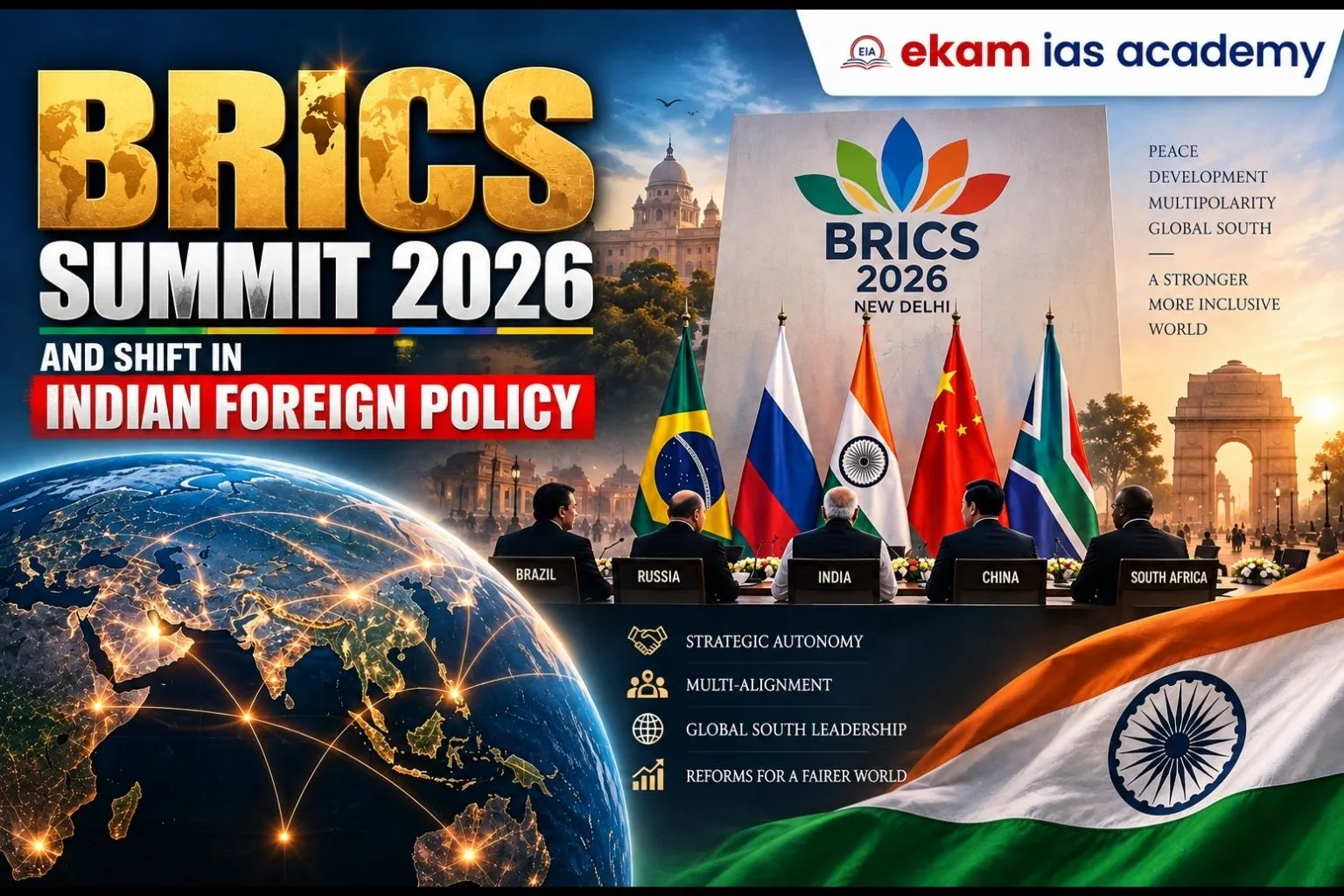
The BRICS Summit 2026, hosted by India, and the BRICS 2026 New Delhi Declaration have generated debate about whether India is moving towards a more non-Western foreign policy orientation. The BRICS Summit 2026 India discussions highlight India’s evolving approach to India Foreign Policy 2026.
Key Features of the Declaration
- Opposition to unilateral sanctions and coercive economic measures.
- Support for reform of global governance institutions, particularly the UN Security Council.
- Condemnation of civilian casualties in West Asia and support for a two-state solution to the Israel-Palestine conflict.
- Promotion of greater use of national currencies in trade settlements.
- Demand for a more inclusive and representative international order.
- These positions broadly reflect concerns shared by the India and Global South, Global South and emerging economies.
- The BRICS New Delhi Declaration 2026 reflects India’s emphasis on India Strategic Autonomy and a more representative international order.
Why It Is Not a Return to Non-Alignment
- Non-alignment emerged in a bipolar Cold War world.
- Presently, India seeks to become an influential pole in a multipolar world.
- India simultaneously participates in: BRICS, Quad, G20, SCO, I2U2, Indo-Pacific partnerships.
- This demonstrates a policy of multi-alignment, not neutrality.
- BRICS and Multipolar World discussions illustrate India’s attempt to engage multiple power centres while maintaining strategic flexibility.
Diplomatic Importance
- Reinforces India’s engagement with diverse power centres.
- Enhances India’s role as a bridge between the Global South and developed economies.
- Strengthens India’s image as an independent actor capable of engaging rival blocs.
- The BRICS India Foreign Policy approach also supports India’s engagement with emerging economies and reinforces India Global South Leadership.
Economic and Geopolitical Implications
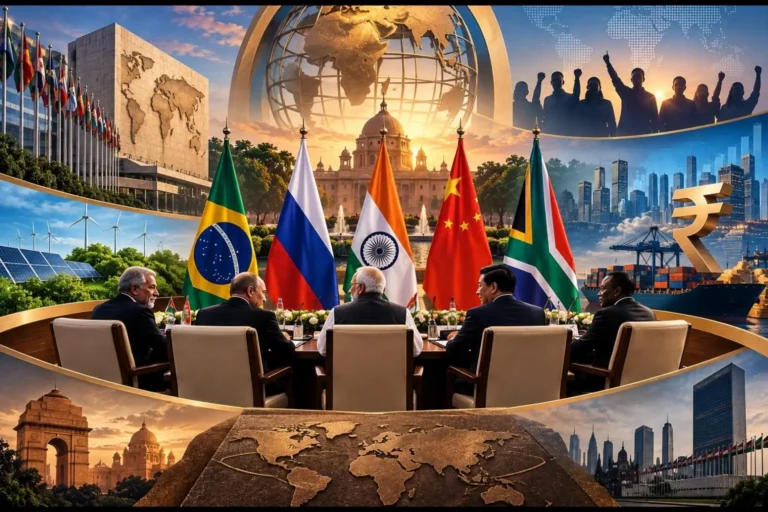
- BRICS discussions on local currency settlements aim to reduce excessive dependence on the U.S. dollar.
- India supports flexible payment mechanisms but remains cautious about any system dominated by a single alternative currency.
- BRICS strengthens demands for:
- UN reforms
- Greater representation for developing countries
- Multipolarity in international affairs
- These developments are relevant to India Foreign Policy 2026 and India’s broader economic and geopolitical engagement through BRICS and India.
Challenges Ahead
- Balancing relations between the United States, Russia, China, and the Global South.
- Managing differences within BRICS, particularly with China.
- Ensuring that economic interests are protected amid growing geopolitical competition.
- Maintaining India Strategic Autonomy while strengthening cooperation through BRICS India Foreign Policy.
Conclusion
The BRICS Summit 2026 does not indicate a fundamental shift in Indian foreign policy. The summit reinforces India’s aspiration to act as a bridge between competing geopolitical camps and as a leading voice of the Global South. The BRICS Summit 2026 India discussions therefore highlight India’s continuing preference for multi-alignment and strategic autonomy rather than a return to Cold War-era non-alignment.