

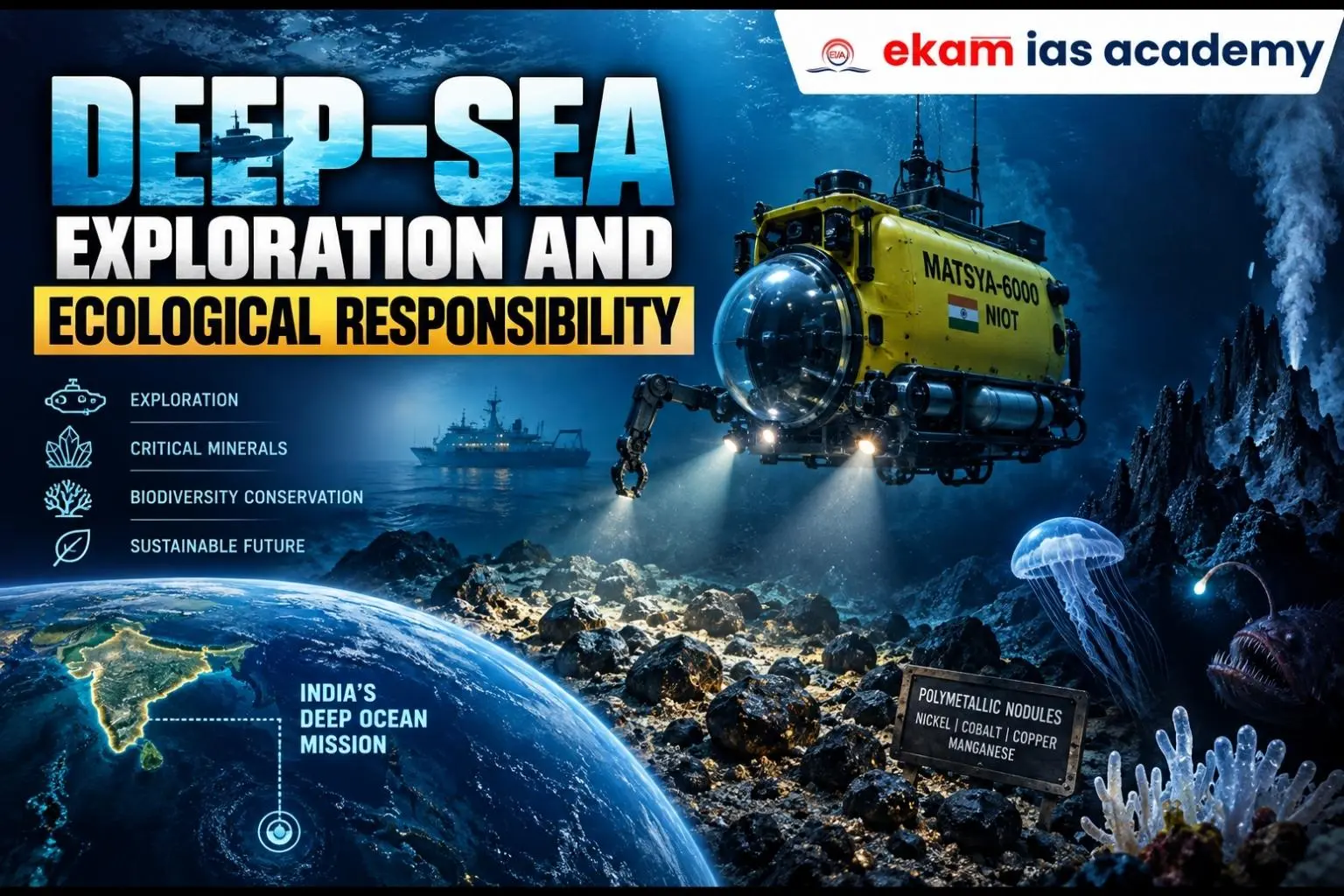
Deep-Sea Exploration and Ecological Responsibility is becoming increasingly important as India expands its Deep-Sea Exploration in India capabilities through the Deep Ocean Mission India. India is rapidly developing technologies for deep-sea exploration, underwater robotics and seabed mineral research under the Deep Ocean Mission.
India’s Deep-Sea Ambitions
- The Deep Ocean Mission India focuses on deep-sea mining technology, crewed submersibles, biodiversity research, ocean surveys, climate services, and ocean-based energy and freshwater.
- India has three International Seabed Authority (ISA) contracts covering about 95,000 sq km for exploration of polymetallic nodules and sulphides in the Indian Ocean.
- MATSYA-6000, developed by NIOT, is designed to carry three persons to a depth of 6,000 metres.
- NIOT has also developed Deep-Sea Exploration Technology for collecting polymetallic nodules from deep seabeds.
Why Deep-Sea Minerals Matter
- Polymetallic nodules and sulphides contain minerals such as nickel, cobalt, copper and manganese.
- These minerals have potential applications in:
- Batteries and electric mobility.
- Renewable-energy technologies.
- Electronics and advanced manufacturing.
- Strategic and defence industries.
- Indigenous Deep-Sea Mining India capabilities can reduce excessive dependence on foreign mineral supply chains.
Ecological Concerns
- Deep oceans contain ecosystems that remain poorly studied, making Deep-Sea Ecosystem Conservation and Deep Ocean Biodiversity important.
- Mining can potentially cause:
- Physical disturbance of seabed habitats.
- Sediment plumes affecting marine organisms.
- Noise and light pollution.
- Loss of biodiversity and disruption of food chains.
- Deep-Sea Mining Environmental Impact remains a major concern due to the lack of adequate baseline data to predict long-term ecological consequences.
- Therefore, technological capability should not automatically become commercial exploitation, particularly given concerns over Deep-Sea Mining and Biodiversity.
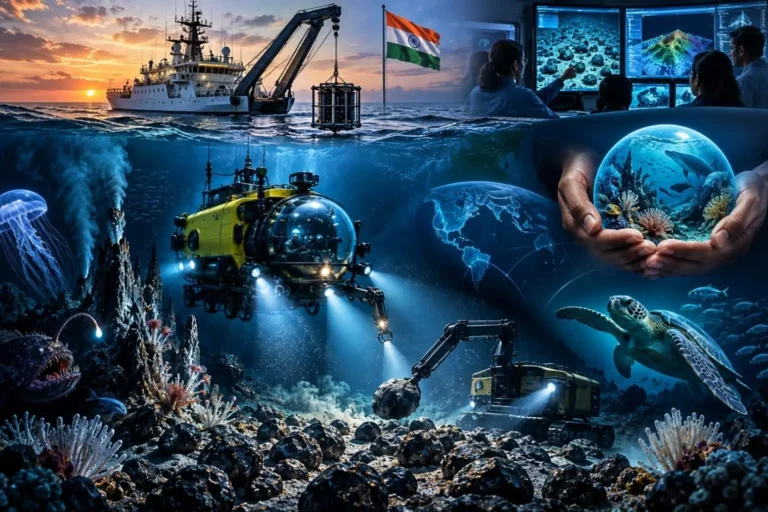
Sustainable Development Perspective
- India can follow the precautionary principle: where serious environmental risks are uncertain, scientific evidence should precede irreversible activity.
- Before commercial extraction, India should assess whether minerals are genuinely necessary.
- This is consistent with Mission LiFE and the circular economy, which emphasise reducing resource consumption rather than continuously expanding extraction.
- Sustainable Ocean Exploration should therefore balance technological development with Marine Ecosystem Protection.
Global Governance
- The BBNJ Agreement, which entered into force in January 2026, strengthens international cooperation for conservation and sustainable use of marine biodiversity beyond national jurisdiction.
- It covers marine genetic resources, area-based management, environmental impact assessments and technology transfer.
- India should align its deep-sea activities with UNCLOS, ISA rules and emerging BBNJ governance, supporting Ocean Biodiversity Conservation.
Way Forward
- Complete detailed biodiversity and environmental baseline studies.
- Make independent Environmental Impact Assessments (EIAs) mandatory before commercial mining.
- Adopt adaptive and area-based management with strict ecological thresholds.
- Invest in recycling, mineral substitution and a circular economy.
- Promote transparent sharing of scientific data.
- Separate scientific exploration from any automatic decision to undertake commercial extraction.
- Strengthen Deep-Sea Ecology UPSC perspectives by integrating conservation with Deep-Sea Mining UPSC and India Deep Ocean Mission UPSC preparation.
Conclusion
True ocean leadership lies not merely in reaching the deepest parts of the sea, but in ensuring that scientific progress protects the natural capital on which future development depends. Deep-Sea Exploration and Ecological Responsibility must therefore advance together.