

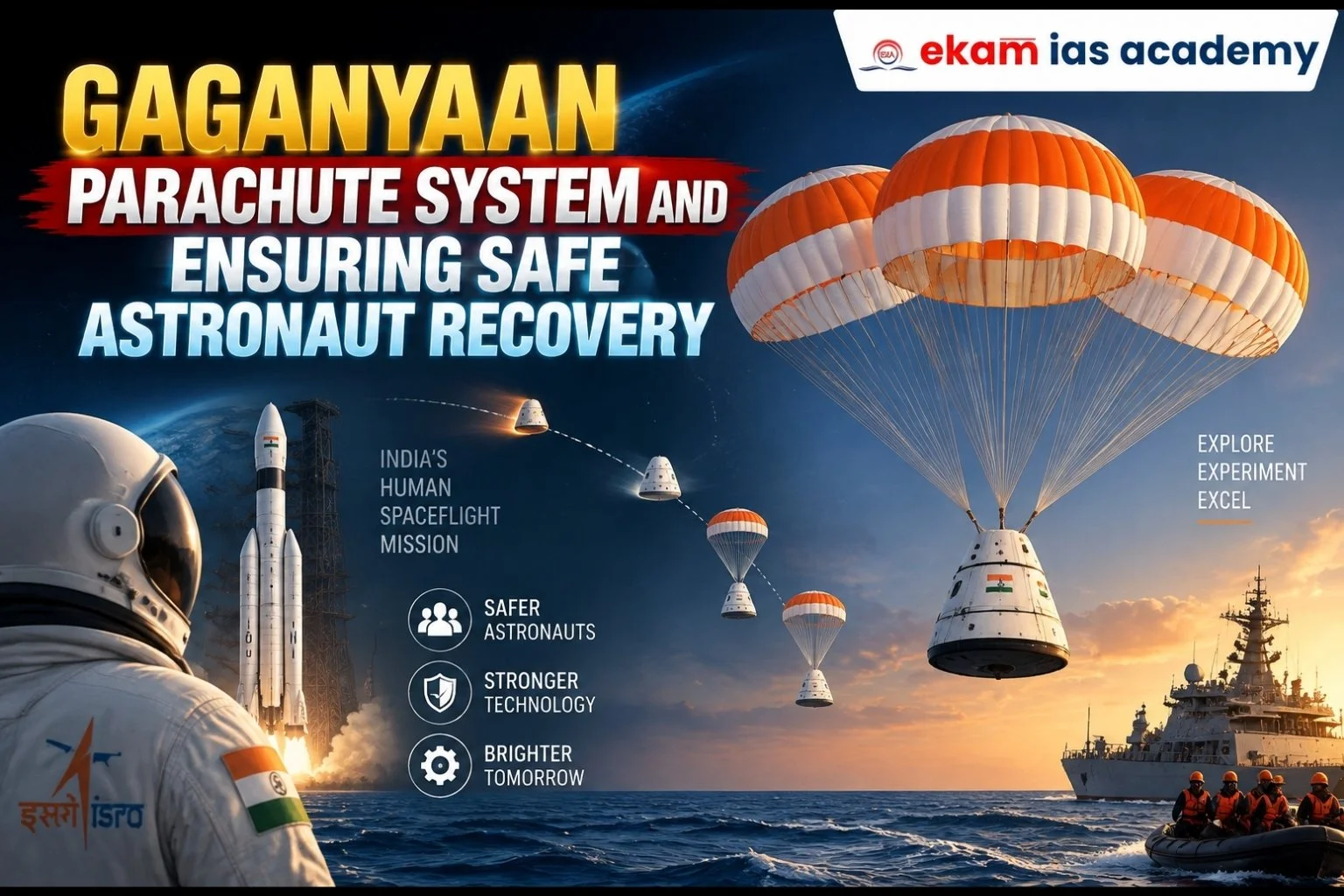
India is conducting successive tests to validate the Gaganyaan Parachute System and recovery mechanism of the Gaganyaan Crew Module before its human spaceflight mission. The Gaganyaan Mission India represents India’s ambitious Indian Human Spaceflight Programme, where astronaut safety and reliable recovery systems are critical components.
Why Does Gaganyaan Need Parachutes?
- During atmospheric re-entry, the Crew Module travels at very high speed.
- Atmospheric drag removes a major portion of this velocity, but cannot alone reduce it to a safe landing speed.
- Parachutes provide controlled deceleration and enable a relatively gentle sea landing.
- Since human life is involved, the Gaganyaan Astronaut Recovery system must have redundancy, reliability and fault tolerance.
- The Gaganyaan Crew Recovery System ensures safe return of astronauts after completing the mission.
Multi-Stage Parachute System
- The Gaganyaan Parachute System India uses 10 parachutes of four types, each performing a specific function:
- Apex Cover Separation parachutes – 2: Help separate the protective cover before the main recovery sequence.
- Drogue parachutes – 2: Stabilise the Crew Module and initially reduce its speed.
- Pilot parachutes – 3: Extract the three larger main parachutes from their compartments.
- Main parachutes – 3: Provide the major final-stage deceleration before splashdown.
- The three main parachutes provide redundancy, with two designed to be sufficient for a safe landing.
- This multi-layered Gaganyaan Safe Astronaut Landing mechanism strengthens mission reliability.
Why Is Deployment Done in Stages?
- Opening a large parachute at very high speed can generate excessive opening shock, damaging the canopy and imposing dangerous loads on astronauts.
- Therefore, smaller parachutes act first, followed by larger ones as the spacecraft slows.
- Reefing initially restricts the canopy’s opening; later disreefing allows full inflation at a safer speed.
- The parachutes must also be ejected beyond the turbulent wake behind the blunt Crew Module for reliable deployment.
- This staged process is an important part of Gaganyaan Re-entry Technology and the overall Gaganyaan Deceleration System.

How Are They Tested?
- Rail Track Rocket Sled: High-speed deployment is tested using rocket-powered sleds at DRDO’s TBRL facility in Chandigarh.
- Air-drop tests: Simulated Crew Modules are released from aircraft to test the integrated parachute sequence under realistic atmospheric conditions.
- Integrated testing: Different combinations and abnormal conditions, such as delayed deployment or asymmetric loading, are examined.
- ISRO’s Integrated Main Parachute Air Drop Tests (IMAT) further validate main-parachute performance.
- These trials are important milestones in the ISRO Gaganyaan Mission and its safety validation process.
Institutional Cooperation
- ISRO: Mission and Crew Module development and system integration.
- ADRDE, Agra: Major role in parachute development.
- DRDO/TBRL: Advanced parachute testing facilities.
- Indian Air Force and Navy: Support air-drop testing and sea-recovery operations.
Significance
- Strengthens India’s human-spaceflight capability.
- Promotes indigenous expertise in aerospace materials, precision manufacturing and safety systems.
- Creates technological foundations for future space-station and advanced crewed missions.
- Enhances India’s capabilities in Human Spaceflight India initiatives and future space exploration programmes.
- The development of the Gaganyaan Crew Escape System and recovery technologies demonstrates India’s focus on astronaut safety.
Conclusion
Gaganyaan’s redundant, multi-stage parachute architecture shows that India’s human-spaceflight ambitions depend not only on reaching space, but on bringing astronauts safely back to Earth. The Gaganyaan Current Affair is highly relevant for Gaganyaan UPSC and ISRO Space Missions UPSC preparation as it highlights India’s advancements in space technology and crew safety systems.