
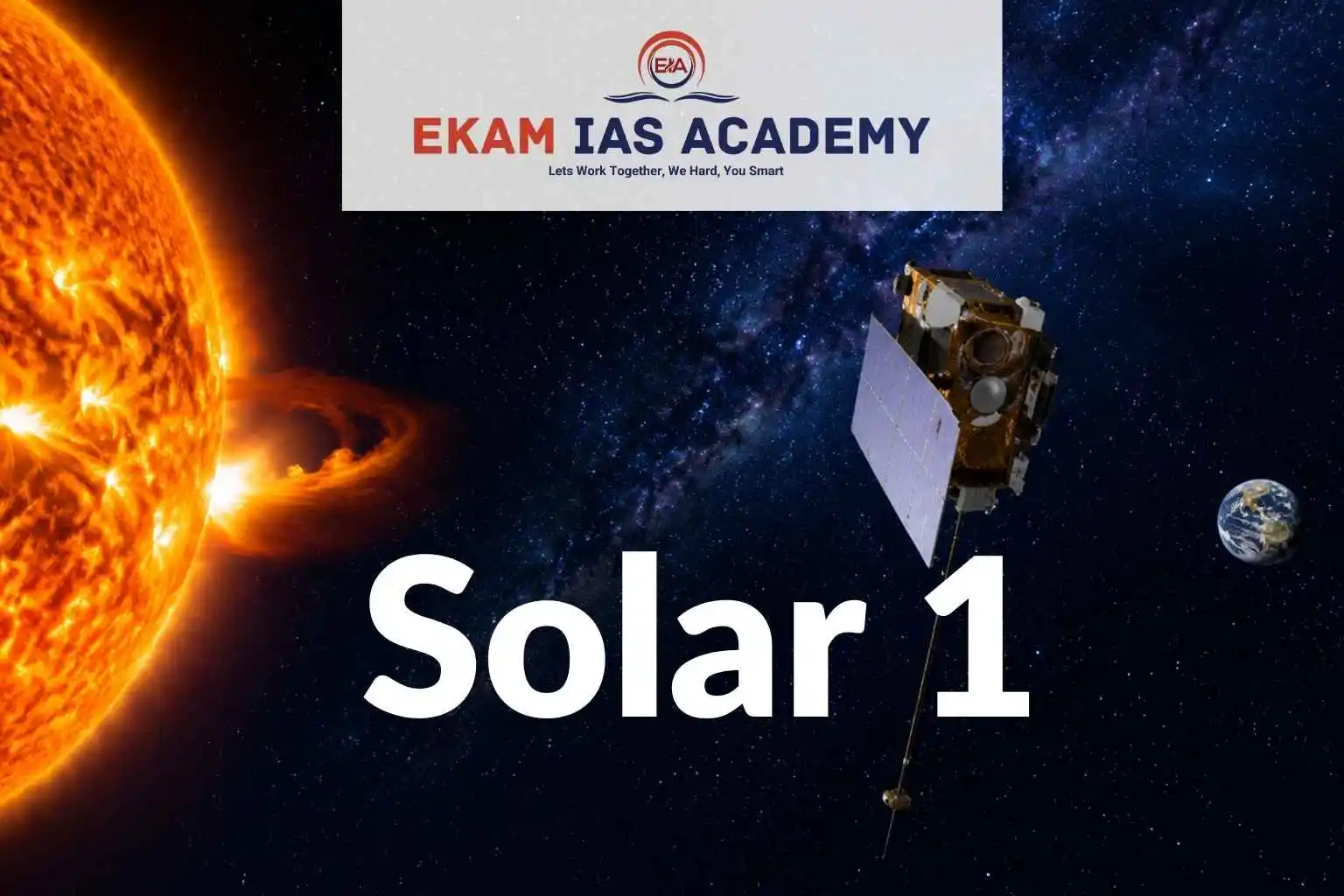
The United States has launched SOLAR 1, its first satellite exclusively for space weather monitoring, to provide faster warnings of solar storms that threaten GPS, communications, satellites, and power grids. This topic is important for aspirants preparing for GS3 Science and Technology and space-related issues through civils coaching in Hyderabad.
SOLAR 1
• First Dedicated Satellite: Designed solely for continuous operational observation of solar activity and space weather events.
• Operator: Managed by the U.S. National Oceanic and Atmospheric Administration (NOAA).
• Renaming: Originally called SWFO L1, later renamed Space Weather Observations at L1 to Advance Readiness – 1 (SOLAR 1).
• Launch Details: Launched on 24 September 2025 aboard a SpaceX Falcon 9 rocket.
• Orbit: Positioned at Sun–Earth Lagrange Point 1 (L1), about 1.6 million km from Earth, enabling uninterrupted solar monitoring.
Mission Features
• Continuous Monitoring: Tracks solar wind and coronal mass ejections (CMEs) before they reach Earth.
• Compact Coronagraph: Specialized instrument to observe the solar corona and detect solar eruptions.
• Rapid Transmission: Sends CME images to NOAA’s Space Weather Prediction Center within 30 minutes, compared to earlier systems that took up to 8 hours.
• Gravitational Stability: The L1 position allows stable orbit maintenance with minimal fuel consumption.
Significance & Impact
• Aurora Forecasting: Improves prediction of auroras and geomagnetic storms.
• Infrastructure Protection: Strengthens protection of power grids, navigation systems, and communication networks.
• Space Mission Safety: Enhances safety of satellites and astronauts from harmful solar radiation.
• Global Importance: Aligns with similar initiatives like ESA’s Vigil mission, reflecting global focus on space weather resilience.
Conclusion
SOLAR 1 marks a major advancement in space weather monitoring, enabling faster alerts and stronger protection for critical infrastructure and global space operations.