

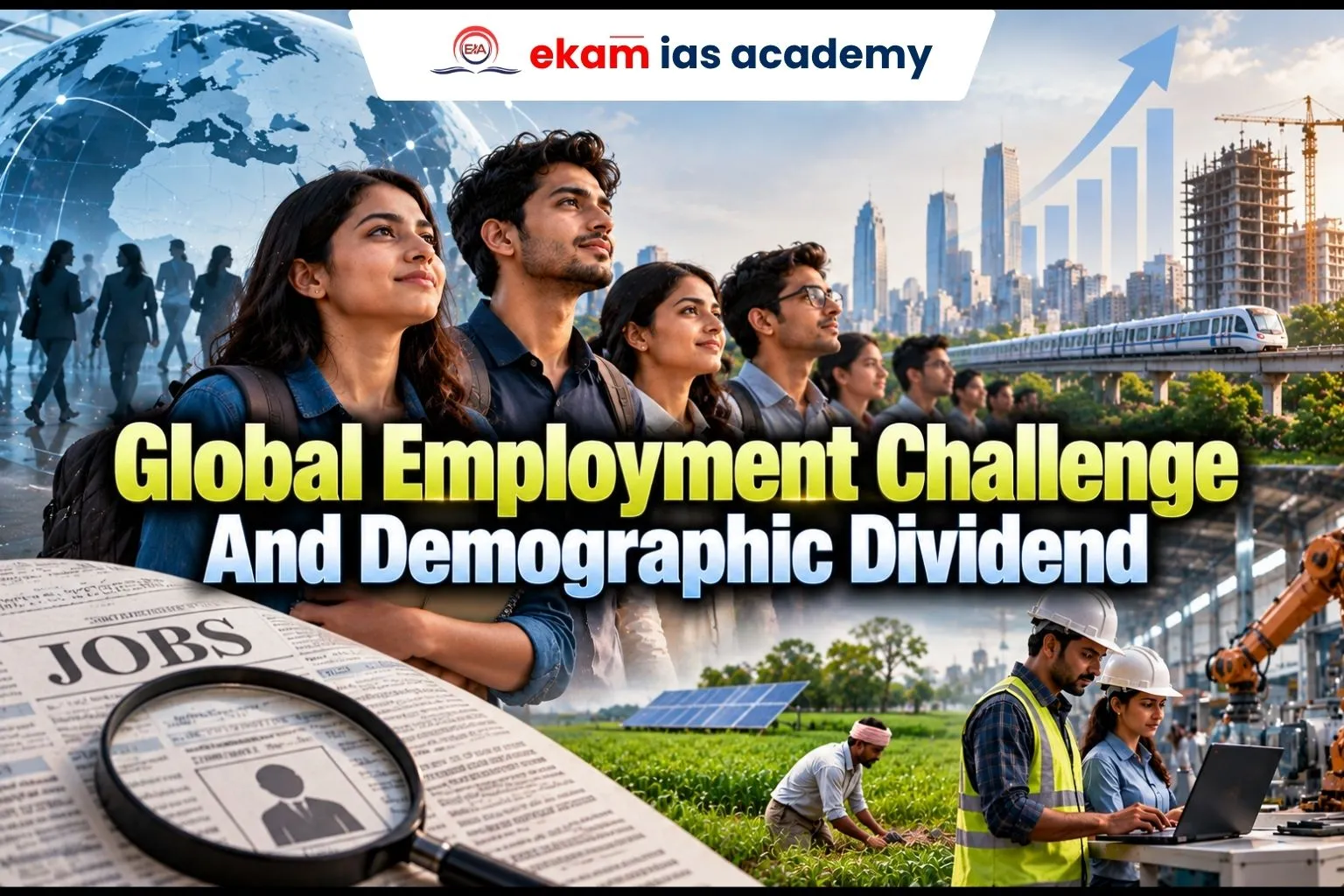
The World Bank estimates that about 1.2 billion young people in developing economies will reach working age over the next 10–15 years, raising concerns over a widening Global Employment Challenge and Global Employment Crisis. These Global Employment Trends highlight the growing importance of the Employment Challenge and Demographic Dividend.
What is Employment?
- Employment means engagement in productive economic activity for wages, salary, profit or other income.
- Demographic dividend arises when a larger working-age population contributes to faster economic growth. The Global Demographic Dividend depends on converting this population advantage into productive employment.
- However, this dividend depends on sufficient productive jobs, skills, health and investment opportunities.
Why is the Global Jobs Challenge Growing?
- Demographic pressure: Labour-market entrants are increasing faster than employment opportunities in many developing economies, intensifying Employment Challenges in Developing Countries.
- Automation: Robotics and advanced technologies reduce labour requirements in traditional manufacturing.
- Premature deindustrialisation: Some developing economies face declining manufacturing employment before achieving high-income status.
- Skill mismatch: Education systems often fail to provide digital, technical and workplace skills demanded by employers, highlighting the importance of Skill Development and Employment.
Why Does Unemployment Matter?
- Economic: Persistent unemployment reduces incomes, consumption, savings and overall productive potential.
- Social: Educated unemployment and underemployment can deepen inequality and weaken social mobility.
- Political: Lack of opportunities can reduce institutional trust and increase social tensions.
- Migration: Large employment gaps may intensify domestic and international migration pressures.
- Gender: Limited suitable employment can particularly restrict women’s economic participation.
India’s Employment Challenge
- India has a large working-age population, making job-rich growth central to its development strategy and the Demographic Dividend in India.
- PLFS 2025 recorded an overall LFPR of 59.3% for persons aged 15+, while female LFPR stood at 40%. This makes Labour Force Participation India an important indicator of employment performance.
- The share of workers in regular wage/salaried employment increased to 23.6% in 2025, while agriculture’s employment share declined and manufacturing’s broadly increased.
- India therefore needs not merely more employment, but productive, formal and adequately remunerated jobs, particularly to address Youth Employment in India and Youth Unemployment India.

High-Potential Employment Sectors
- Agriculture and agribusiness: Food processing, cold chains and high-value farming can strengthen rural employment.
- Healthcare and care economy: Nurses, community workers and elderly-care services offer labour-intensive opportunities.
- Tourism: Hospitality, transport, handicrafts and cultural tourism generate decentralised local employment.
- Green manufacturing: Solar equipment, electric mobility and energy-efficient technologies can create emerging industrial jobs.
- Infrastructure: Construction, logistics and digital infrastructure generate employment while improving long-term productivity and supporting Employment Generation in India.
Way Forward
- Align education and skilling systems with rapidly changing labour-market requirements.
- Promote MSMEs and entrepreneurship through easier credit and predictable regulations.
- Expand labour-intensive manufacturing alongside high-productivity technology-intensive industries.
- Increase female workforce participation through safety, childcare and flexible employment.
- Strengthen apprenticeships and continuous reskilling for AI and automation-driven workplaces to support Jobs and Economic Growth India.
Conclusion
India must convert its demographic advantage into productive human capital through job-rich growth, otherwise a shrinking demographic window could become a major economic and social challenge. Addressing the Global Employment Challenge and strengthening the Demographic Dividend UPSC and Employment and Demographic Dividend UPSC themes are therefore crucial for understanding India’s long-term development prospects.