
Coal inventories at several thermal power plants have fallen sharply amid rapidly rising electricity demand and weaker hydropower availability, creating concerns over India Coal Stock Stress, the Coal Stock Shortage in India and the broader India Coal Stock Crisis.
Present Situation
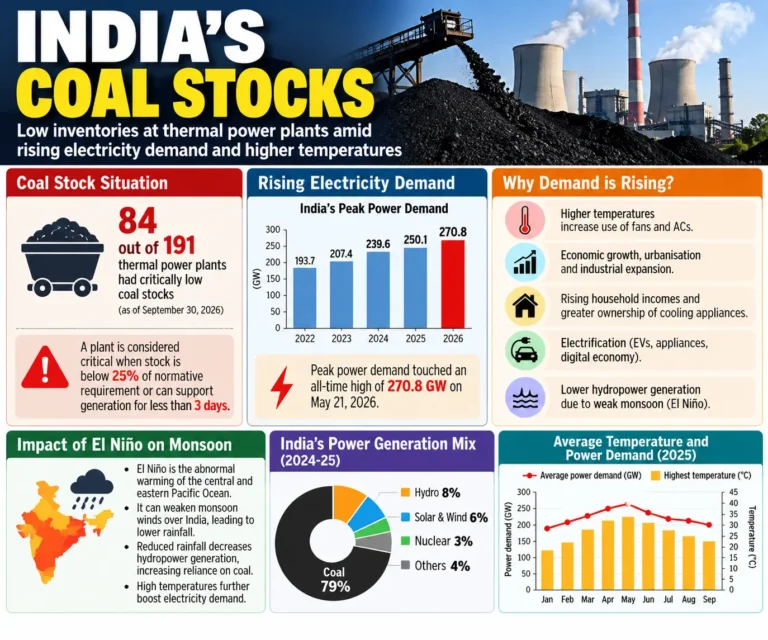
- According to the article, 84 of 191 thermal plants had critically low coal stocks by September end 2026, highlighting the issue of Coal Inventory in Power Plants.
- The Central Electricity Authority (CEA) continuously monitors coal receipts, consumption and stocks at thermal power stations, which are central to Thermal Power Coal Stocks India.
- India’s electricity system is experiencing exceptionally high demand; CEA reported peak demand met of 270.2 GW in July 2026.
Why is Power Demand Rising?
- Extreme temperatures: Hotter conditions increase electricity consumption for fans, coolers and air-conditioners.
- Economic growth: Industrialisation, urbanisation and expanding commercial activity increase electricity requirements.
- Cooling demand: Rising household incomes are increasing ownership and use of cooling appliances.
- Electrification: Electric mobility, appliances and expanding electricity access add new sources of demand.
- Hydropower variability: Weak rainfall can reduce hydroelectric generation, increasing pressure on thermal plants and Coal Demand and Supply India.
Role of El Niño
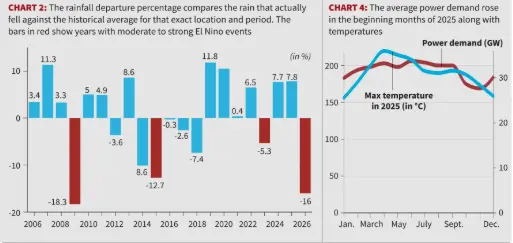
- El Niño refers to abnormal warming of the central and eastern equatorial Pacific Ocean.
- It can influence atmospheric circulation and is often associated with weaker Indian monsoon conditions, though impacts vary between events.
- Reduced rainfall can lower reservoir levels and hydropower generation, increasing dependence on coal-fired electricity and adding pressure on India Energy Security.
- High temperatures simultaneously increase cooling requirements, creating a double pressure on electricity supply.
Why Coal Remains Important
- Coal plants provide dispatchable electricity, supporting the grid when renewable generation fluctuates.
- India still possesses a substantial coal-based power fleet; as of February 2026, coal and lignite capacity was about 227.8 GW.
- MoSPI’s Energy Statistics also demonstrates the continuing structural importance of coal in India’s energy system and the significance of Coal Supply in India.
Challenges
- Energy security: Low inventories increase vulnerability during unexpected demand surges and highlight Coal Stock and Energy Security concerns.
- Supply-chain constraints: Railway availability and mine-to-plant logistics can affect timely coal delivery, adding to India Coal Supply Challenges.
- Climate challenge: Greater coal generation can increase greenhouse-gas and local air-pollutant emissions.
- Renewable intermittency: Solar and wind require storage and flexible generation for round-the-clock reliability.
- Climate-power feedback: Rising temperatures increase cooling demand, placing additional stress on electricity infrastructure.
- Import dependence: Disruptions in domestic availability can increase reliance on Coal Imports and Energy Security, while broader Coal Sector Challenges India affect energy resilience.
- Production capacity: Maintaining adequate Coal Production in India is important for reducing supply-side vulnerabilities.
Way Forward
- Maintain adequate strategic coal stocks before high-demand summer and monsoon periods.
- Improve railway logistics and mine-to-plant coordination for uninterrupted coal transportation.
- Accelerate solar, wind, hydro and nuclear capacity to diversify electricity generation.
- Expand battery and pumped-storage systems for balancing variable renewable electricity.
- Promote energy-efficient air-conditioners, buildings and cooling technologies to moderate peak demand.
Conclusion
India’s energy security requires reliable short-term coal management alongside faster clean-energy, storage and efficiency transitions for long-term resilience. Strengthening Coal and Energy Security UPSC and Indian Energy Security UPSC perspectives is essential for addressing India’s evolving power-sector challenges.