
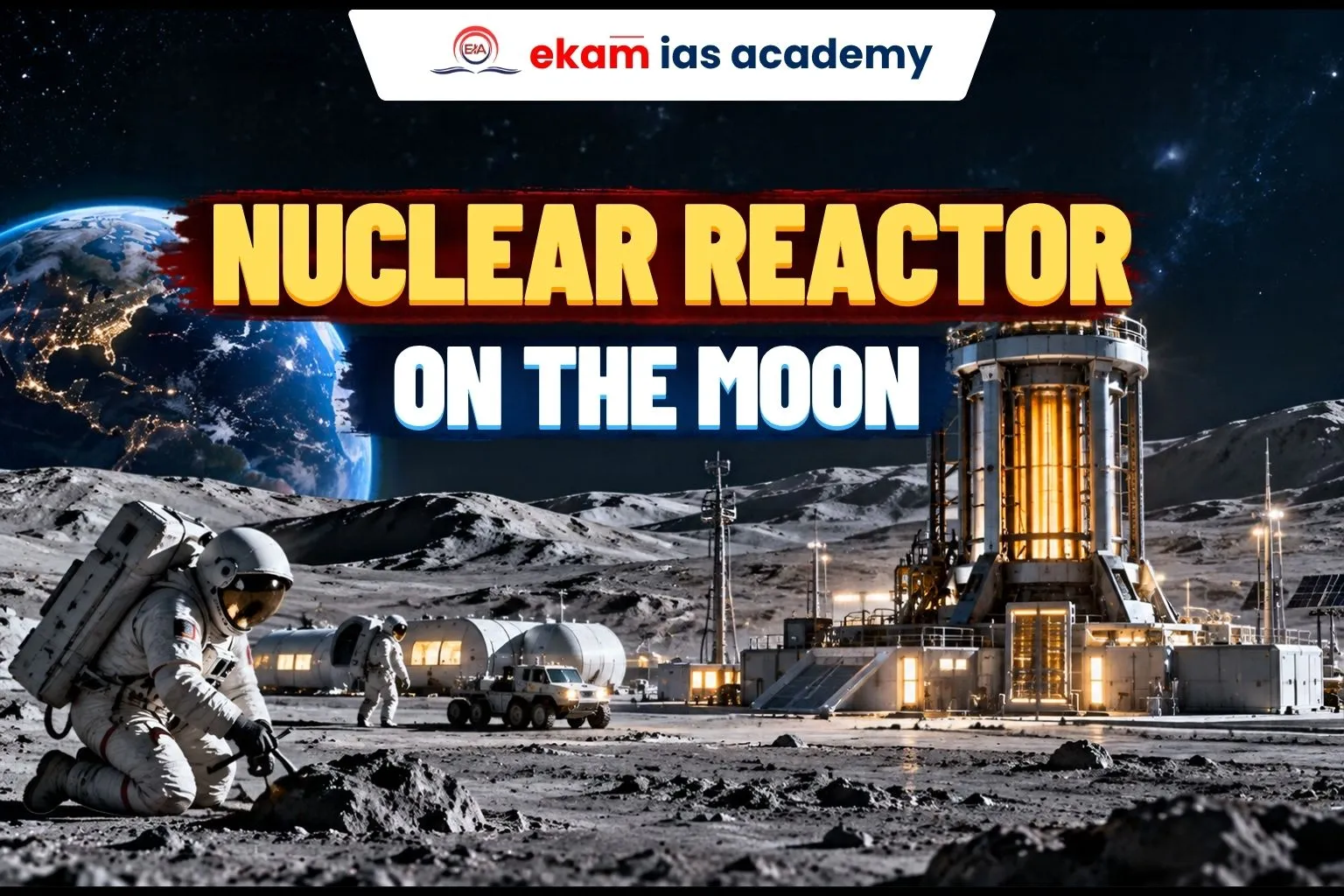
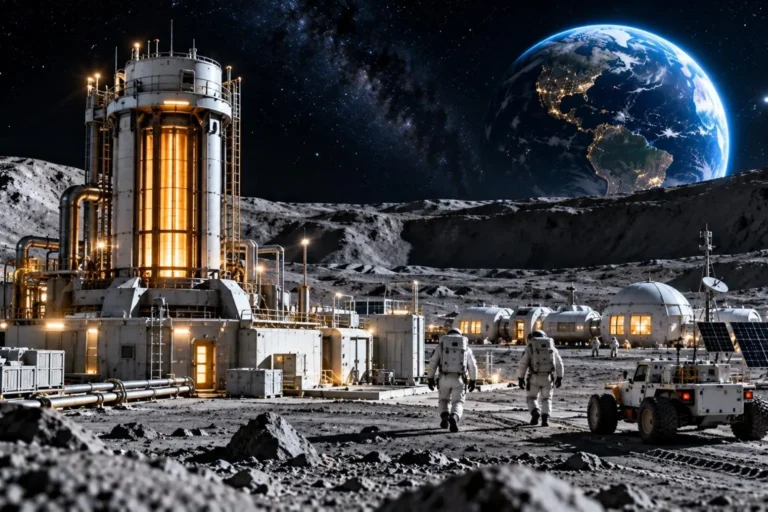
NASA and the U.S. Department of Energy are working towards developing a Nuclear Reactor on the Moon by 2030, supporting long-duration Moon missions and future Mars exploration. The proposed Lunar Nuclear Reactor could become a key Space Nuclear Power technology for sustained lunar operations.
Why Does the Moon Need Nuclear Power?
- A lunar day-night cycle lasts about 29.5 Earth days, creating roughly two weeks of darkness at many locations.
- Hence, solar panels alone may not provide reliable continuous power for long-duration settlements.
- A compact Moon Nuclear Reactor can provide 24×7 electricity, independent of sunlight, making Nuclear Power on the Moon a reliable option.
- It could support:
- Astronaut habitats and life-support systems
- Rovers and scientific instruments
- Communication and computing systems
- Extraction of oxygen and other resources from lunar material
- Construction and manufacturing on the Moon
- NASA is already seeking technologies for power generation, oxygen extraction and lunar construction for a future Moon Base, where a Nuclear Reactor for Moon Base operations could provide a dependable Lunar Base Power Supply.
Strategic Importance
- Lunar South Pole: Attractive because permanently shadowed regions may contain water ice useful for drinking water, oxygen and potentially rocket propellant.
- Permanent presence: Reliable power is essential for shifting from short missions to long-term lunar habitation, increasing the importance of Lunar Energy Systems.
- Mars preparation: Lunar reactors could demonstrate technologies required for future deep-space missions and Nuclear Energy for Lunar Missions.
- Geopolitics: Early infrastructure may give space powers technological and operational advantages in strategically important lunar regions.
Major Challenges
- Launch accident: Nuclear material must be transported safely from Earth.
- Radiation: Astronauts and equipment require adequate shielding.
- Waste heat: With virtually no atmosphere, reactors require specialised radiators to remove heat.
- Environmental concern: Accidents could contaminate scientifically valuable lunar locations.
- Strategic competition: Infrastructure around valuable resources could create disputes over access.
International Legal Framework
- Outer Space Treaty, 1967: The Moon cannot be nationally appropriated; it must be used for peaceful purposes. Nuclear weapons/WMD are prohibited, but peaceful nuclear-power systems are not banned. States must also avoid harmful contamination.
- Liability Convention, 1972: Establishes international liability rules for damage caused by space objects.
- UN Nuclear Power Sources Principles, 1992: Provide international principles concerning safe use of nuclear power sources in outer space.
- Artemis Accords: Non-binding principles promote safe and peaceful space exploration and measures to avoid harmful interference.
India’s Perspective
- India has ratified the Outer Space Treaty and Liability Convention. It has signed, but not ratified, the Moon Agreement.
- India joined the Artemis Accords in 2023, making evolving rules on lunar resources and infrastructure directly relevant to its future space ambitions.
- India should strengthen expertise in Space Nuclear Energy, planetary protection, lunar resource technologies and international space law. Lunar Exploration Technology and Nuclear Power in Space will become increasingly relevant to India’s future space ambitions.
Conclusion
Nuclear power can enable a permanent human presence on the Moon, but its success requires strong safety standards and global rules ensuring that lunar exploration remains peaceful, sustainable and accessible to all. The Nuclear Reactor UPSC perspective is important for understanding the intersection of space technology, energy security, international law and geopolitics.