
The article reports that the MPC raised the repo rate by 25 bps to 5.50% and adopted a “calibrated tightening” stance amid renewed inflation risks, highlighting the significance of RBI Monetary Tightening, RBI Monetary Policy and RBI Monetary Tightening and Growth.
Repo Rate
- RBI lends to banks: It is the interest rate at which the RBI lends short-term money to commercial banks.
- Repo Rate ↑, Loans become costlier: Banks may raise interest rates → home/car/business loans become expensive → spending falls → inflation may reduce. This explains the link between RBI Repo Rate, RBI Interest Rate Policy and Monetary Tightening and Inflation.
- Repo Rate ↓, Loans become cheaper: Banks can borrow more cheaply → loan rates may fall → borrowing, spending and investment increase → economic activity gets a boost. Thus, the Repo Rate and Economic Growth relationship is important for understanding Monetary Policy and Economic Growth.
Monetary Policy Framework
- Repo rate: Interest rate at which RBI lends short-term funds to banks; changes influence borrowing costs, demand and inflation.
- Under the RBI Act, the six-member MPC determines the policy rate required to achieve the inflation target. The Monetary Policy Committee India plays a central role in Monetary Policy Transmission India.
- India follows Flexible Inflation Targeting (FIT): price stability is the primary objective while growth is also considered.
- The established framework targets 4% CPI inflation with a ±2 percentage-point tolerance band. Inflation and Monetary Policy India are therefore closely interconnected.
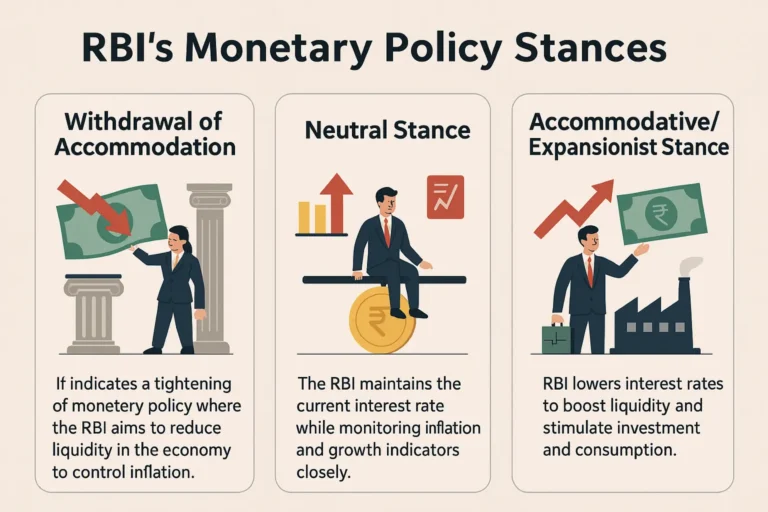
Why Tightening?
- Imported inflation: Higher crude prices raise transport and production costs.
- Food inflation: Weak monsoon/El Niño can affect crops and rural consumption.
- External vulnerability: Strong dollar and high global bond yields can generate capital-flow and exchange-rate pressures.
- Second-round effects: Persistent fuel/food shocks may spread to wages and other prices, increasing the need for RBI Monetary Tightening in India.
Impact on Economy
- Households: Floating-rate loans and EMIs may become costlier.
- Businesses: Higher borrowing costs can moderate investment.
- Inflation: Lower credit-fuelled demand can reduce demand-side price pressures.
- Savers/Rupee: Higher rates may improve deposit returns and support financial stability. This reflects the broader impact of RBI Interest Rate Hike decisions on the economy.
Conclusion
India needs a coordinated monetary-fiscal-supply strategy that anchors inflation without sacrificing durable and inclusive growth. Effective RBI Monetary Policy and Monetary Policy Transmission India are crucial for balancing price stability with economic growth, making RBI Monetary Policy UPSC and Indian Economy UPSC important areas for UPSC preparation.