

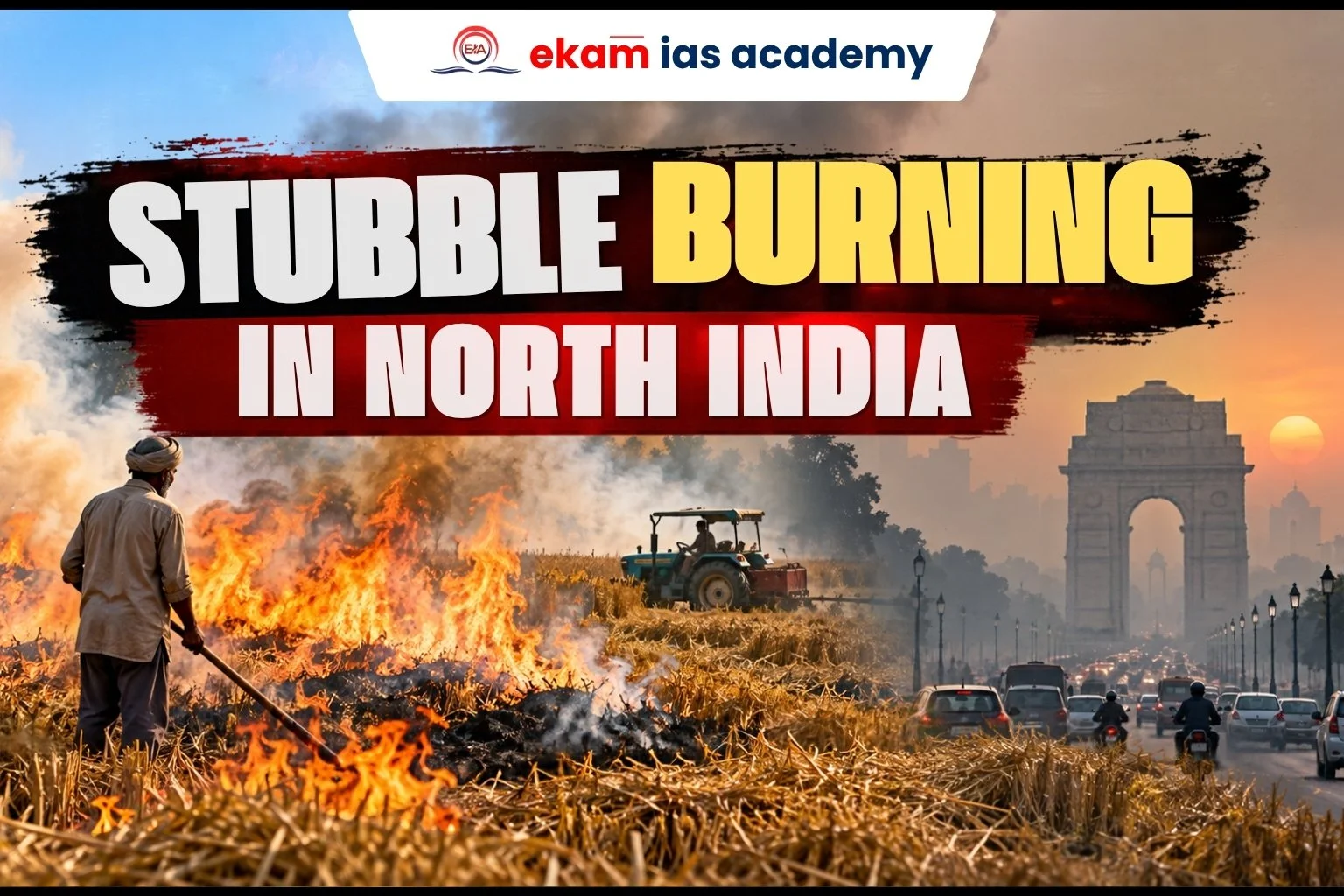
With winter approaching, Stubble Burning in North India has again raised concerns about worsening air pollution in Delhi-NCR. The issue of Stubble Burning in India, particularly Stubble Burning in Punjab and Haryana, remains a major environmental and public-health concern.
What is Stubble Burning?
- It involves burning crop residues left after harvesting, particularly paddy straw, commonly referred to as Crop Residue Burning India.
- It generally occurs during October–November, before wheat cultivation begins.
- Punjab and Haryana together generate approximately 29 million tonnes of paddy straw.
Why Does Stubble Burning Continue?
Short Agricultural Window
- The Punjab Preservation of Sub-Soil Water Act, 2009 delayed paddy transplantation to conserve groundwater.
- Consequently, harvesting occurs closer to winter, leaving farmers roughly 10–15 days to prepare for wheat sowing.
- Combine harvesters leave substantial straw, making burning a quick and inexpensive option and contributing to continued Stubble Burning Prevention Methods challenges.
Economic Incentives
- Assured Minimum Support Price (MSP) procurement encourages continued paddy-wheat cultivation.
- Free or subsidised agricultural electricity supports groundwater-intensive farming.
- Alternative crops lack equally reliable markets and procurement arrangements.
Technological Constraints
- Machines such as Happy Seeders and Super Seeders are expensive.
- Small farmers face difficulties accessing machinery during peak harvesting periods.
- Collecting and transporting straw for industrial use also involves additional costs, highlighting the need for Happy Seeder Technology and affordable Agricultural Waste Management India solutions.
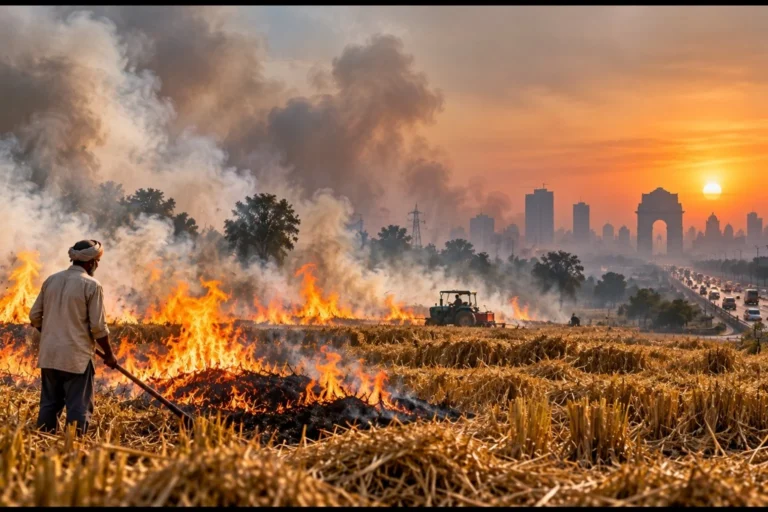
Environmental and Health Impacts
- Air pollution: Releases PM2.5, carbon monoxide and other harmful pollutants, contributing to Stubble Burning and Air Pollution.
- Public health: Increases respiratory and cardiovascular risks.
- Soil degradation: Destroys organic matter and reduces nutrient availability.
- Climate change: Releases greenhouse gases and black carbon.
- Regional impact: Smoke contributes to Delhi NCR Air Pollution alongside vehicles, industries, dust and weather conditions.
Government Initiatives
- Crop Residue Management Scheme: Supports machinery purchases and Custom Hiring Centres and forms an important part of Crop Residue Management India.
- In-situ management: Happy Seeders and mulching retain or incorporate straw in fields.
- Ex-situ management: Converts straw into bioenergy, compressed biogas and industrial fuel, including opportunities for Biofuel from Crop Residue.
- CAQM: Coordinates monitoring and enforcement across Delhi-NCR and adjoining States.
- Haryana’s incentive model: Rewards residue management, direct-seeded rice and crop diversification.
- The Centre provides 50% machinery assistance to individual farmers and 80% assistance for eligible Custom Hiring Centre projects.
Why Are Satellite Estimates Questioned?
- Polar satellites such as MODIS and VIIRS detect fires during limited observation periods.
- Fires occurring outside these periods may escape detection.
- Therefore, fewer recorded fire incidents do not necessarily mean an equivalent reduction in total burnt area.
- Combining polar and geostationary satellite observations with field verification can improve accuracy.
- Government data reported approximately 90% fewer detected incidents in 2025 than in 2022.
Way Forward
- Promote crop diversification towards maize, pulses and oilseeds through reliable markets.
- Expand affordable machinery rental services for small farmers.
- Establish assured prices and supply chains for collected straw.
- Encourage short-duration paddy varieties and water-saving cultivation.
- Combine financial incentives, farmer awareness and proportionate enforcement to develop Sustainable Solutions to Stubble Burning.
Conclusion
Ending Stubble Burning in India requires making sustainable farming economically rewarding, technologically accessible and environmentally responsible rather than relying mainly on penalties. Strengthening the Crop Residue Management Scheme, promoting Stubble Burning Prevention Methods and developing sustainable agricultural-waste and biofuel solutions can help address Air Pollution and Environment UPSC concerns while protecting farmers’ livelihoods. Stubble Burning UPSC is therefore an important topic linking agriculture, environment, public health and climate change.