
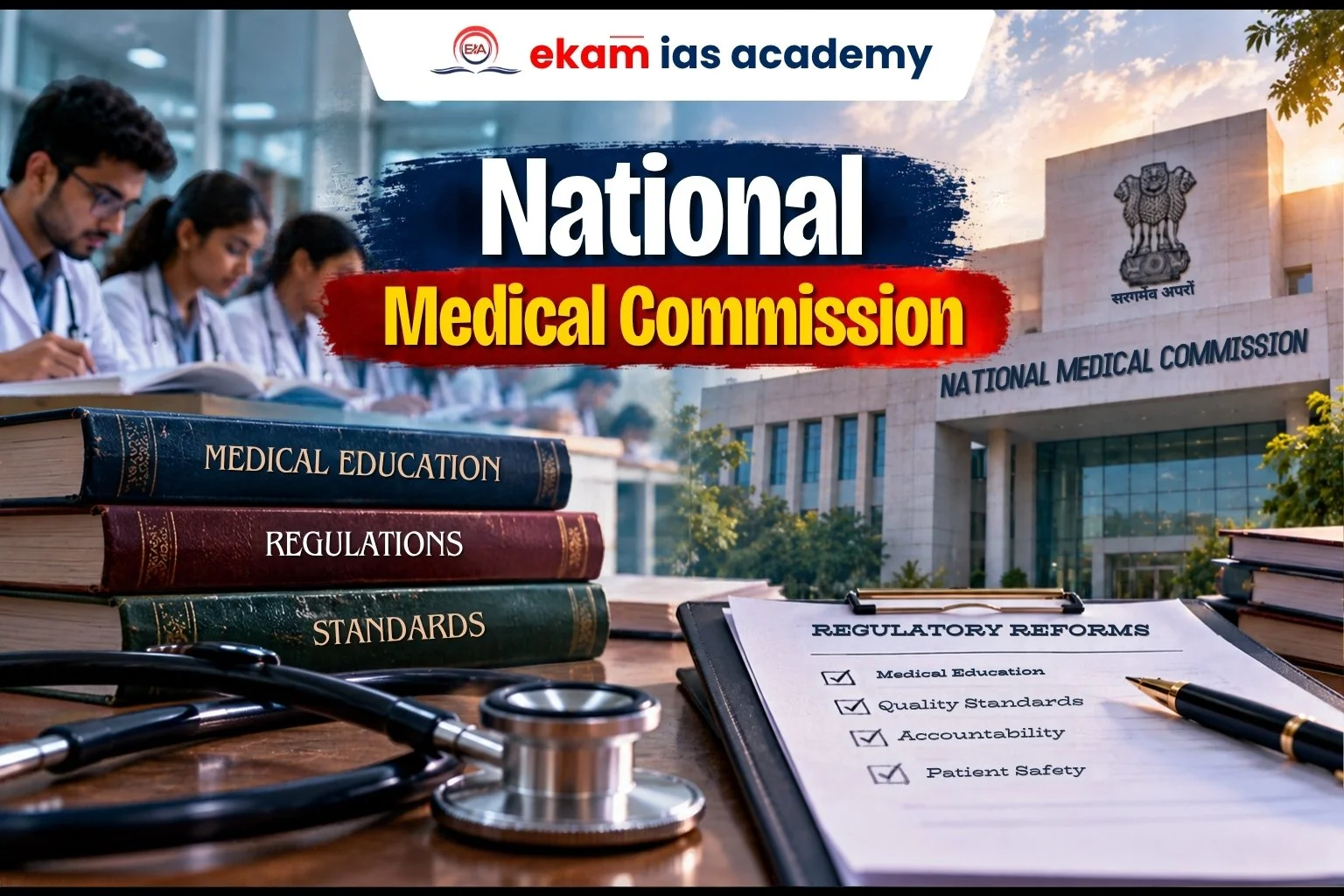
The National Medical Commission (NMC) has withdrawn the Maintenance of Standards of Medical Education Regulations (MSMER), 2023, raising concerns about weaker accountability in medical colleges and renewed debate over National Medical Commission Regulatory Changes and NMC New Regulations 2026.
National Medical Commission
- The NMC is India’s statutory regulator for medical education and professional standards under the National Medical Commission India regulatory framework.
- Established under the National Medical Commission Act, 2019, it replaced the Medical Council of India in 2020.
- Its objectives include maintaining educational quality, ensuring adequate medical professionals and improving institutional accountability.
- It operates through four autonomous boards responsible for undergraduate education, postgraduate education, medical assessment and professional ethics, forming an important part of Medical Education Reforms in India.
What Were the MSMER, 2023?
- The regulations prescribed standards for infrastructure, teaching staff, clinical facilities and academic quality under India’s Medical Education Standards India framework.
- They aimed to prevent misleading information during medical college inspections.
- Individual accountability: Faculty members and administrators could face penalties of up to ₹5 lakh for submitting false information.
- They also provided procedures for monitoring compliance and appealing penalties under the broader NMC Regulatory Framework India.
Why Were the Regulations Withdrawn?
- According to the NMC, the regulations created overlapping inspection powers.
- Undergraduate and postgraduate education boards could evaluate institutions, potentially duplicating the responsibilities of the Medical Assessment and Rating Board (MARB).
- However, complete withdrawal has raised questions about whether important safeguards were unnecessarily removed and its implications for the NMC Guidelines for Medical Colleges.

Challenges
- Ghost faculty: Some institutions allegedly present temporary or fictitious teaching staff to satisfy inspection requirements.
- Ghost patients: Artificially inflated patient numbers may misrepresent clinical training facilities.
- Reduced personal liability: Weakening individual penalties could reduce deterrence against malpractice.
- Transparency gaps: Limited public access to college assessment reports makes independent scrutiny difficult.
- Legal uncertainty: Differences between regulatory appeal deadlines and statutory provisions may delay enforcement.
Existing Regulatory Safeguards
- MARB Regulations, 2023: Permit penalties of up to ₹1 crore against non-compliant medical institutions.
- Postgraduate Medical Education Regulations, 2023: Retain certain penalties against individual faculty members.
- NMC Act, 2019: Provides statutory powers for assessment, regulation and appeals and remains central to the National Medical Commission Rules.
- Right to Information Act, 2005: Supports public access to regulatory information, subject to lawful exemptions.
- These safeguards are relevant to NMC MBBS Regulations, Healthcare Regulation in India and continuing Medical Education in India reforms.
Way Forward
- Restore clear individual accountability for deliberate misrepresentation.
- Define inspection responsibilities to prevent institutional overlap.
- Publish annual college assessments and compliance reports.
- Use verified digital faculty attendance and hospital records to detect fraud.
- Ensure transparent appeals, independent inspections and proportionate penalties.
Conclusion
India’s expanding medical education system needs simpler regulations, but never at the cost of strong enforcement, transparent inspections and patient safety. Effective implementation of the National Medical Commission Act 2019, Medical Council of India Reforms, National Medical Commission UPSC perspectives and Health Sector Current Affairs UPSC remains important for maintaining quality and accountability in medical education.