

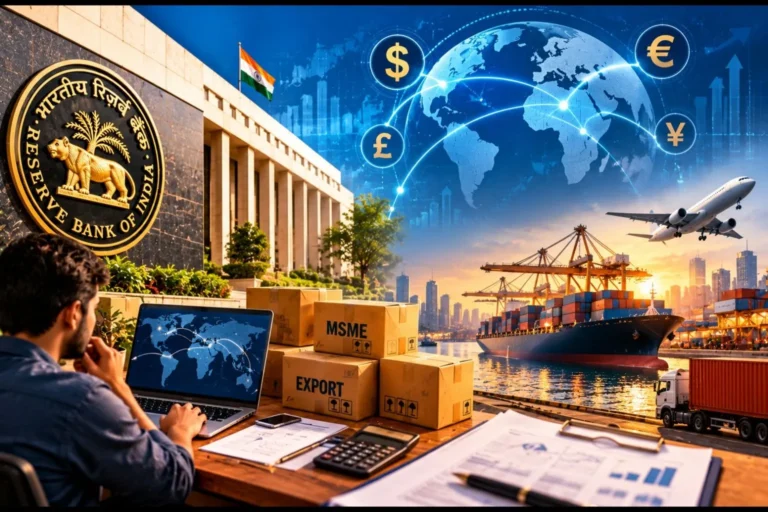
RBI’s RBI New Forex Reporting Rules 2026, effective from October 1, 2026, have reportedly caused payment delays for freelancers and Micro, Small and Medium Enterprises (MSMEs). The changes form part of India’s broader RBI Foreign Exchange Regulations and RBI Forex Reporting Rules framework.
What are Forex Reporting Rules?
- Foreign exchange regulations govern payments received from abroad and money transferred overseas.
- They operate under the Foreign Exchange Management Act India (FEMA), 1999, administered by RBI.
- Authorised Dealer (AD) banks handle foreign exchange transactions and ensure regulatory compliance under RBI FEMA Regulations 2026.
- The revised framework aims to simplify reporting for exports and imports of goods and services.
Major Provisions of the New Rules
- Export Declaration Form (EDF): Service exporters covered by the requirement must declare the value of exported services under the Export Declaration Form India framework.
- Reporting deadline: Within 30 days after the end of the month in which the invoice is issued.
- Individual exemption: According to RBI’s clarification described in the report, individuals are exempt from EDF filing regardless of transaction value.
- Business compliance: Eligible business exporters must provide transaction details for monitoring and reconciliation under RBI Export Reporting Rules.
- Objective: Improve transparency, streamline documentation and facilitate legitimate foreign exchange transactions and Service Exports Reporting India.
Challenges Faced by Freelancers and MSMEs
- Implementation gap: Some banks reportedly demand EDF submissions even from exempt individuals.
- Payment delays: Foreign earnings may remain uncredited while documentation is processed.
- Complex procedures: Repeated reporting requires invoices, customer information, currency details and service classification.
- Higher costs: Small businesses may need additional accounting or professional assistance.
- Regulatory uncertainty: Different banking practices create confusion among exporters, particularly under Forex Rules for Small Exporters and MSME Export Compliance India.
Economic Significance
- Digital exports: Freelancers, software developers and online consultants contribute to India’s expanding services trade.
- Employment: Delayed payments can affect self-employed workers and small enterprises.
- Foreign exchange: Smooth export payments support foreign exchange earnings and external sector stability.
- Ease of doing business: Predictable regulations improve confidence among entrepreneurs and international clients.
- Example: A graphic designer receiving monthly payments from an overseas client may face cash-flow difficulties if the bank unnecessarily delays credit.
- MSME exporters: Smooth and predictable procedures are important for MSME Exporters India participating in international markets.
Broader Governance Issues
- Policy implementation: Regulatory reforms require consistent interpretation by banks.
- Proportionality: Compliance requirements should reflect transaction size and risk.
- Digital governance: Automated reporting can reduce paperwork and human errors.
- Financial inclusion: Complex procedures may discourage small exporters from accessing global markets.
- International trade: Clear reporting requirements are important for International Trade Compliance India.
Way Forward
- RBI should issue clear FAQs and standard operating procedures for banks.
- Introduce a common digital reporting platform with pre-filled transaction details.
- Consider simplified declarations and minimum-value exemptions for small businesses.
- Establish fixed payment-processing timelines and accessible grievance mechanisms.
- Train banking staff and monitor unnecessary compliance demands.
Conclusion
Effective forex regulation must balance financial transparency with simple, predictable procedures that protect small exporters and strengthen India’s digital economy. The issue is particularly relevant for RBI Regulations UPSC and Indian Economy Current Affairs UPSC, given the importance of MSMEs and India’s growing services exports.