
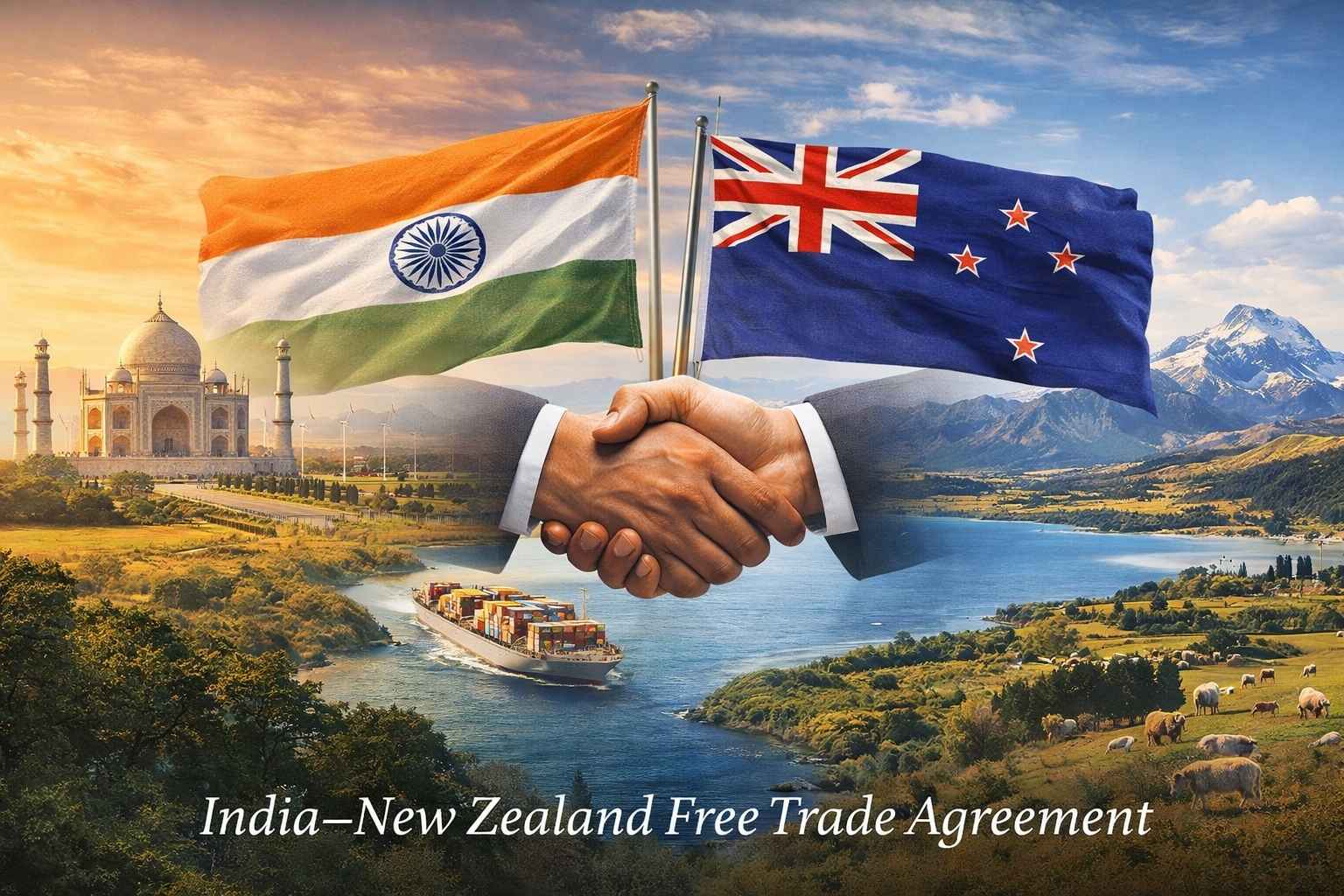
India and New Zealand have successfully concluded negotiations on a Free Trade Agreement (FTA), which will be formally signed in the first half of 2026. The agreement has wide-ranging economic and strategic implications and is a key current affairs topic for aspirants preparing through UPSC coaching in Hyderabad.
Background
- India and New Zealand established diplomatic relations in 1952, and their ties are rooted in Commonwealth membership, democratic governance, and common law traditions.
- Sporting connections, especially cricket, hockey, and mountaineering, along with tourism, have strengthened goodwill between the two societies.
- The Indian-origin population in New Zealand is approximately 292,000, and Hindi is the fifth most spoken language in the country.
Strategic Framework
- New Zealand identified India as a priority partner through initiatives such as “Opening Doors to India” (2011) and the NZ Inc. India Strategy.
- This partnership was further deepened by the “India–NZ 2025: Investing in the Relationship” strategy, which envisioned stronger cooperation across political, economic, and people-centric domains.
Trade and Economic Relations
- New Zealand is India’s 11th largest two-way trading partner. In 2023–24, the total trade between India and New Zealand was valued at US$ 1.75 billion.
- India’s major exports to New Zealand include pharmaceuticals, precious metals and gems, textiles, motor vehicles, and non-knitted apparel.
- India’s imports from New Zealand mainly consist of logs, forestry products, wool, and edible fruits and nuts.
- Key sectors of cooperation include education, tourism, dairy, food processing, pharmaceuticals, renewable energy, and critical minerals —areas frequently analysed in GS3 economy discussions at civils coaching in Hyderabad.
Defence and Maritime Cooperation
- Defence ties are expanding steadily with regular naval visits and port calls by Indian Navy ships.
- High-level exchanges between naval leadership have strengthened cooperation.
- Both countries collaborate under Combined Task Force-150, where Indian Navy personnel contribute while New Zealand has taken leadership roles.
- These engagements support maritime security and stability in the Indo-Pacific region.
Education and Research Partnerships
- India is the second-largest source of international students in New Zealand, with nearly 8,000 students enrolled.
- Collaboration includes the New Zealand Centre at IIT Delhi and joint research projects in cancer, robotics, cybersecurity, waste management, and medical technology.
- Education cooperation agreements have also been signed with GIFT City and IIM Ahmedabad.
FTA Highlights
- New Zealand will invest $20 billion in India over the next 15 years as part of the agreement.
- A dedicated annex on health and traditional medicine has been included, which is New Zealand’s first such agreement with any country.
- Tariff liberalisation will cover 95% of New Zealand’s exports, with 57% becoming duty-free from day one, rising to 82% upon full implementation.
- India has safeguarded sensitive sectors such as dairy, onions, sugar, spices, edible oils, rubber, rice, wheat, and soya, which will not face tariff concessions.
Conclusion
The India–New Zealand FTA is a landmark agreement that strengthens economic, strategic, and cultural ties between the two nations. By balancing market access with protection of sensitive domestic sectors, the agreement promises growth in trade, investment, employment, and mobility, while deepening cooperation beyond commerce into defence, education, and people-to-people relations—making it a high-value topic for aspirants following UPSC online coaching.
This topic is available in detail on our main website.