

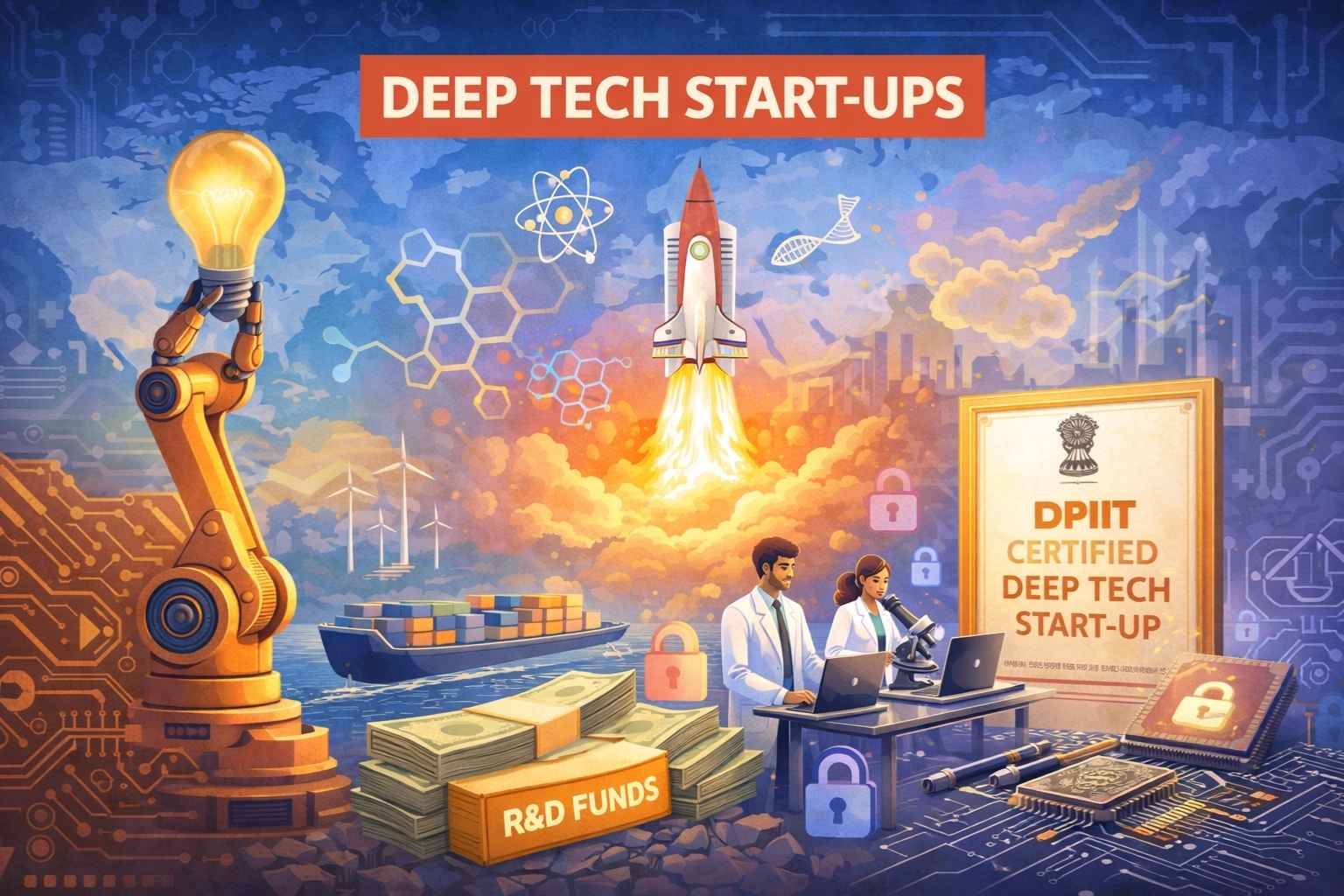
The Department for Promotion of Industry and Internal Trade (DPIIT) has officially defined what qualifies as a deep tech start-up in India. This clarification is important for aspirants studying science–technology and economy under UPSC coaching in Hyderabad.
About Deep Tech Start-up
- Concerned with creating solutions based on new scientific or engineering knowledge.
- Must spend majority of funds on research and development (R&D).
- Owns or is developing novel intellectual property (IP) and working to commercialise it.
- Faces long gestation periods, high capital needs, and technical uncertainties.

Eligibility Criteria
- Normal Start-up: Less than 10 years old, turnover below ₹200 crore.
- Deep Tech Start-up: Can be recognised for up to 20 years, turnover limit raised to ₹300 crore.
- Must apply to DPIIT for certification. Certification decided by an Inter-Ministerial Board (includes DPIIT, Department of Science & Technology, Department of Biotechnology).
Restrictions
- Deep tech start-ups cannot invest in activities unrelated to their knowledge creation mandate.
- Prohibited from investing in real estate, speculative assets, shares, or securities, unless directly linked to their research.
Policy and Funding Support
- Linked to the Anusandhan National Research Foundation (NRF), custodian of the ₹1 lakh crore Research and Development Innovation (RDI) Fund over seven years.
- Part of this fund will support deep tech start-ups.
- Financing may be available at concessional rates of 2%–4% with long tenures up to 15 years.
- A dedicated deep tech policy was drafted in July 2023 by the Principal Scientific Adviser’s office and is awaiting Cabinet approval—often discussed in innovation modules of IAS coaching in Hyderabad.
Importance
- Provides clarity for investors, innovators, and policymakers.
- Encourages long-term innovation in high-risk but transformative sectors.
- Aligns with India’s push for technology-driven growth and global competitiveness, a recurring GS-III theme for aspirants enrolled in UPSC online coaching.
Conclusion
The new definition and framework for deep tech start-ups give them a longer runway, financial support, and regulatory clarity. This step strengthens India’s innovation ecosystem and ensures that high-risk, high-reward ventures can thrive with proper recognition and support.
This topic is available in detail on our main website.