
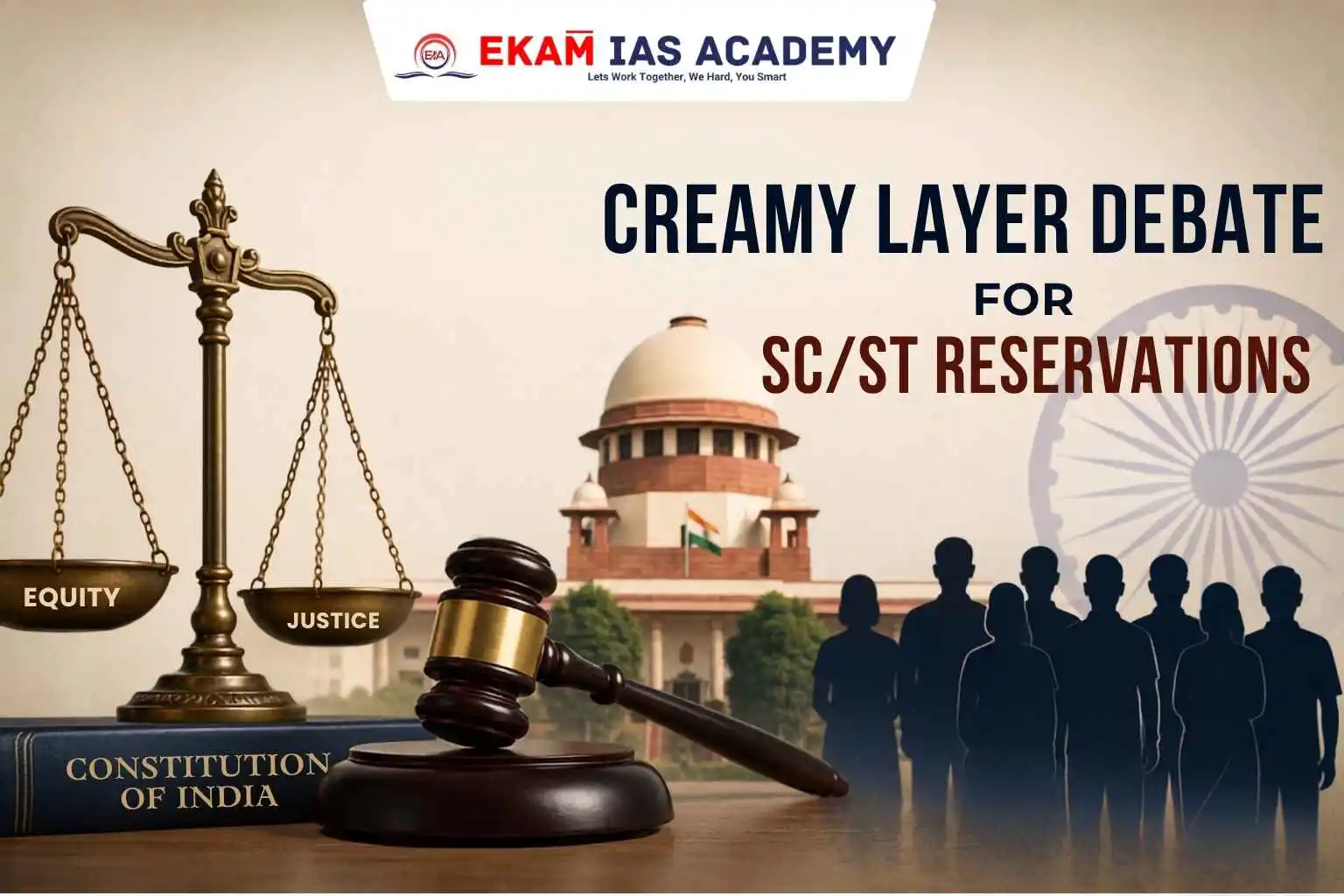
The debate over applying the creamy layer principle to SC/ST reservations has gained attention after recent judicial developments. The Union Government has opposed extending creamy layer exclusion to Scheduled Castes and Scheduled Tribes, arguing that their disadvantage arises from historical untouchability, social exclusion, and systemic discrimination, rather than only economic backwardness. This topic is important for aspirants preparing for GS2 Polity through UPSC Coaching in Hyderabad.
Background
- The issue stems from the Davinder Singh judgment (2024), where a 7-judge Bench allowed States to sub-categorise SC/ST lists to ensure equitable distribution.
- Justice B.R. Gavai suggested exploring creamy layer exclusion for SC/STs, sparking debate.
- A petition by Ashwini Kumar Upadhyay claims “elite capture” of SC/ST benefits by affluent families.
Key Reservation Mechanisms
- Sub-Categorisation: Divides quota internally to guarantee representation for the most backward groups. Example: Telangana, Haryana, Punjab have sub-classified SCs; Mizoram has done so for STs.
- Creamy Layer: Excludes socially advanced families from reservation benefits. Originated in Indra Sawhney (1992) for OBCs.
- Key distinction: Sub-categorisation redistributes benefits; creamy layer denies them altogether.
Legal Position
- Indra Sawhney (1992): Creamy layer applies only to OBCs, not SC/STs.
- E.V. Chinnaiah (2005): Any exclusion within SC/ST lists requires Parliamentary action, not judicial orders.
- Ashoka Kumar Thakur (2008): Reaffirmed creamy layer inapplicable to SC/STs.
- Articles 341 & 342: Only the President and Parliament can alter SC/ST lists.
Centre’s Arguments
- Historical disadvantage: SCs face untouchability; STs face isolation and cultural backwardness — not purely economic criteria.
- Separation of powers: Courts cannot direct reservation policy; only Parliament can legislate.
- Maintainability issue: Petition under Article 32 shows no direct violation of fundamental rights.
- Conditional stance: Any change requires a holistic review with socio-economic data, initiated by the government.
Broader Dimensions
- Equity vs Efficiency: Sub-categorisation ensures equitable distribution; creamy layer risks excluding historically oppressed groups.
- State Practices: Sub-division of ST quota in Eklavya Model Schools for PVTGs shows targeted inclusion.
- Pending Reform: The Rohini Commission (2017) on OBC sub-categorisation remains unimplemented, reflecting Centre’s cautious approach.
- Comparative Insight: Similar debates exist in affirmative action globally — e.g., U.S. discussions on race vs income-based criteria.
Way Forward
- Holistic Data Review: Conduct a nationwide socio-economic survey to assess intra-group disparities among SCs/STs, similar to the Socio-Economic and Caste Census (2011), before considering any policy shift.
- Strengthen Sub-Categorisation: Encourage States to adopt sub-classification within SC/ST lists to ensure equitable distribution, as already practiced in Telangana, Haryana, Punjab, Mizoram.
- Legislative Route: Any creamy layer extension must come through Parliamentary legislation, respecting Articles 341–342 and separation of powers.
- Targeted Schemes: Expand schemes like Eklavya Model Schools for PVTGs to ensure the most vulnerable groups benefit from affirmative action.
Conclusion
Reservation for SC/STs is about correcting structural injustice, not economic advancement — hence creamy layer exclusion cannot dilute their constitutional protection.