
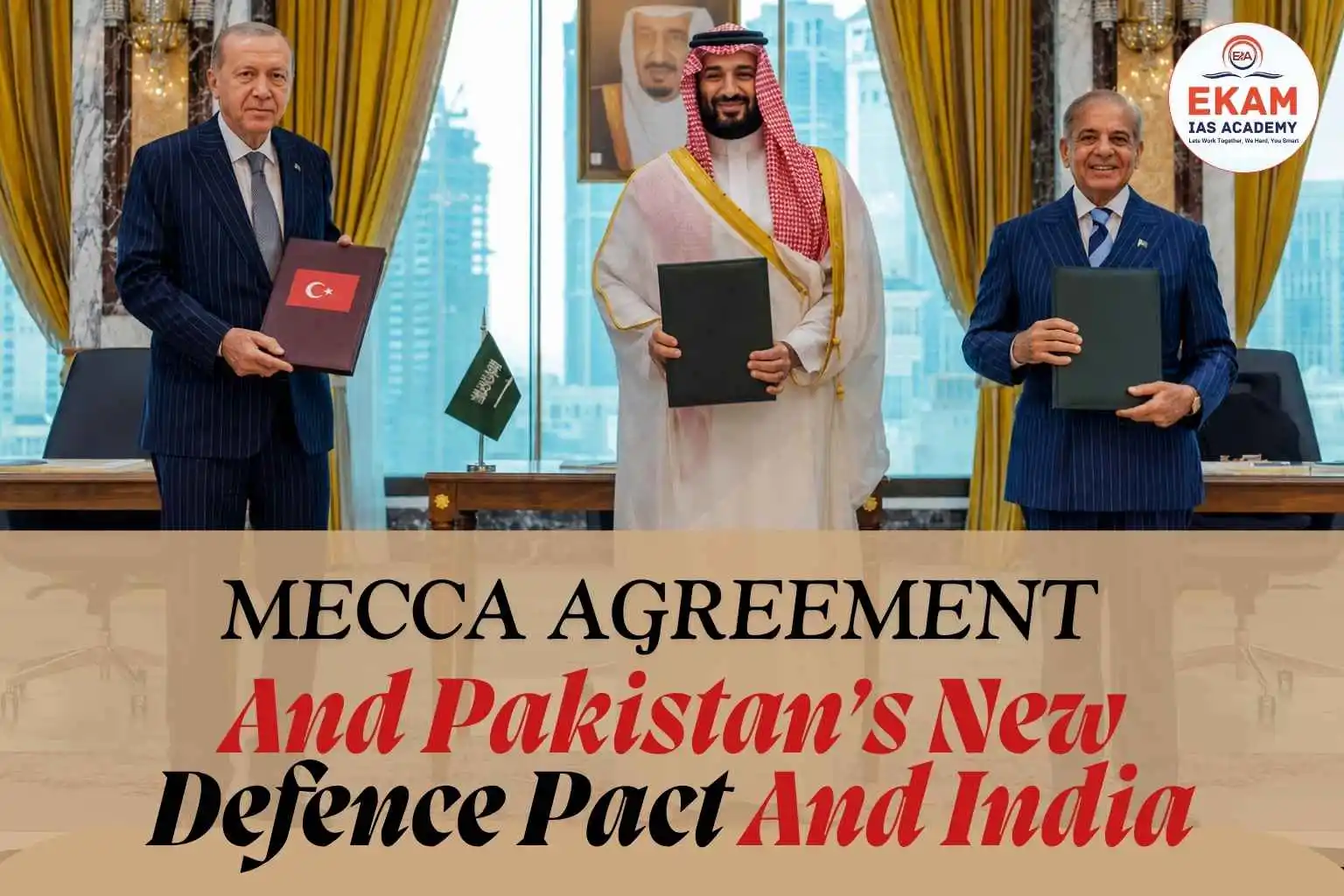
The signing of the Mecca Joint Defence Agreement between Saudi Arabia, Turkey, and Pakistan marks a significant development in the evolving security architecture of West Asia. The trilateral arrangement reflects regional efforts towards strategic autonomy, defence cooperation, and collective security, with potential implications for India’s interests in the Gulf region. This topic is important for aspirants preparing for GS2 International Relations through Civil Services Preparation.
Background
- Builds upon the Saudi–Pakistan Strategic Mutual Defence Agreement (2025), now expanded to include Turkey.
- Full text not released; only a joint statement highlighting collective deterrence.
- Turkey’s NATO-standard military capabilities add weight to the pact.
Features of the Pact
- Collective Deterrence Clause: Modeled on Article 51 of the UN Charter.
- Joint Training & Exercises: Enhancing interoperability among forces.
- Intelligence Sharing: Coordinated security information exchange.
- Defence-Industrial Integration: Turkish drones and defence technology supporting Saudi capacity.
- Exclusionary Clause: No protection for members initiating aggression.
- Limitations: No joint command, standing force, or nuclear-sharing provision.
Strategic Context
- US–Israel–Iran Confrontation: Saudi reliance on US guarantees weakened after missile defence shortages.
- Regional Recalibration: Post-October 7 developments pushed Riyadh to diversify partners.
Complementary Strengths
- Saudi Arabia – financial depth & strategic geography.
- Turkey – defence industry & NATO-standard doctrine.
- Pakistan – manpower & nuclear capability.
Not a “NATO of the East”
- Unlike NATO’s Article 5, this pact lacks integrated command and binding obligations.
- Past precedent: Pakistan did not intervene militarily when Saudi faced missile attacks under the earlier pact.
Target and Subtext
- Officially framed against Iran, but deeper concerns point towards Israel, especially from Turkey’s perspective.
- Israeli leaders have accused Turkey of building a “hostile Sunni axis” with Pakistan.
Global Reactions
- China: Silent, benefits from stability for Belt and Road projects.
- Russia: Neutral, balancing Iran ties with reduced US influence.
- India: Cautious, closely monitoring developments without overt alignment.
Implications for India
- Signals deeper Saudi integration with the Pakistan–Turkey–China axis.
- Turkey’s hostility towards India and military cooperation with Pakistan raises concerns.
- Saudi Arabia’s growing dependence on Pakistan may strain India–Saudi ties.
- India’s strategic imperatives:
- Strengthen Saudi ties in energy, diaspora welfare, and counterterrorism.
- Expand defence diplomacy with Gulf states to counter isolation.
- Calibrate extended neighbourhood policy via Quad, Indian Ocean presence, and ties with Israel & moderate Arab states.
Conclusion
The Mecca Agreement reflects shifting security dynamics in West Asia. For India, the challenge lies in sustained, balanced diplomacy to safeguard its interests while preventing this pact from evolving into a coordinated front against Indian strategic space.