
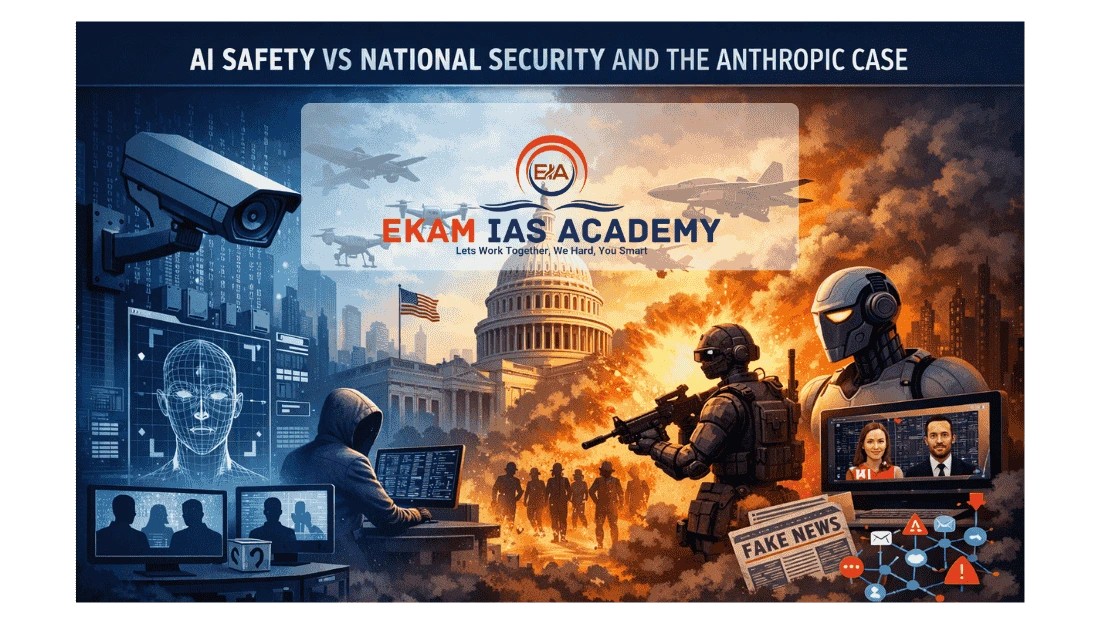
The U.S. Department of Defence declared AI firm Anthropic a “supply chain risk” after it refused to allow its AI tools for domestic surveillance and autonomous weapons — an issue increasingly discussed in UPSC coaching in Hyderabad while analysing global AI governance and emerging security challenges.
Background
• Anthropic’s Stand: The company, creator of Claude, rejected U.S. demands to enable surveillance and weaponisation.
• Government Reaction: The Defence Department accused Anthropic of pursuing a “radical agenda” and excluded it from defence supply chains.
• OpenAI’s Response: Soon after, OpenAI agreed to provide flexibility to the Defence Department, weakening collective industry resistance.
Key Issues
• AI Safety Ignored: The U.S. stance undermines commitments made at global forums like the Bletchley Park AI Safety Summit.
• Weaponisation Risks: Reports suggest AI tools were used in military operations against Iran, raising fears of autonomous warfare without safeguards.
• Surveillance Concerns: If powerful states demand unrestricted AI use, weaker nations may follow, legitimising spyware and authoritarian practices.
• Corporate Dilemma: Firms face pressure between profit motives and ethical responsibility; Anthropic resisted, but industry solidarity was lacking.
Global Implications
• Multipolar World Challenge: Great powers ignoring safety norms make it harder to build shared international standards.
• Impact on Middle Powers: Countries prone to surveillance may misuse AI further if global leaders set poor examples.
• Weak Institutions: With global institutions struggling, private firms are being looked to for leadership on safety — but profit pressures limit their role.
AI Threats to Internal Security
• Mass Surveillance & Privacy Breach: AI-powered facial recognition, predictive policing, and data mining can be misused by governments or hostile actors to monitor citizens, suppress dissent, and erode democratic freedoms.
• Cybersecurity Risks: AI can automate sophisticated cyber attacks, including hacking critical infrastructure (power grids, banking systems, defence networks), making internal systems vulnerable to disruption.
• Disinformation & Social Manipulation: AI-generated deepfakes and fake news can spread rapidly, fueling communal tensions, political instability, and weakening trust in institutions.
Way Forward
• Global AI Governance: Establish binding international rules under UN or G20 frameworks to regulate AI use in defence and surveillance.
• Industry Solidarity: AI firms must coordinate and resist unsafe demands collectively to protect ethical standards.
• Transparency & Accountability: Governments and technology companies must ensure responsible AI deployment with clear oversight mechanisms — issues widely examined in IAS coaching in Hyderabad and UPSC online coaching for GS2 international relations and technology governance.
Conclusion
Without stronger international legal frameworks and collective industry backbone, AI risks being normalised for mass surveillance and autonomous weapons, threatening both democratic values and global security — an emerging theme frequently discussed in civils coaching in Hyderabad.
This topic is available in detail on our main website.